

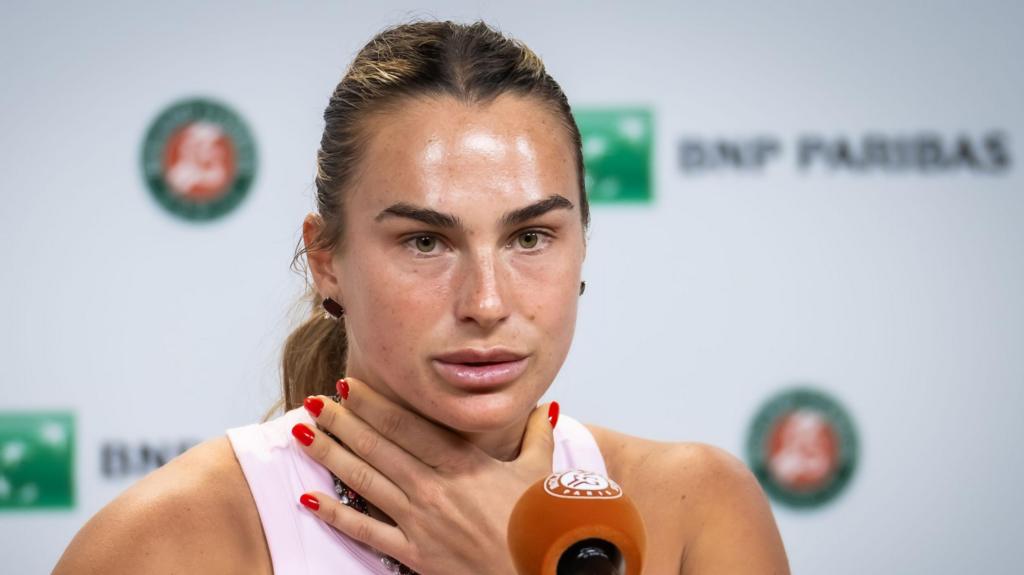
Aryna Sabalenka has been a vocal figure in the dispute between the players and the four Grand Slam tournaments
World number one Aryna Sabalenka curtailed her French Open press conference as part of a 15-minute limit on media duties, a protest against the offered prize money.
Players are advocating for a more substantial portion of the revenue generated by the Grand Slam tournaments to be allocated to prize money.
The imposed 15-minute limit is intended to symbolize the 15% of revenue currently allocated by the French Open.
Several other prominent players, including men’s world number one Jannik Sinner and four-time French Open champion Iga Swiatek, adhered to the ‘work-to-rule’ directive during Friday’s pre-tournament media day.
Novak Djokovic, a frequent advocate for players’ rights, did not participate in the action but expressed support for the underlying principle.
Sabalenka of Belarus has been a leading voice in these discussions, recently suggesting that players will “at some point” boycott a Grand Slam over the dispute.
The 28-year-old spent five minutes with the host broadcaster for an on-camera interview, followed by a 10-minute press conference with reporters.
She concluded the English-speaking portion of her news conference to allow time for questions from reporters from her nation.
“I’m here to talk to you because I have respect for you guys,” Sabalenka stated.
“We just wanted to make our point and we are united – 15 minutes is better than zero.
“As I said a thousand times today, I have huge respect, but we know what’s happening here, so thank you so much.”
Trust and a connection – why Raducanu rehired Richardson
GB’s Gill loses in final round of qualifying
Reigning French Open women’s champion Coco Gauff believes this collective action from players in an individual sport highlights the strength of feeling surrounding the issue.
“I’m proud that we were all able to get on the same page,” the 22-year-old American remarked.
Italy’s Sinner pointed to a lack of “respect” towards the players, while American world number eight Taylor Fritz stated that they acted because they “felt ignored.”
Former world number one Djokovic did not participate because he was not involved in the action or the preceding discussions.
“I haven’t been part of the process, the conversation, the planning or decision-making so I can’t comment on that,” the 24-time major champion said.
“But what I can do is reiterate my own position that I have always been on the players’ side and tried to advocate for players’ rights and better future for players.
“We tend to forget how little the number of people that live from this sport is. I will never stop mentioning or talking about that.”
The collective decision by a group of top-20 players to limit their media commitments represents the latest development in a long-standing dispute.
Players held an initial meeting with the Grand Slams last year, and further discussions have taken place since, but the players feel that insufficient progress has been made.
The key issues the players seek to address are:
Prize money: A higher prize money-to-revenue ratio that acknowledges the players’ contribution to the tournaments’ financial success, with a greater allocation of funds to lower-ranked players.
Player welfare: The level of contribution the Grand Slams are willing to make to pension, healthcare, and maternity provisions.
Increased consultation: Players seek greater input into major decisions made by the Slams to alleviate demanding schedules, late-night finishes, and extended tournaments.
The group is requesting that the Slams allocate 22% of their revenue to prize money by 2030, arguing that the French Open’s current 15% allocation is insufficient.
This year’s Roland Garros prize money has increased by 9.5%, compared to the 20% increase at last year’s US Open and nearly 16% at January’s Australian Open.
French Open tournament director Amelie Mauresmo expressed that she was “very sad” about the players’ actions but remained “deeply confident” that the issue will be resolved.
Mauresmo and French Tennis Federation (FFT) president Gilles Moretton are scheduled to meet with former WTA chairman Larry Scott, who represents the players in the dispute, on Friday.
The participating players declined to comment on whether a boycott of the majors might be their next course of action.
“I don’t know if I want to start throwing around the ‘b-word’,” Fritz stated.
“I don’t think we should really make big threats like that unless we’re fully ready to do it.
“But if it gets to a point where something does have to change if we are ignored, that’s a conversation to have.”
French Open
Sunday, 24 May – Sunday, 7 June
Live text commentaries of key matches on the BBC Sport website and app, along with daily commentary live from Court Philippe-Chatrier across 5 Live Sport, BBC Sounds and the BBC Sport website and app
Grand Slam rules mandate that all main-draw players participate in “feature media opportunities” both before and during the tournament “in order to help drive engagement with the sport.”
Media sessions are intended to “enable players to put across their opinions on their performance and provide valuable exposure to the media and fans.”
A player may face a fine of up to £50,000 for non-appearance, unless a valid justification has been communicated to the governing bodies.
The players who fulfilled their core commitments on Friday but departed after 15 minutes will not be penalized.
Live scores, results and order of play
Get tennis news sent straight to your phone