

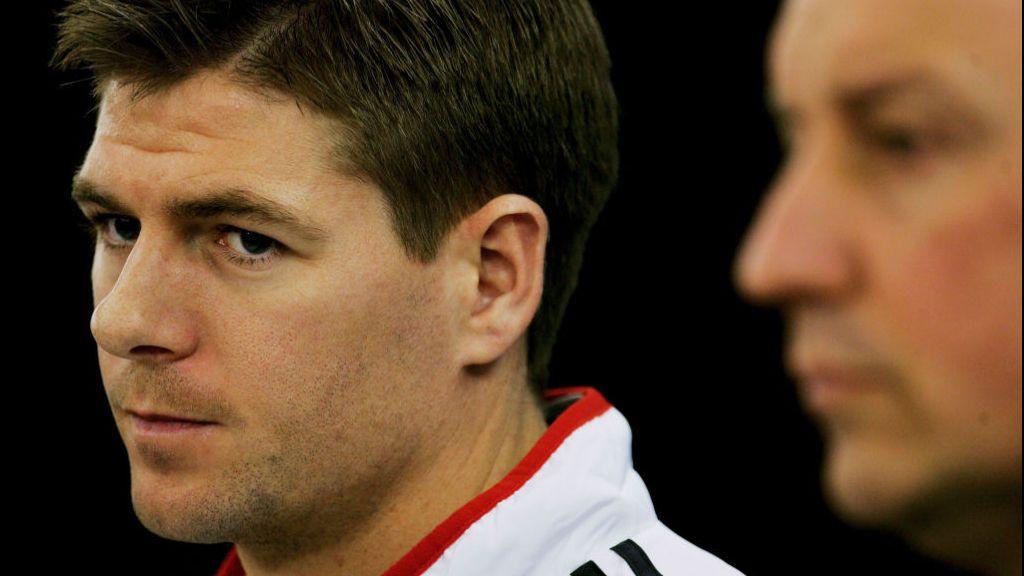
Steven Gerrard, who captained Liverpool to Champions League victory under Rafael Benitez in 2005, reveals that criticism from the Spanish manager made him feel unwanted at the club.
Reflecting on the 2005 Champions League final, Steven Gerrard describes it as the pinnacle of his career., external
However, just two months later, the midfielder announced his intention to leave Liverpool, a decision he would dramatically reverse the following day.
In a new Netflix documentary chronicling Liverpool’s triumph in Istanbul, Gerrard admits he was in a “bad place” mentally during that period.
He attributes his potential departure from his boyhood club, in part, to criticism from then-manager Rafael Benitez.
In May 2005, Gerrard led Liverpool to a historic victory, overcoming a 3-0 half-time deficit against AC Milan to win the Champions League final on penalties, securing the club’s fifth European Cup.
The win fueled hopes that Gerrard would commit his long-term future to Liverpool amid interest from Real Madrid and Chelsea, then managed by Jose Mourinho.
However, six weeks later, Gerrard announced he was leaving, before ultimately deciding to stay.
“Mourinho was on the phone – the best manager in the world at the time, offering lucrative contracts. Chelsea were spending big and guaranteed success,” Gerrard recalls.
“I couldn’t dismiss my connection to Liverpool. I was in a bad place mentally, unsure of what to do.”
Benitez’s management style further complicated matters.
“I felt like he didn’t value me, didn’t trust me, didn’t want me,” Gerrard, now 45, explains.
“I always wanted to be a Liverpool player, but the doubt, the coldness, and the feeling that we couldn’t compete at the top made me consider other options.”
Former teammate Jamie Carragher believes Gerrard needed encouragement.
“Rafa Benitez wasn’t one to provide that,” says the Sky Sports pundit. “He was very unemotional.”
The documentary highlights how Benitez’s meticulous tactical focus sometimes created friction within the team.
Gerrard was particularly affected.
“My game was built on emotion, passion, commitment – everything I felt for the club,” he says. “I felt like he wanted to change me.”
“Nothing was ever enough for him.”
Benitez, 66, defends his methods.
“When I arrived at Liverpool, the culture was based on emotion,” he says. “But football requires more. Excessive emotion can hinder success.”
With time, Gerrard has gained a new appreciation for Benitez’s approach.
“Looking back, I consider Rafa the best coach I’ve worked with,” he admits.
Michael Owen left Liverpool for Real Madrid in August 2004 to join a squad that included David Beckham and Ronaldo
A year prior to Gerrard’s potential transfer, Michael Owen’s future at Liverpool was also uncertain.
Owen, another academy graduate, had also grown dissatisfied with the situation at Anfield.
Gerard Houllier was dismissed as manager in the summer of 2004 after Liverpool finished 30 points behind Arsenal.
Benitez’s primary task upon taking over was to convince Owen and Gerrard to stay.
He met with Owen, Gerrard, and Carragher in Portugal, where they were with the England squad for the European Championship. The meeting was not what they expected.
“He immediately focused on tactics,” says Gerrard. “He was critical, and it felt like he didn’t trust me. I thought to myself, ‘You’ll need me more than I need you.'”
Carragher recalls Benitez telling Owen, the 2001 Ballon d’Or winner, that he needed to improve his turning speed.
“That was probably the best aspect of my game at the time,” says Owen, 46. “He certainly didn’t convince me to stay.”
In August 2004, Owen joined Real Madrid for £8m.
Benitez’s recollection of that first meeting is different.
“You can tell if someone is happy with the conversation,” he says. “I believe they were quite satisfied.”
Carragher describes Benitez’s training methods as unconventional.
“There were no balls, just cones scattered across the pitch,” says the former England defender, 48.
“Rafa would say, ‘The ball is at cone A, then cone D, then cone F,’ and we had to run to our designated positions.”
Benitez acknowledges his attention to detail.
“I like to analyze every detail,” he says. “A centimetre can be the difference between success and defeat.”
His attention to detail proved crucial during the penalty shootout in Istanbul.
Jerzy Dudek reveals that Benitez had compiled extensive notes on the penalty-taking tendencies of Milan’s players.
“We had a code,” says the former Poland goalkeeper. “The goal was divided into six squares. He shared the information, for example: ‘Shevchenko prefers squares one and four.'”
Dudek saved two penalties, including the decisive one from Shevchenko.
Dietmar Hamann’s half-time substitution helped turn the game around
A key element of the 2005 Champions League final’s narrative revolves around the events in the Liverpool dressing room at half-time.
Liverpool scored three goals in six second-half minutes after Benitez replaced defender Steve Finnan with midfielder Dietmar Hamann.
The change saw Liverpool switch from a four-man defense to three, with Hamann and Xabi Alonso as holding midfielders and Gerrard given more freedom to attack.
Carragher describes the half-time interval as “chaotic.”
Djimi Traore was initially told he was being substituted before Benitez realized Finnan was injured.
Hamann recalls beginning his warm-up while his teammate went to shower, only to find him back in his kit upon his return.
“I went back to the dressing room and the first person I saw was Djimi,” he says.
“I said, ‘I’m coming on, who’s coming off?’ He said, ‘I don’t know. I have no idea what’s going on.'”
Benitez says the final taught him a valuable lesson.
“I realized that while it’s important to play with your head, you must never forget to play with your heart,” he concludes.
Follow your club with BBC Sport
Listen to the latest Football Daily podcast
Get football news sent straight to your phone