

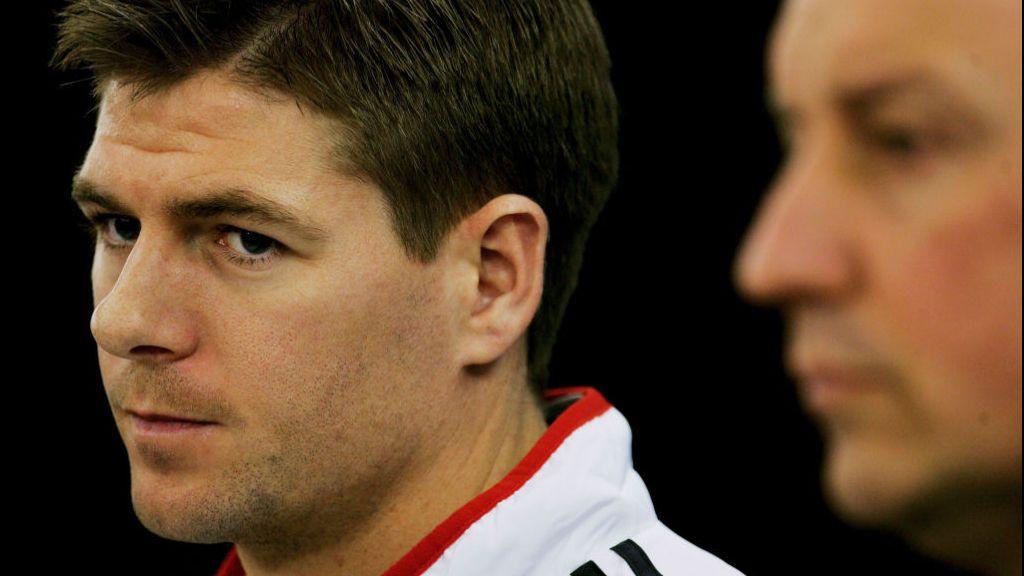
Steven Gerrard, who captained Liverpool to Champions League glory under Rafael Benitez in 2005, has revealed that criticism from the Spanish manager made him feel unwanted at the club.
Reflecting on the 2005 Champions League final, Steven Gerrard describes it as the best night of his life., external
However, just two months later, he announced his intention to leave Liverpool, before dramatically reversing his decision overnight.
In a Netflix documentary about Liverpool’s triumph in Istanbul, Gerrard admits to being in a “bad place” mentally, feeling overwhelmed.
He attributes his potential departure from his boyhood club to criticism from then-manager Rafael Benitez.
In May 2005, Gerrard led Liverpool to a historic victory, overcoming a 3-0 half-time deficit against AC Milan to win on penalties and secure the club’s fifth European Cup.
Fans hoped this victory would convince Gerrard to commit his future to Liverpool, amidst interest from Real Madrid and Chelsea, then managed by Jose Mourinho.
Six weeks later, Gerrard announced his departure, only to then remain at the club.
“Mourinho was on the phone, the best manager in the world at the time, offering lucrative contracts, which naturally turn your head. Chelsea were spending fortunes, and success there was guaranteed,” he states.
“I couldn’t dismiss my relationship with Liverpool. When Chelsea approached, I was conflicted. Mentally, I was in a bad place, feeling overwhelmed.”
Benitez’s demeanor further complicated the situation.
“I felt like he didn’t rate me, didn’t trust me, and didn’t want me,” Gerrard, now 45, explains.
“I’ve always maintained my desire to be a Liverpool player, but with that doubt, coldness, and being part of a team where you don’t believe you can compete at the top, your head gets turned.”
Gerrard’s former teammate, Jamie Carragher, believes Gerrard “probably needed an arm around his shoulder.”
“Rafa Benitez was never going to do that,” the Sky Sports pundit notes. “He’s very unemotional.”
The documentary highlights how Benitez’s criticism and focus on tactical details sometimes caused friction.
Gerrard, in particular, felt this disconnect.
“My game was about emotion, passion, desire, commitment to the badge, the club, and the family,” he says. “It was innate, and I felt he wanted to fundamentally change me.
“Nothing would ever satisfy him.”
Benitez, 66, defends his approach.
“When I joined Liverpool, there was a culture based on emotion,” he states. “Football requires more than that. Excessive emotion hinders the path to success.”
Time has softened Gerrard’s perspective, and he now appreciates Benitez’s methods.
“Looking back, I consider Rafa the best coach I’ve worked with,” he admits.
Michael Owen departed Liverpool in August 2004 to join Real Madrid.
A year prior to Gerrard’s transfer speculation, the future of another Liverpool academy graduate dominated headlines.
Striker Michael Owen, like Gerrard, had become disillusioned with life at Anfield.
Gerard Houllier was dismissed as manager in the summer of 2004 after Liverpool finished far behind champions Arsenal.
Upon his appointment, Benitez was tasked with convincing his two best players to stay.
He traveled to Portugal to meet Owen, Gerrard, and Carragher, who were with the England squad at the European Championship. The encounter was not the charm offensive some might have anticipated.
“He immediately focused on tactics,” says Gerrard. “‘I don’t want this, I don’t want that. You can’t play in this team unless we trust you.’ It was intense, and I thought, ‘I guarantee you’ll need me more than I need you.'”
Carragher recounts Benitez telling Owen, who had won the Ballon d’Or in 2001, that he needed to learn to “turn on the ball quicker.”
“That was arguably what I was best at,” says Owen, 46. “He certainly didn’t convince me to stay, to put it mildly.”
In August 2004, Owen joined Real Madrid for £8m.
Benitez’s recollection of that first meeting differs.
“You can sense if someone is happy with the conversation,” he says. “I believe they were quite content.”
Reflecting on Benitez’s tenure, Carragher describes the manager’s training methods as “a bit strange.”
“There would be no ball, just cones all around the pitch,” says the former England defender, 48.
“Rafa would say, ‘The ball’s at cone A, the ball’s at cone D, the ball’s at cone F,’ and we’d all have to run to our designated positions.”
Benitez admits to his penchant for detail in coaching.
“I enjoy analyzing things,” he says. “A single centimeter higher or lower can be the difference between success and defeat.”
That attention to detail proved crucial during the penalty shootout in Istanbul.
Jerzy Dudek reveals that Benitez had compiled extensive notes on the preferred placement of Milan’s players’ penalties.
“We had a code,” says the former Poland goalkeeper. “The goal was divided into six squares. He shared the information: ‘Andriy Shevchenko prefers one and four.'”
Dudek saved two penalties, including the decisive one from Shevchenko.
Dietmar Hamann’s half-time introduction helped turn the game
The 2005 Champions League final is also remembered for the events in the Liverpool dressing room at half-time.
Liverpool scored three goals in six second-half minutes after Benitez substituted midfielder Dietmar Hamann for defender Steve Finnan.
This resulted in a change from a four-man defense to three, with Hamann and Xabi Alonso as holding midfielders and Gerrard given greater freedom to attack.
Carragher describes the 15 minutes at half-time as “chaotic.”
Djimi Traore was initially told he was being substituted before Benitez learned of Finnan’s injury.
Hamann describes warming up while his teammate showered, only to find him back in his full kit upon his return.
“I returned to the dressing room and saw Djimi,” he says.
“I asked, ‘I’m coming on, who’s coming off?’ He replied, ‘I have no idea what’s going on.'”
Benitez says the final taught him a valuable lesson.
“I began to realize that while it’s important to play with your head, you must never forget to play with your heart,” he concludes.
Follow your club with BBC Sport
Listen to the latest Football Daily podcast
Get football news sent straight to your phone