

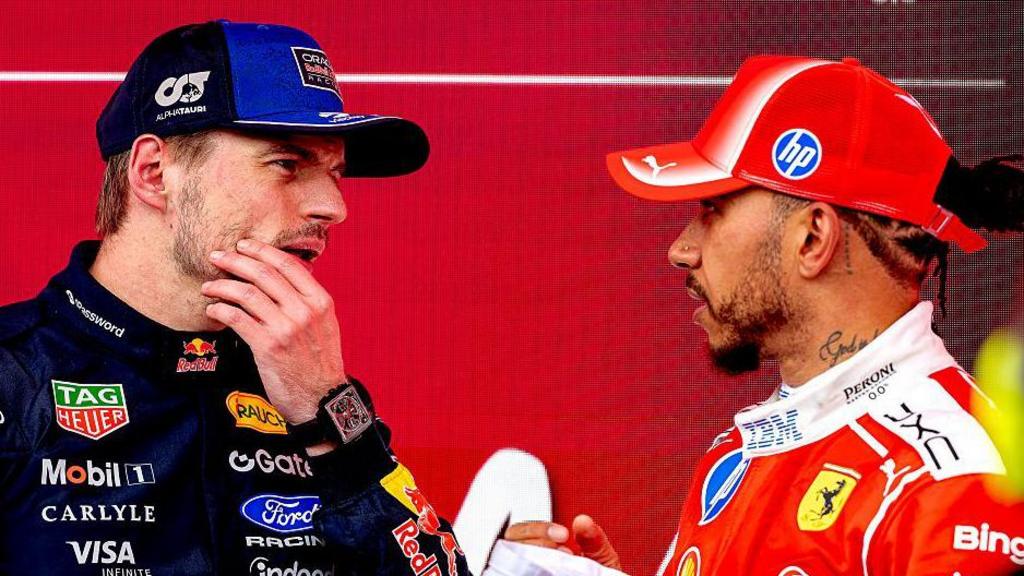
Max Verstappen and Lewis Hamilton collectively hold 11 world championship titles.
Kimi Antonelli has widened his lead in the drivers’ championship standings following the retirement of his Mercedes teammate, George Russell, at the Canadian Grand Prix.
Ferrari’s Lewis Hamilton secured second place, while Max Verstappen of Red Bull completed the podium.
Earlier in the weekend, Russell demonstrated his prowess by converting his sprint pole position into a victory on Saturday.
BBC F1 correspondent Andrew Benson addresses pressing questions from fans following the Montreal race weekend.
The irony of Hamilton finishing behind Antonelli is notable. What is the underlying issue at Ferrari? Has their simulator been hindering Hamilton’s performance? – Tom
Lewis Hamilton exhibited strong competitive form in Canada, consistently outpacing his teammate, Charles Leclerc, throughout the weekend.
Following the Miami race, Hamilton indicated that he felt the Ferrari simulator was leading him astray with setup configurations. Consequently, he opted not to use it before Canada, a decision he confirmed was beneficial in Montreal.
He stated: “I felt like we started on the right foot, came with the right attitude, and the car really generally felt great.”
This situation presents a delicate challenge, as Hamilton is wary of appearing critical of the simulator. However, he believes he has identified a key factor contributing to his struggles at Ferrari and wishes to make it known.
“I’m sure I would drive it at some point,” Hamilton said after the race regarding the simulator. “What could be good is, for example, going back and doing correlation to this weekend so we can find out where it’s missing.”
“The test driver will only know what they know because it’s only Charles and I get to drive the car.”
“So, the positive of being able to drive the real car, go back and say, ‘This is actually what it feels like. These are the things that we’re missing [from the simulator experience].’ So we can improve it. I’m always there to help the team move forward and develop it.”
“Now, whether I use it to prepare for another race? Probably not. There are just too many risks. If you look at the two best races I’ve had, I didn’t use a simulator. And that’s honestly how it was.”
“Pretty much all the championships [I won] before, except for probably 2008, I didn’t use the sim. So it’s not a necessity. It’s a tool that can be powerful. But for me, I’m old school. I’m probably better without it.”
An outstanding question remains: Hamilton refers to China and Canada as his “two best races” this year.
However, these are circuits where he has historically performed exceptionally well, alongside Silverstone and Hungary.
While there’s no reason to doubt Hamilton’s concerns regarding the simulator, further evidence across a broader range of races is likely needed before definitively concluding that this is a comprehensive solution to his past challenges.
This video can not be played
Why it ‘clicked’ for Hamilton and Ferrari in Canada
Do you believe Max Verstappen will leave F1 at the end of the season if the engine regulations are not amended? – Paddy
Max Verstappen’s statements about his inability to endure another year driving the current cars appear sincere.
In Montreal, he explicitly stated his reluctance to continue if the engine rules remain unchanged. “It’s just mentally not doable for me to stay like this,” he said. “It’s really not.”
Following the race, Verstappen acknowledged enjoying his battle with Hamilton but elaborated on his dissatisfaction with the new cars and, particularly, the new engines’ emphasis on constant energy management.
Verstappen noted that competing in the Nurburgring 24 Hours reminded him “how pure motorsport can be”.
He said of F1 this year: “For me, while driving, it’s all a bit confusing. It’s not what Formula 1 should be about. It’s way too complex.”
“Most of the rules, the fans don’t even know what we are dealing with while driving, what is allowed when you’re behind or when you’re the car ahead, what we have to do on a formation lap or what we have to do in an out-lap, or how much battery that we’re allowed to charge.”
“It’s just such a shame that we have to deal with all these things. F1 just needs to be more pure and I really hope that what they try to do [for] next year will go through because I think that is necessary, the minimum necessary, to make it a bit more natural and a bit more back to normal, or at least a bit more pure racing.”
“As drivers, give us any kind of car, we’ll always race and give good entertainment or a good show. Doesn’t matter that people say, ‘Oh, but look now, the show is great, the cars were fighting.’ But it has nothing to do with the car. It just needs to be more pure.”
While Verstappen is the most outspoken, his sentiments are largely echoed by other drivers.
Antonelli said after the race that “still sometimes it triggers you a little bit how the system works”.
Hamilton added: “It still continues to be a weird feeling”, continuing, “You go on the power, you open up the [straight-line mode], and then the power dies halfway down the straight and the RPM starts dropping.”
“It doesn’t feel what motorsport should be. The engine should be ringing its neck right to the end of the straight and just pulling and pulling.”
Verstappen is referencing the current proposal by F1 management to alter the ratio between internal combustion and electrical power to 60:40 next year, deviating from the current nominal 50:50 split (approximately 54:46 in practice).
This adjustment, likely achieved by increasing the fuel-flow limit, would alleviate the need for extensive energy management, particularly during qualifying, and restore a more “on the limit” driving experience.
Regulators also have the opportunity to address certain anomalies in the new rules that make the cars and engines exceptionally challenging to handle during warm-up laps due to energy limit restrictions.
The intricacies are too complex to delve into here, but the drivers’ struggles raise questions about how F1 arrived at this situation.
Although the FIA announced an “agreement in principle” on the 60:40 shift over two weeks ago, sufficient support from engine manufacturers for the changes to proceed has yet to materialize.
However, efforts are underway to persuade dissenting companies—Ferrari, Audi, Honda, and Cadillac—and hopes remain that a compromise addressing the concerns of Ferrari and Audi, in particular, can be reached this week.
It’s important to acknowledge that the current rules have yielded some superficial benefits, primarily concerning racing.
The new cars are lighter, smaller, and more agile. Additionally, “overtake mode,” which provides a following car within one second of the leader with an extra 0.5MJ of electrical energy per lap, has fostered the multi-lap battles characterized by frequent passing and re-passing that have become a hallmark of this year’s racing.
The goal is to maintain these positives while resolving concerns about the negative impact of the new engines on driving purity.
The title battle finally came alive – then Antonelli took control
Antonelli wins again to capitalise on Russell retirement in Canada
Canadian GP Review: Ecstasy, Agony and Strategy Blunders
Given their impressive start to the season, is it premature to consider the title Mercedes’ to lose, or have they simply adapted to the new regulations more effectively than their rivals? – Chris
Mercedes has secured pole position and victory in every grand prix held this season. The sole exception occurred in Miami, where McLaren’s Lando Norris claimed pole position and won the sprint race.
Their average qualifying advantage over the next fastest car, the McLaren, is 0.369 seconds.
After five races, Kimi Antonelli’s championship lead over the highest-placed non-Mercedes driver stands at 56 points, equivalent to more than two clear race wins.
Therefore, they are indeed strong championship favorites, and it could be argued that the title is theirs to lose.
The current question revolves around the extent of Mercedes’ potential dominance this season, rather than whether they will ultimately secure the drivers’ and constructors’ championships.
However, this does not imply that they will face no challenges moving forward.
In Miami, McLaren demonstrated that Mercedes is vulnerable, with Norris poised to win the grand prix had McLaren not erred in their pit strategy, costing him track position.
Furthermore, the upcoming race in Monaco is expected to favor Ferrari. They have historically performed well there, the car’s characteristics appear well-suited to the track’s slow and twisty nature, and Charles Leclerc is particularly adept around Monaco. Lewis Hamilton is also a strong contender.
Whether any team can sufficiently improve their car to consistently challenge Mercedes on a race-by-race basis remains to be seen.
Other teams have upgrades in development, but so does Mercedes.
If they emerge from the Spanish Grand Prix, the week after Monaco, with another convincing victory, their control over the season will appear virtually absolute.
As last year demonstrated, unforeseen circumstances can arise. The cars and regulations are relatively new, and it is not inconceivable that a rival team could close the gap, with McLaren considered the most likely candidate.
The key question is how long such progress would take and whether Mercedes’ championship advantage would by then be insurmountable.
This video can not be played
Mercedes team-mates go head-to-head for F1 crown
Given the ongoing discussions about altering the balance between internal combustion and electrical energy for next year, would simply increasing the fuel tank size or completely redesigning the engine be necessary? – Peter
If the proposed shift to a 60:40 split, or thereabouts, between internal combustion and electrical power is implemented, all engine manufacturers will need to revise their engine designs.
This is a central point of contention in the ongoing debate, as addressed in the previous answer.
Audi’s objections to the rules are related to cost, while Ferrari’s concern the regulations regarding additional development allowed to manufacturers deemed to be lagging behind the best engine by a specific margin.
Ferrari is seeking to be granted this extra development but argues that Mercedes does not require it due to their current advantage. If the rules are revised, all manufacturers can redevelop their engines.
Political considerations have entered a matter that, ideally, should be addressed solely with the sport’s best interests in mind.
However, F1 is inherently competitive, so teams have a responsibility to protect their own competitive interests.
Some teams feared the need to construct new chassis for next year to accommodate larger fuel tanks, which would be required for a few races to complete the grand prix distance should the rules be altered.
This presented a problem because several teams plan to carry over their chassis into next year to reduce costs and remain within the cost cap.
However, Racing Bulls team principal Alan Permane revealed over the weekend that an agreement was reached to shorten races with the highest fuel consumption by a lap or two, if necessary, to enable teams to retain their current fuel tank sizes.
Send us your question for F1 correspondent Andrew Benson
Listen to Back at Base on BBC Sounds
‘Not mentally doable to stay like this’ – Verstappen renews quit threat
F1 great Prost ‘injured as masked gang raid home’
Hamilton says he has no plans to retire from F1