

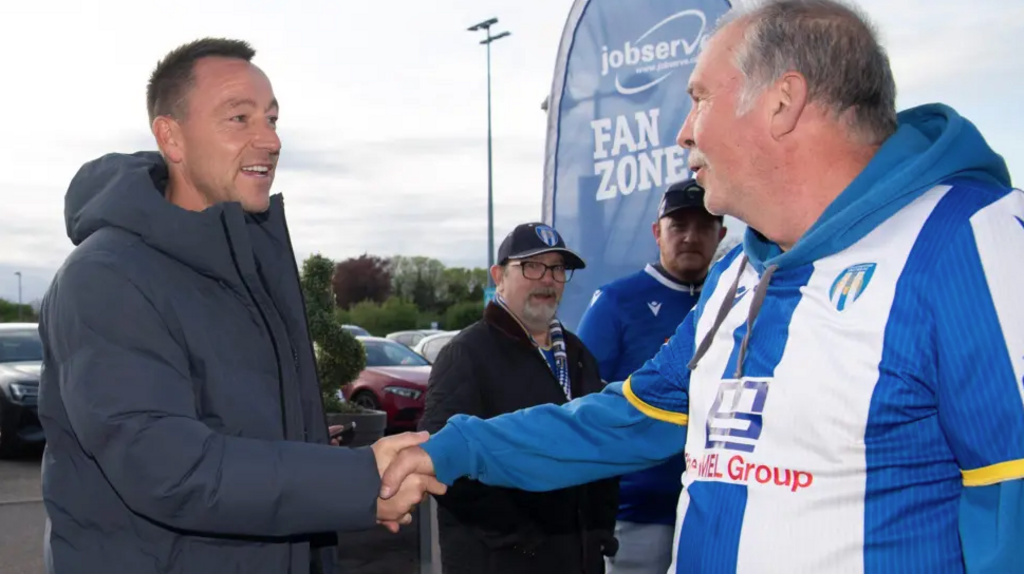
John Terry amassed 17 trophies during his 19-year playing career with Chelsea.
Colchester United acknowledged on Monday that the club is engaged in “detailed discussions” regarding a potential sale to a consortium of investors, but refrained from disclosing the identities of the prospective buyers.
However, BBC Sport has learned that reports linking former England and Chelsea captain John Terry to the investment group are indeed accurate. He was also in attendance at their League Two victory over Accrington on Tuesday.
The U’s have been on the market since last year. Following two unsuccessful takeover attempts, fans are eager for a deal to be finalized before the summer transfer window.
What makes a potential deal appealing to both the club and Terry, and why are numerous high-profile former footballers investing in teams?
Colchester has not suffered the financial instability that has plagued many rival clubs in the Football League. However, they are experiencing one of the longest periods without a promotion of any of the 72 teams, having spent 10 consecutive seasons in League Two.
Owner Robbie Cowling, who has been in charge since 2006, put the club up for sale last year, stating his desire to find “the right long-term steward” to drive it forward.
“I think I could grow [Colchester] incrementally, but fans aren’t interested in that. All they’re worried about is how it does in the league and whether it wins,” Cowling said.
Two potential deals—one with an American investment vehicle and the other with a consortium involving former AC Milan and Chelsea forward Alexandre Pato—have already fallen through.
Terry’s career has been marked by a series of controversies, including a ban for racist abuse, being stripped of the England captaincy, an alleged affair with a teammate’s partner, promotion of football-related cryptocurrency, and, more recently, a social media message in which he responded with clapping emojis to a call for a ban on Muslim women wearing the burqa in the United Kingdom.
How would fans react to a group involving Terry taking control?
“It might work in our favor with respect to player recruitment and things like that, because of his standing in the game,” says Glen Worrell, secretary at Colchester United Supporters Association.
“Someone like him maybe could be a really good figurehead as a director of football. Having a big name like that involved might even attract other investors as well. It depends what his overall role is going to be.”
“I don’t think people aren’t going to turn up because John Terry is involved with the club.”
“The fans really do want to see something happen on the pitch to get them excited.”
Colchester must focus amid Terry ‘noise’ – Payne
Since retiring as a player in 2018, Terry has made no secret of his desire for a frontline, day-to-day role in football, but has been left frustrated in his endeavors so far.
He left his position as assistant to Dean Smith at Aston Villa in 2021 to focus on finding a managerial job. In recent years, he has combined a role as a part-time mentor at Chelsea’s academy with coaching a team of influencers in the six-a-side Baller League.
“It’s really disheartening, actually,” Terry said in an interview with BBC Sport last year.
“I have interviewed for a few [managerial] jobs myself and not got them due to my lack of experience as a number one. But having captained Chelsea and my country, I’m not sure you can do much more in terms of leading teams and people.”
“I am ready and willing. If someone needs to win football matches, I’m not sure you’re going to get anyone better.”
The apparent lack of interest in Terry as a manager contrasts sharply with some of his contemporaries from England’s ‘golden generation’.
Michael Carrick, Steven Gerrard, and Frank Lampard have all managed in the Premier League, while Ashley Cole coaches Serie B side Cesena, and Wayne Rooney has been in charge of three different clubs in the Championship and one in MLS.
It is unclear whether Terry would be willing to set aside his managerial ambitions and take more of a background role at Colchester, or use it as a starting point for his career as a head coach.
Installing himself as manager in place of current head coach Danny Cowley and assistant/brother Nicky would be deeply unpopular with fans.
“It would be 100% be controversial – there would be a backlash,” Worrall says. “What those two have done has been monumental. They have developed the team and generated so much interest in the club from the surrounding community.”
“They make the place buzz. If you took those two away and ended up with just John Terry as the coach, that would be damaging to the supporter base.”
“He hasn’t coached at this level, and it would be quite a culture shock. Is he really going to want to go away to Newport on a Tuesday night?”
The Cowley brothers’ leadership of Colchester has proven hugely popular.
Some of the most high-profile players of the 21st century have opted to purchase stakes in clubs rather than committing to full-time coaching, a marked difference from previous generations.
Perhaps Terry would aim to follow in the footsteps of another former teammate, Cesc Fabregas, by taking on a dual role.
The Spaniard bought shares in Serie A side Como in 2022 before being made manager in 2023.
Terry’s former England teammate David Beckham is a co-owner of MLS side Inter Miami, having negotiated the rights to founding a club as part of the contract he signed when he joined Los Angeles Galaxy in 2007.
Beckham is also a part-owner of Colchester’s League Two rivals Salford City, alongside Gary and Phil Neville, Nicky Butt, Ryan Giggs, and Paul Scholes.
Others, including Ronaldo (Real Valladolid), Kylian Mbappe (SM Caen), and Gerard Pique (FC Andorra), are all majority shareholders in clubs based in countries where they spent significant portions of their careers.
The likes of Luka Modric (Swansea), Thierry Henry (Como), Zlatan Ibrahimovic (Hammarby), and Cristiano Ronaldo (Almeria) have also become part-owners of clubs outside the European elite in recent years.
When former players invest in clubs, they are often buying a much smaller amount of shares and stumping up far less than their business partners.
Adding a household name from within the game to a group of investors can lend star power and authenticity to a takeover.
“The opportunity has been created for ex-pros to stay in the game in a way that wasn’t possible before because of the way football has evolved on a commercial level,” says Dan Plumley, professor of sports finance at Sheffield Hallam University.
“There are clear positives to combining business acumen with people who have lived and breathed football – it gives you a diverse range of opinions.”
“Being part of a consortium also spreads the financial risk across the group of investors, rather than it all being on one owner.”
“History tells us you don’t make money out of owning football clubs, so there can be wider leverage for the former pro too – it can be a way for them to take on different roles in football, learn from them, and make professional progress.”
“If you invest lower down the pyramid and build a project that you’re a part of, that can return some gain depending on how far up the football ecosystem you can take it.”
The excitement when a former star joins forces with a lower league club can pay almost immediate dividends.
“This takeover hasn’t even been confirmed yet, but you can see the story is all across the media and there is extra attention on the club already.”
“As the game continues to move forward at pace in a business sense, we can expect to see more of this kind of model in the future.”