

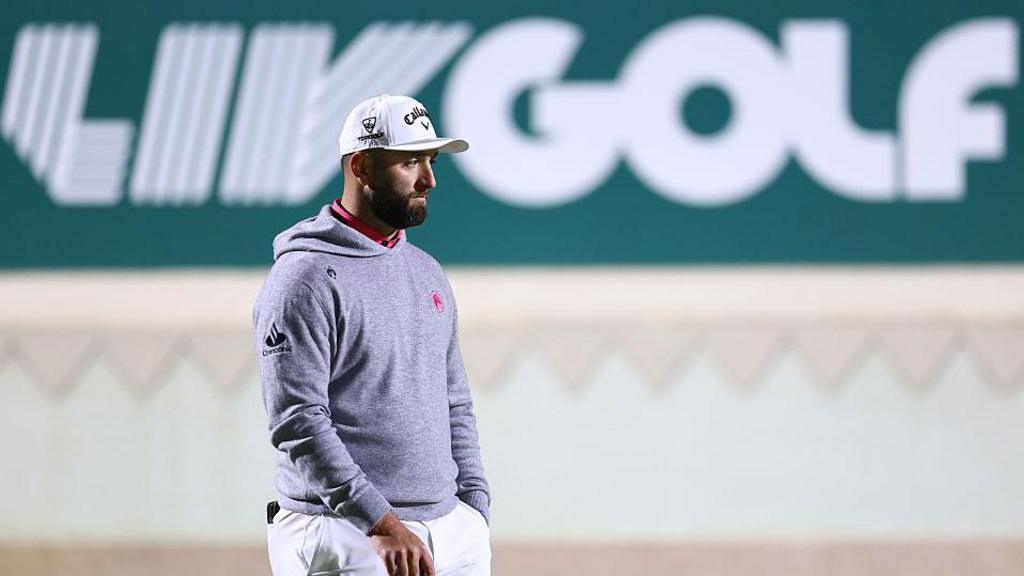
Two-time major champion Jon Rahm’s move to LIV Golf in 2023 sent shockwaves through the sport.
LIV Golf positioned itself as a disruptive force poised to revolutionize the landscape of professional golf.
Just over four years ago, LIV Golf injected significant capital into acquiring prominent players, aiming to reshape the sport with its ambitious vision.
However, with increasing speculation that Saudi Arabia’s Public Investment Fund (PIF) may curtail its financial backing, the future of the tour, which has depended on over $5 billion from the Gulf state, now faces considerable uncertainty.
Named after the Roman numeral representation of its unconventional 54-hole format, LIV undeniably disrupted the existing order.
Yet, it did not achieve the swift and decisive triumph over the PGA Tour and DP World Tour that its founders had envisioned.
While LIV’s leadership has confidently asserted that it’s business as usual, senior figures within European golf have conveyed to BBC Sport their belief that LIV’s operations will cease beyond this year.
Consequently, the question arises: What lies ahead? What becomes of the high-profile players, including Jon Rahm, who were enticed to join LIV? And does this signify a broader trend of Saudi Arabia, a significant investor in various sports, reducing its expenditures?
Discussions surrounding LIV’s future intensified on Wednesday as the tour prepared for its latest event in Mexico.
Numerous media outlets, spanning golf, sports news, and finance, reported on its impending closure, prompting LIV chief executive Scott O’Neil to issue a reassuring email to staff, affirming that operations would continue uninterrupted.
“Our season continues exactly as planned, uninterrupted and at full throttle,” O’Neil stated.
Notably, O’Neil only addressed plans through 2026, omitting any discussion of the tour’s long-term prospects.
While players were informed last month that funding was secured until 2032, well-informed sources within European golf have indicated to BBC Sport that PIF is withdrawing its financial support.
One source expressed the expectation that 2026 would mark LIV’s final season, while another suggested that its leadership was attempting to explore alternative revenue streams.
However, many believe that the tour’s collapse may occur swiftly.
The LIV project, which this year shifted to a more conventional 72-hole format, has been heavily funded by PIF.
The total investment has surpassed $5 billion following an additional $266.7 million injection earlier this year., external
The tour’s net losses in markets outside the U.S. increased to $462 million in 2024, resulting in total losses exceeding $1.1 billion since its inception in 2021.
Considering the substantial funds invested in the U.S. arm of the operation, cumulative losses are projected to reach several billion dollars.
“Without PIF funding, the viability of LIV is questionable given the losses,” one of the European sources noted.
Australia’s Cameron Smith was a key attraction at the LIV Adelaide event, which organizers report drew a record 115,000 fans.
O’Neil stated earlier this year that the tour would not achieve profitability for another 5-10 years.
On Thursday, a LIV source informed BBC Sport that four of its 14 events would be profitable by 2026, along with 10 of its 13 teams.
Additionally, a revenue increase of $100 million after its first five events of the year, compared to the same period in 2025, was cited as a positive indicator.
However, this remains a relatively low return given the magnitude of the investment.
Revenue from sponsorship deals with global brands was reported to have increased by 40% year-on-year, while revenue from ticket sales (130%), hospitality (67%), merchandise (26%), and YouTube content (303%) also saw improvements.
The source only provided percentage figures and not amounts of revenue.
In January, LIV executive Katie O’Reilly stated that the organization was focused on laying the groundwork for growth through increased sponsorship revenue.
“Our goal is to build 13 billion-dollar franchises,” said O’Reilly, who serves as LIV’s executive vice-president of team business operations.
“That is our goal. Are we there yet? No. But right now we are building the foundation for that.”
If LIV were to dissolve, the pathways back to the PGA Tour and DP World Tour vary.
Returning to either tour would require acknowledging past decisions and, for some, paying significant sums to facilitate the process.
LIV’s credibility as a major force capable of challenging the established tours was strengthened by the acquisition of several high-profile players through lucrative multi-million-dollar deals.
The signing of major champions at the peak of their careers, such as Brooks Koepka, Cameron Smith, and Bryson DeChambeau, was complemented by the addition of European stars Ian Poulter and Lee Westwood.
In 2023, LIV made an even more significant statement by luring Rahm, then the Masters champion and a recent Ryder Cup winner.
In February, Rahm, Smith, and DeChambeau declined a one-time opportunity to apply for reinstatement to the PGA Tour under its ‘Returning Member Programme,’ which was available to those who had won a major championship or The Players Championship since 2022.
Five-time major winner Koepka was the only player to accept the offer, facilitating his return by paying fines reported to be approximately £63 million.
It remains uncertain whether LIV’s potential demise would lead to the reopening of this pathway, and under what conditions.
Shortly after Koepka’s decision, 2018 Masters champion Patrick Reed, who did not meet the criteria, also opted to leave LIV.
Reed has been competing on the DP World Tour this year, winning two tournaments and leading the Race to Dubai seasonal standings, while knowing that he can return to the PGA Tour in 2027, one year after his last LIV appearance.
In essence, he has accepted the consequences. Others may need to follow suit.
Rahm remains in dispute with the DP World Tour after rejecting its terms for maintaining membership, which would require paying a fine and serving a suspension.
The same would apply to Westwood and Poulter, who resigned from the tour to avoid the fines.
Hatton would be eligible to play full-time on the tour because he was one of eight players who paid the imposed fine and agreed to a series of other conditions.
The 34-year-old Englishman, who finished tied for third at the Masters last week, was joined by Laurie Canter, Thomas Detry, Tom McKibbin, Adrian Meronk, Victor Perez, David Puig, and Elvis Smylie in reaching an agreement.
In January, a senior source in Saudi Arabia told BBC Sport that towards the end of last year there was “a shift” in the kingdom’s attitude towards some investments, with “everything in the PIF world under serious review”.
The change in strategy, emphasizing more sustainable investments, followed a major budget deficit of $73 billion last year, driven by increased spending and lower oil revenues.
This position also appears to have been accelerated by the Iran war, which has severely disrupted Saudi Arabia’s oil exportation.
However, the Gulf state remains committed to other expensive projects.
Plans to construct Neom Super City, a futuristic, carbon-free metropolis, may have been scaled down, but the underlying vision remains unchanged.
Hosting the 2034 World Cup necessitates the construction of up to 15 new stadiums, as well as a significant airport expansion to accommodate the hundreds of thousands of visitors.
LIV Golf, or sport in general, was not mentioned when PIF announced its 2026-2030 strategy on Wednesday.
But the message was clear: there will be a more savvy approach to its spending.
“The new plan suggests PIF is no longer willing to keep pumping resources into projects that offer little prospect of profitability,” Dr. Kristian Ulrichsen, who shapes policy and provides analysis on the Middle East at the Baker Institute in the U.S., told BBC Sport.
“The perception that resources and ambitions were limitless has given way to a more realistic assessment of what is feasible in a more constrained financial environment.
“That predated the war with Iran and has been under way for more than a year.”
This sentiment, coupled with the uncertainty surrounding LIV Golf’s future, has inevitably sparked discussions about other international sports that have relied on substantial Saudi investment, including boxing, F1, tennis, and even teams like the Premier League football club Newcastle United.
Brazil superstar Neymar was one of the most high-profile transfers to the Saudi Pro League when he joined Al-Hilal in 2022
Domestically, there is further evidence of a subtle shift of strategy.
The Saudi Pro League has attracted numerous high-profile players in recent years, most notably Cristiano Ronaldo, by offering lucrative contracts and paying substantial transfer fees.
The PIF fund has held a 75% stake in four clubs, Al-Hilal, Al-Nassr, Al-Ahli, and Al-Ittihad, since 2023.
On Thursday, PIF announced the sale of 70% of Al-Hilal’s share value, valued at £275 million, to publicly listed Saudi investment firm Kingdom Holding Company (KHC).
A source close to PIF said the move should not be seen as a sign of any lessening in interest in sports investments.
“This is not to say that PIF or Saudi Arabia is pulling out of sports investment but that the authorities are having to prioritize the allocation of resources more carefully,” added Dr. Ulrichsen.
“It is likely that PIF and the Saudi state will prioritize the World Cup going forward, at the expense of other sports projects, including LIV Golf.”
Whether it is “business as usual,” as O’Neil asserted, will become evident when the Mexico event commences on Thursday.
Spain’s Sergio Garcia, captain of the Fireballs team, stated on Wednesday that players had been informed earlier this year that the tour would continue for “many years.”
Players are likely to be questioned following Thursday’s rounds.
Mexico is the sixth tournament of LIV’s 2026 season, following events in Saudi Arabia, Australia, Singapore, Hong Kong, and South Africa.
The remaining nine events, including two at Donald Trump-owned courses in the United States and one at the JCB Golf and Country Club in the UK, are scheduled to take place over the next four months.
Beyond that, only time will reveal what the future holds for LIV.
Comments can not be loaded
To load Comments you need to enable JavaScript in your browser