

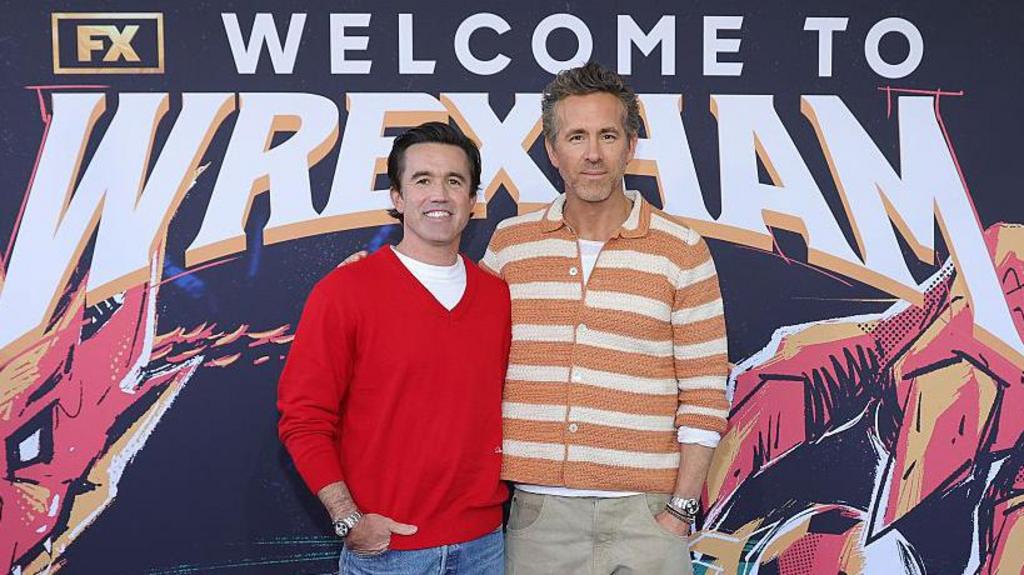
Co-chairmen and executive producers of ‘Welcome to Wrexham’ Rob McElhenney (left) and Ryan Reynolds (right) finalized their acquisition of Wrexham AFC in 2021.
Spoiler warning: This article contains details from the first two episodes of the new season of ‘Welcome to Wrexham’.
The premise of ‘Welcome to Wrexham’ might seem unconventional, yet its success has defied expectations.
A documentary chronicling a lower-tier Welsh football club, geographically and culturally distant from the Premier League’s spotlight, would not typically be considered a recipe for widespread acclaim.
However, the series has emerged as a compelling and captivating narrative within the realm of sports entertainment in recent years.
Season 5 premieres on Disney+ in the UK, and FX and Hulu in the US on Friday, 15 May.
BBC Sport was granted an exclusive preview of the initial episodes prior to their official release.
What can viewers anticipate, and how has this documentary series propelled a football club in North Wales to global prominence?
The acquisition of Wrexham by Hollywood figures Ryan Reynolds and Rob McElhenney foreshadowed the likelihood of a documentary, which quickly materialized.
Reynolds, recognized for his marketing acumen alongside his acting career, and McElhenney, who cited the Netflix documentary ‘Sunderland ‘Til I Die’ as inspiration for acquiring Wrexham, brought storytelling expertise to the venture.
Humphrey Ker, an executive producer of the series and a club director, played a key role in introducing McElhenney to the world of football.
“We always hoped that telling an authentic story about something as unique and yet universal as a football club would resonate… But I don’t think any of us expected the level of interest” says Ker.
While Reynolds and McElhenney’s involvement initially garnered attention, the series’ enduring appeal lies elsewhere.
“It is the authenticity that keeps people coming back. People like Wayne Jones [owner of the Turf pub], Kerry Evans [the club’s disability liaison officer], and Phil Parkinson [the manager] and staff are the real stars” says Ker.
The series consistently emphasizes community, opting for the unpredictable realities of football and the experiences of those involved over solely focusing on performance or carefully crafted narratives.
“I think it’s definitely the reason it works,” adds Ker.
“Lots of sports docs present a polished and anodyne version of the ‘product’… I think that veracity is what got people hooked.”
For viewers, this authenticity creates a more immersive experience.
The extent of this connection has even prompted academic research.
Professor Jan Boehmer from the University of Michigan is the co-author of the study ‘Did Deadpool Save a City? The Socio-Economic Impact of Welcome to Wrexham’.
He suggests that the series allows viewers to forge a personal connection with the town itself.
“Viewers quickly form a strong bond,” explains Boehmer.
“They might feel as if they knew the people of Wrexham personally, making them part of the community… it doesn’t feel like marketing. It feels like a good story.”
This dynamic has facilitated the series’ reach beyond traditional football fans.
While game outcomes contribute to the narrative, the emotional core revolves around the club’s social presence.
The series has highlighted the team’s consecutive promotions, but setbacks have also played a role in maintaining viewer interest.
“Adversity makes for more interesting television,” explains Ker – pointing to the club’s failure to secure promotion in the first season as a key driver for returning viewers.
“People are very proud to see the club and the city represented this way… I’m honestly astonished by the lack of naysaying.”
While the documentary has not generated direct revenue for the club, its wider impact has been substantial.
Welcome to Wrexham has become the most-watched docuseries on FX Entertainment, with audiences spanning multiple territories. Less than half of its viewership comes from North America, with the UK representing its largest secondary market – an indication of both domestic and international appeal.
Its success has also been recognised with 10 Emmy Awards and a multi-season renewal.
“When we launched Welcome to Wrexham, we never imagined the impact it would have on the club and the town while creating one of TV’s most successful and beloved docuseries,” said Nick Grad, President of FX Entertainment.
“The three-season renewal is a testament to the vision of Rob and Ryan and the enduring connection they’ve built with fans around the world.”
Financially, Wrexham has seen rapid growth.
According to Dr Christina Philippou, an Associate Professor in sport finance, income has increased more than five-fold between 2022 and 2025. Commercial revenue in particular has surged, rising more than 14 times over the ownership period – far outpacing matchday income.
“The Hollywood glamour in action has played a big part in pushing global appeal and bringing in global sponsors,” says Philippou.
The documentary’s role in that transformation has been indirect but profound. By offering sustained global exposure, it has functioned as a long-form introduction to the club and its community.
The economic effects have extended beyond football. Boehmer’s study suggests measurable change following the series’ release – within the first four weeks of the programme airing, the club generated six times more retail revenue than it had in the previous 12 months combined.
The study also found that Wrexham moved from having one of the lowest employment rates in Wales in September 2022 to the highest by March 2024.
Boehmer describes the findings as “one of the clearest displays of the real-world impacts of mediated sport”, highlighting how sustained global exposure can translate into economic outcomes.
The scale of that impact remains difficult to fully foresee.
“We had hopes that it could prove as popular as it has… but I think we’d be lying if we predicted every aspect of it” Ker adds.
“I think football clubs are extraordinary dragnets through the communities they represent and finding good stories has never been difficult… managing what the club has become and what it will continue to evolve into will always be the greater challenge.”
Season 5 continues to highlight the community surrounding the club, as in previous seasons.
The first episode, aptly titled The Heart of Wrexham, centres on the family of Bailey Jones, a 20-year-old supporter who died in 2023 following a freak accident that subsequently caused a bleed on the brain.
His parents, Jamie and Ann-Marie, speak about their decision to donate his organs – an act that would later bring them into contact with Matthew, the recipient of Bailey’s heart.
Matthew expresses how the “ultimate respect” would be “to bring Bailey’s heart back to Wrexham” – so he and his wife join Bailey’s parents in watching Wrexham face Derby on the second anniversary of his passing.
The episode also follows the club’s preparation and tough start to the 2025-26 season in the Championship, and the challenge of integrating 14 new players into their squad.
There’s even a cameo from the Everton manager, David Moyes!
Joey Jones, the legendary former Wales, Liverpool and Wrexham defender is honoured in episode two – his former teammate and friend of 56 years Mickey Thomas leads the tributes.
We also get a taste of Wrexham through the eyes of Katrina Jones, the club caretaker.
But the episode doesn’t shy away from difficulties on the pitch with a heavy focus on whether Parkinson is the man to take the team forward.
Beyond the Hollywood story – what are Wrexham really building?
Why Wrexham’s global fanbase is about more than fame and glory
Latest Wrexham news, analysis and fan views