

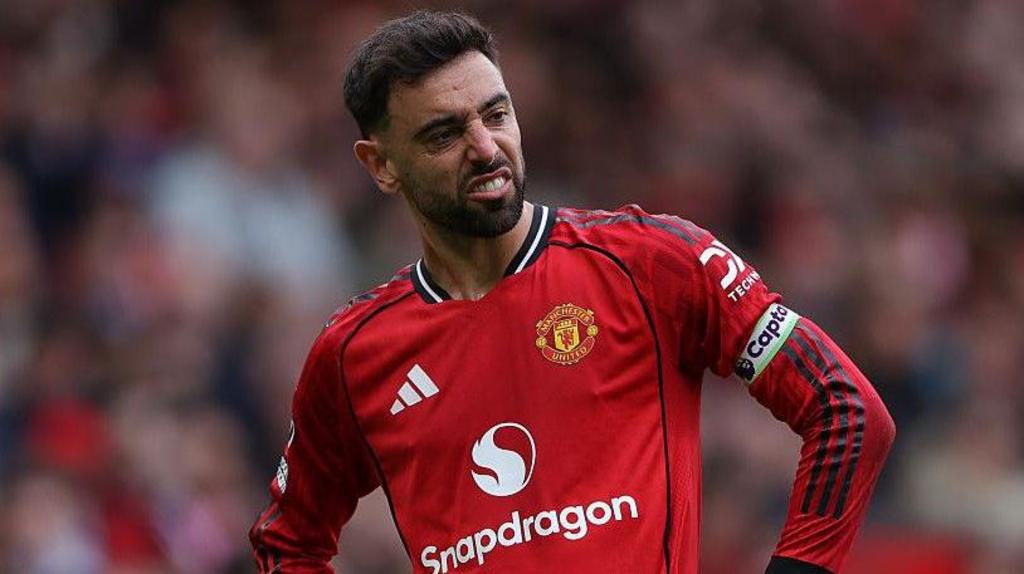
Manchester United’s Bruno Fernandes has orchestrated 29 ‘big chances’ this season, highlighting his creative prowess.
Since joining Manchester United in 2020, captain Bruno Fernandes has yet to achieve Premier League or Champions League glory.
Under Erik ten Hag’s leadership, he has secured domestic cup victories, and a potential third-place finish this season would mark one of United’s best league performances during his tenure.
However, for a player often hailed as United’s most impactful signing since Sir Alex Ferguson’s retirement in 2013, and one deserving of recognition among the club’s Premier League greats, the trophy haul remains modest.
Recently, he was honored as the Football Writers’ Association’s Footballer of the Year. Yet, Fernandes maintains a team-first perspective, not prioritizing individual accolades.
In a past media address, he stated, “I don’t believe that one player is superior to another based solely on trophy count. The Ballon d’Or winner isn’t always the world’s best player.”
“My ambition is to win trophies and be recognized for my positive contributions to the club, for bringing success back, not just for personal statistics.”
While a trophy may elude United this season, Fernandes has significant milestones within reach.
He needs just one more assist to equal the individual Premier League record of 20 in a single campaign – jointly held by Arsenal great Thierry Henry and former Manchester City star Kevin de Bruyne.
Fernandes leads the Premier League’s assist chart this season, ahead of Manchester City’s Rayan Cherki, with West Ham’s Jarrod Bowen in third place.
Breaking the record holds considerable importance for Fernandes, a key figure in Portugal’s upcoming World Cup campaign. One of his United teammates even suggested that Fernandes might previously have opted for a shot against Brentford over setting up Benjamin Sesko. Fernandes refuted the claim.
Fernandes is also a frontrunner for the prestigious PFA Players’ Player of the Year award, previously won twice by both Henry and De Bruyne.
In the absence of major silverware, would surpassing the assist record and securing another player of the year award solidify his reputation as one of the Premier League’s most influential creative forces?
The ‘assist king’ is typically viewed as a creative playmaker.
However, the reality can be more nuanced.
In recent seasons, Liverpool’s Mohamed Salah has topped the assist charts twice, while strikers Ollie Watkins (Aston Villa) and Harry Kane (formerly of Tottenham) have each achieved it once. None of these players are typically regarded as creators in the same vein as De Bruyne, who has led the chart on four occasions.
A relevant comparison for Fernandes might be Cesc Fabregas’s tenure at Arsenal.
During his time as a first-team regular until 2011, the Spanish international led the league in assists in two seasons. His most significant domestic trophy during this period was the FA Cup. It wasn’t until his return to England with Chelsea that Fabregas secured a Premier League title.
In the Premier League’s early years, Southampton’s Matt le Tissier and Liverpool’s Steve McManaman also topped the assist charts, yet neither won a league title.
Liverpool captain Steven Gerrard led the assist charts in 2013-14 and won both the PFA Player of the Year and FWA equivalent awards. While he led Liverpool to a memorable Champions League victory in 2005, Gerrard never won the league, yet his status as a Premier League icon remains undisputed.
Bruno Fernandes has scored 106 goals in 324 appearances for Manchester United
Regardless of individual accolades, United fans are eager to ensure their talisman remains at the club.
His contract has one year remaining, with the club holding an option for an additional season.
After rejecting a lucrative offer from Saudi Pro League club Al-Hilal last summer, speculation arose that Fernandes might depart if United failed to secure Champions League qualification.
Now that qualification has been achieved, the player is reportedly keen to discuss a contract extension. United are open to negotiations but remain committed to maintaining a controlled wage structure.
The club believes they are in a strong negotiating position, considering Fernandes will be 33 when his contract expires, assuming the option is exercised.
Of particular interest is a release clause set at 65 million euros (£56.23 million), enabling him to join a club outside England if triggered in a timely manner.
Fernandes is reportedly enthusiastic about the challenges ahead at Old Trafford. However, the potential impact of the release clause being triggered, coupled with United failing to meet his expectations, remains to be seen.
Speaking prior to Saturday’s Premier League match against Sunderland, interim head coach Michael Carrick appeared confident about the situation.
“Bruno is clearly happy, playing exceptional football, perhaps at his peak, and he’s had some outstanding periods here,” he said.
“He has an important end to the season ahead and a significant summer, of course. We value him highly at the club. He’s integral to our operations.”
Under former manager Ruben Amorim, Bruno Fernandes partnered Casemiro in a midfield two as Manchester United played in a 5-2-3 shape. His role was to shoulder much of United’s build-up responsibility, helping them get up the pitch.
Higher up, Amorim encouraged passing routines that ended with direct through balls for attackers and wing-backs running in behind.
Fernandes was tasked with playing the long pass from deep, and although this got United into dangerous areas, his team-mates needed more than just one long through ball to turn possession into goals.
Carrick has moved to a more traditional and defensively secure 4-2-3-1 that encourages fast counter-attacks. Fernandes is the number 10 in this system, surrounded by Kobbie Mainoo, Casemiro, Bryan Mbeumo or Amad Diallo, plus Matheus Cunha and Benjamin Sesko.
By being positioned higher up the pitch – closer to team-mates and with more passing options – he is able to generate chances more often. The reduced physical demands of his role ensure that when he does play passes late in the game, he has the energy to execute them more reliably.
What jumps out with Fernandes is the similarity in the assists he has made. Looking at his past 10 assists for Manchester United, three patterns are consistent.
The first is a set of assists that come from crosses with his right foot from the right side of the pitch. These can be further split into those that come from open play or via set-pieces – including corners or free-kicks.
A corner is cleared, but Bruno Fernandes – now from open play – is still able to assist Casemiro via a deep outswinging cross from the right flank
When Fernandes gets on the ball and looks to cross, teams inadvertently drop off closer to goal. Fernandes’ crosses from the right swing back away from goal, which often gives his team-mates space to head the ball.
Casemiro’s aerial quality has been remarkable, with right-sided outswingers from Fernandes converted by the Brazilian against Fulham, Newcastle, Aston Villa and Leeds in recent weeks. Fernandes has set up Casemiro six times – the most any player has assisted a team-mate in the league this season.
This time Bruno Fernandes’ free-kick from the right assists Casemiro. The pair have combined well at the near post
The second group of assists have come from Fernandes starting in a central number 10 position before moving into wide areas.
This poses a challenge for the defending side in terms of who is responsible for marking him, which can leave Fernandes unmarked.
His movement often provides United with an overload in the wide areas and, with time and space on the ball, Fernandes has made some impressive assists.
Fernandes moves into an unusual wide left position and Aston Villa’s players are unsure who should pick him up. From here he plays an early through ball, assisting Cunha
From the right flank, his ability to drive with the ball pushes opposition defences closer to their own goal before he looks for cut-backs into the space in front of the defence – resulting in assists against Chelsea and Fulham.
Fernandes runs down the right flank having left his central position. Chelsea’s backline moves closer to goal which opens space for the cut-back, resulting in Manchester United scoring
Lastly, playing in transition under Carrick, Fernandes has attacked through the middle against disorganised defences.
Carrying the ball up the pitch, he holds it, waiting to commit one of the opponent’s defenders.
He often moves his body in a way that looks like he is going to pass to one team-mate, before passing it to the spare man after fooling the defenders.
Fernandes angles his body and fakes to pass it to Mbeumo on the right, which drags Brentford’s defenders across, before he finds Sesko, who scores from the left
Carrick has utilised Fernandes in a role that suits his strengths far more, but the captain’s ability to hold on to the ball, delaying the pass until the very last moment, is likely to have been a skill he mastered when having to play more slowly, deeper on the pitch, under Amorim this season.
Latest Manchester United news, analysis and fan views
Ask about Man Utd – what do you want to know?