

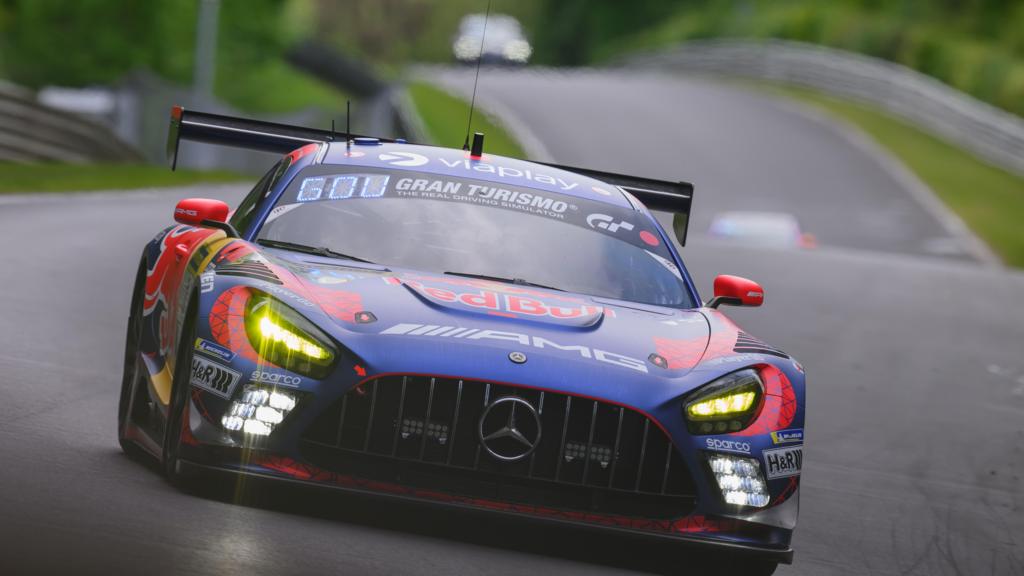
The Mercedes driven by Max Verstappen, Lucas Auer, Jules Gounon, and Daniel Juncadella was in the lead at the Nürburgring 24 Hours with three hours and 20 minutes remaining when a driveshaft failure forced their retirement.
Formula 1 returns to North America this weekend for the Canadian Grand Prix, the fifth round of the 2026 season.
Mercedes’ George Russell, the winner of last year’s race, aims to close the 20-point gap to teammate Kimi Antonelli in the drivers’ championship standings.
Ahead of the Montreal race, BBC F1 correspondent Andrew Benson answers your latest questions.
Why don’t other F1 drivers participate in different forms of motorsport, as Max Verstappen is currently doing with endurance racing? – Paul
Max Verstappen’s participation in the Nürburgring 24 Hours last weekend garnered significant attention. However, it is noteworthy that he is only the third Grand Prix driver in over two decades—possibly longer—to seriously compete in other racing disciplines while simultaneously racing in Formula 1.
Fernando Alonso was another prominent figure who engaged in such activities toward the end of his initial F1 career, participating in the Indianapolis 500, the Daytona 24 Hours, and subsequently joining Toyota for the World Endurance Championship while still under contract with McLaren.
Nico Hulkenberg also competed at Le Mans during his time with Force India in 2015.
The primary reason why drivers typically do not engage in such activities is that their contracts prohibit it.
The rationale behind this includes the inherent risk involved, potential contractual conflicts, and the significant time commitment required to pursue such endeavors properly.
In Verstappen’s case, the allowance stems from the power dynamic between the driver and the team. His position with Red Bull provides him with substantial leverage that most other drivers lack.
As a four-time world champion, the team is keen to maintain his satisfaction, particularly given their awareness that he is currently not entirely enamored with F1.
Alonso’s situation was similar. His McLaren was uncompetitive, and the team sought to keep him content. Furthermore, McLaren F1 boss Zak Brown is an avid motorsport enthusiast who found the Indy endeavor particularly appealing.
Regarding Verstappen, his performance at the Nordschleife was predictably exceptional.
During his initial stint on Saturday afternoon, he elevated his team from 10th to the lead, a position they maintained until a driveshaft failure ended their chances of victory on Sunday morning.
Much of this progress involved Verstappen overtaking other cars, although some competitors pitted out of his way due to differing strategies.
However, the race also highlighted why F1 teams typically discourage drivers from participating in such events.
Verstappen narrowly avoided a high-speed crash early in his stint when his car’s front wheels became airborne over a crest while pursuing a rival.
There were also numerous other near-misses, which are common in races featuring multiple classes of cars and significant speed differentials.
Generally, these types of races are more dangerous than F1.
Red Bull’s Sebastian Vettel won the 2013 drivers’ championship—the last to feature V8 engines—by 155 points over Ferrari’s Fernando Alonso.
Much of the 2013 season was unexciting. Why is there such fondness for that era? I am intrigued by the demands of the new era and find it consistent and coherent with the current age. Are critics of the current era showing their age and risking obsolescence? – Dave
This question primarily concerns FIA President Mohammed Ben Sulayem’s push to revert Formula 1 to engine regulations similar to those in place from 2010-2013.
We examined this topic in detail last week, and a link to that article is provided below.
Regarding the specific question, it is true that 2013 was largely uneventful, particularly in the second half.
The season began competitively, with Red Bull’s Sebastian Vettel winning four of the first 10 Grands Prix, while Ferrari’s Fernando Alonso, Lotus’ Kimi Raikkonen, and Mercedes drivers Nico Rosberg and Lewis Hamilton each secured victories during that period.
However, a change in tire specifications following a series of blowouts at the British Grand Prix led to Red Bull’s dominance, with Vettel winning the final nine races to clinch his fourth consecutive world title.
The final years of the V8 era, after refueling was banned at the end of 2009, alternated between periods of intense competition and relative dullness.
The 2010 and 2012 seasons featured captivating title battles. In 2010, five drivers were in contention until the penultimate race, and four remained mathematically in the running at the final race.
That year, Ferrari’s strategic misstep in Abu Dhabi cost them the title, allowing Red Bull and Vettel to secure their first championship.
In 2012, there were seven different winners in the first seven races, and the title fight between Vettel and Alonso extended to the final race once again.
In 2011, similar to 2013, Vettel and Red Bull dominated.
However, factors beyond engines played a significant role in these scenarios, including tires and the relative competitiveness of the cars.
Nonetheless, the naturally aspirated era—particularly the years from 1994-2009 when refueling was permitted—was notorious for a lack of on-track overtaking.
Overtaking has certainly increased this year with the new “yo-yo racing” style resulting from the new hybrid engines.
Numerous issues are intertwined in this engine debate, including nostalgia for the past, concerns about cost, the essence of F1, noise, and the evolving road-car market.
Will F1 go back to the future with its engines?
With Kimi Antonelli performing exceptionally well recently and considerable discussion surrounding his talent and future, can some of his success be attributed to his race engineer, Pete Bonnington? We all know how effectively Lewis Hamilton worked with Bono. – Michael
The relationship with their engineer is paramount for a racing driver.
In Peter Bonnington, Antonelli has access to extensive experience, having “learned from the greats,” as Mercedes F1 boss Toto Wolff noted in Miami.
Bonnington previously served in the same role with Michael Schumacher and Lewis Hamilton. Wolff stated, “He has been a good mentor to [Antonelli], but also a strong boss.”
Pairing Antonelli with Bonnington is just one example of the care Mercedes has taken in managing the start of Antonelli’s F1 career.
Wolff has consistently expressed confidence in his protégé’s potential, acknowledging that Antonelli would make mistakes initially but would ultimately excel.
Now that Antonelli has achieved that, Wolff is already focusing on the next phase—keeping him grounded, focused on the task at hand, and preventing him from becoming complacent.
Wolff emphasized, “We need to keep re-emphasizing and repeating the message. This is a long game. He has a killer of a teammate [George Russell] that is extremely fast. The others are catching up in performance. And we want to play the long game.”
Canadian Grand Prix
22-24 May, with race at 21:00 BST on Sunday
Live commentary on BBC Radio 5 Live and BBC Radio 5 Sports Extra; live text updates on BBC Sport website and app
How do a driver’s size and weight affect the vehicle’s performance? Are there any allowances or compensations made for larger drivers, such as Russell versus Antonelli? – Gil
The F1 regulations are designed to minimize any disadvantage a driver might experience due to their size and weight.
The minimum weight for an F1 car this year is 768kg, including the driver.
The principle is to prevent lighter drivers from having an advantage over heavier ones, as lower weight correlates to faster lap times.
In the late 1980s and early 1990s, this was indeed the case. For instance, when Nigel Mansell and Alain Prost were Ferrari teammates in 1990, the significantly heavier Mansell had to drive faster to achieve the same lap times as Prost.
As Mansell was reportedly more than 20kg heavier than Prost, this theoretically placed him at a disadvantage of slightly over 0.2 seconds per lap.
This is now largely a non-issue, although taller drivers occasionally face challenges related to seating position and ensuring their head is low enough to avoid impeding airflow, particularly into the engine air intake.
Send us your questions for F1 correspondent Andrew Benson.