

The Briton Still Highly Sought After in the NBA at 74
Alex McKechnie reflects with amusement on the bold decision he made when he packed his life into boxes in Glasgow and boarded a one-way flight to Vancouver, Canada, on September 7, 1974.
“I had $300 in my pocket,” he recalls. “And no job lined up.”
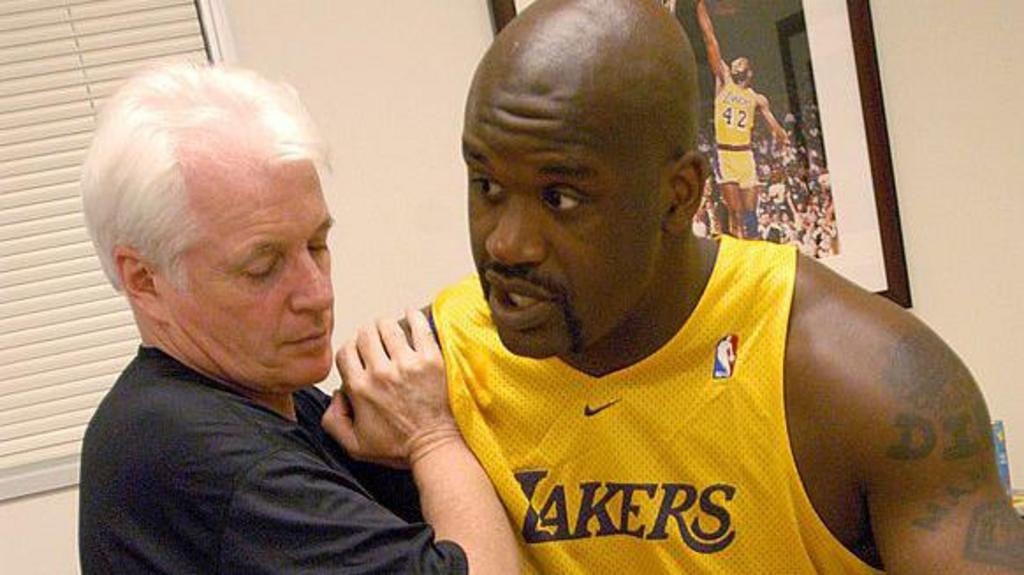
At that juncture, it would have been difficult for the newly qualified physiotherapist to envision a future where he would be instructing basketball icon Shaquille O’Neal – along with his extensive entourage – to wait his turn for treatment.
Or that an observation made while watching a children’s playground would inspire an innovative method to expedite recovery from knee injuries.
His pioneering techniques would establish him as one of the most coveted physiotherapists in sports, and even earn him a place in British sporting history as the first Briton to secure an NBA championship ring, whether as a player or a member of the support staff.
He now boasts six championship rings, and at the age of 74, the individual credited with revitalizing players from potentially career-ending injuries remains highly in demand.
Many prominent figures, including Kobe Bryant (left) and Pau Gasol (right), have sought treatment from Alex McKechnie over the years.
In his youth, McKechnie, a football enthusiast, roamed the tough streets of Easterhouse, a neighborhood in Glasgow notorious for its gang activity. He dreamed of playing for Rangers.
However, a car accident that injured his father and brother introduced him to an alternative career path.
Observing their steady recovery sparked a fascination in the young McKechnie, leading him to pursue physiotherapy studies at a technical college in Leeds before venturing to North America in search of employment.
Within a week, he secured a temporary position at a hospital, and within a month, he was working at a university with athletes from various sports. This ignited his interest in an under-researched area of sports science: anterior cruciate ligament (ACL) injuries.
When he began his practice, there was no surgical procedure that guaranteed a cure.
“Essentially, an ACL tear meant the end of your career,” McKechnie explains.
Through his work with athletes, he began to identify a connection between cruciate injuries, core strength, and pelvic control, leading him to develop a rehabilitation program based on these insights.
He had his patients use elastic resistance bands while performing a series of exercises designed to strengthen their core.
This approach is now commonplace, but at the time, it was groundbreaking.
The resistance bands seen here on the late Kobe Bryant are a signature element of McKechnie’s methods.
His next moment of inspiration came while walking his dog through a park where children were playing on spring-mounted horses.
This sparked the idea for a wobble board, which could enhance core strength through muscle movement, training the body to learn healthy patterns that promote overall stability.
The initial prototype was “built with a large engineering spring,” and Reebok subsequently licensed the idea in 1999, transforming it into a mass-market product sold globally.
Word was already spreading about the physiotherapist who was pioneering new approaches and saving careers.
In 1997, when LA Lakers star O’Neal, then the NBA’s most dominant center, suffered a strained abdominal muscle and faced surgery that would sideline him for up to 10 months, whispers suggested a guru 1,200 miles up the Pacific coast.
McKechnie had successfully treated Anaheim Ducks ice hockey player Paul Kariya for a similar issue without surgery, and the Lakers were intrigued.
The request for assistance from the Lakers’ legendary general manager, Jerry West, altered the Scotsman’s trajectory instantly.
Alex McKechnie drew inspiration from playground equipment like this for his wobble board.
O’Neal, their prized asset, was sent to McKechnie’s clinic in Vancouver for an expert assessment.
Patience, it turned out, was not O’Neal’s strong suit.
“I get a call from the limo driver, from his security team, saying, ‘We’re on our way,'” McKechnie recalls. “I tell them, ‘I can’t see you until 1:30.’ They say, ‘We’d like to come now.'”
“I said, ‘You’ll have to wait. I have patients here I’m working with. I can’t just abandon them.'”
They hung up. 1:30 came and went. O’Neal’s party had changed course and flown back to Los Angeles.
The next day, LA Lakers orthopedic surgeon Steve Lombardo called McKechnie to apologize and asked if he would see O’Neal the following week, and whether he would be willing to come into downtown Vancouver for the consultation.
The response was direct: “No, Shaq can see me at my clinic. End of story.”
It turned out they deemed it worth the effort.
“Shaquille arrives with bodyguards, friends, coaches, trainers – I was swamped with people,” McKechnie says.
“The big guy came in, and we sat down. I’m thinking this could go any way at this point.”
The prescribed Core-X treatment program – focused on aligning muscles in different parts of the body – was unconventional at the time.
But it produced remarkable results. O’Neal was soon back in action for the Lakers without needing surgery.
“He brought me back,” the grateful O’Neal said. “I was dead, and he brought me back.”
Just four days after the initial consultation, McKechnie was flown to Los Angeles and presented with an offer to retain his exclusive services throughout the demanding NBA season.
Accepting the job meant a shift in pace – but also all-access privileges within one of the most renowned and glamorous clubs in global sports.
David Beckham was among the celebrities frequently seen in the crowd at Lakers games.
Sitting nightly in the courtside seats occupied by the Lakers coaching and training staff during that era was akin to having a front-row seat at a blockbuster title fight.
O’Neal and Kobe Bryant, a volatile but extraordinary duo. A head coach in Phil Jackson who had transformed Michael Jordan into a winning machine for the Chicago Bulls and was now replicating that feat in the Hollywood spotlight.
“The Jack Nicholsons of the world, all these other famous people, were sitting three, four feet away from where I was sitting,” McKechnie says. “That’s what I’ll say about the Lakers – the Lakers entertain. It’s an entertainment industry.”
“Every agent is represented around the courtside. It’s unbelievable. People from rock stars to David Beckham – when he was playing [soccer] there in LA – were there during that period. Just amazing, really.”
The Lakers’ dominance during that era ensured their top billing. Keeping O’Neal in top condition was essential, despite his significant weight fluctuations and a well-known aversion to offseason fitness.
McKechnie, Jackson enthused, is “a guy that can keep players on the floor.”
This ability convinced O’Neal to rent a house in Vancouver and maintain his relationship with the physiotherapist during the summer break.
“He [O’Neal] played bocce in my backyard with my daughters or would be out chasing the neighbors’ dog,” McKechnie chuckles.
The staff at the clinic felt his presence, too. “He’d joke around at the reception desk and check patients in,” he says. “Just Shaq being Shaq.”
McKechnie also worked with Bryant, supporting the late superstar’s demanding regimen, which included six hours each day of precise weightlifting, cardio, and skills sessions.
Former England footballer Owen Hargreaves, sidelined for two years with a series of knee injuries, sought out McKechnie and worked with him to make an improbable return to the field.
McKechnie – who once said he treats “broken-down athletes who are almost like reclamation projects” – discovered that Hargreaves’ knee problems stemmed from pelvic instability and focused his efforts on strengthening his core. This approach is now an industry standard with widespread acceptance.
Alex McKechnie won NBA championship rings in 2000, 2001, 2002, 2009, 2010, and 2019.
In 2011, McKechnie was unexpectedly lured back to Canada, assuming the title of assistant coach to Nick Nurse, formerly of the London Towers and the Manchester Giants, but then head coach of the Toronto Raptors.
He was present when the Raptors secured their first and only NBA championship ring in 2019, largely due to the sustained health of their often-fragile centerpiece, Kawhi Leonard. This was another quiet accomplishment for McKechnie, his sixth title – and one senses it was the triumph he enjoyed most.
“It was incredible,” McKechnie, now vice-president of player health and performance for the team, recalls. “The [victory] parade was unlike anything you’ve ever seen. It was unbelievable. There were a million people out there to see us celebrate.”
McKechnie has now completed 26 regular seasons in the NBA. Another playoff campaign awaits this month. His personal acclaim is widespread.
Invitations regularly arrive from Premier League football clubs to visit. It’s an opportunity to share knowledge and gather new ideas, he says, because he is “always seeking a competitive edge.”
That is why, in his eighth decade, McKechnie remains a master of the demanding world he inhabits.
The man who left Scotland with just enough money to make a bold bet on himself still appreciates the rewards of working in this high-pressure environment, where his healing hands can provide a crucial assist.
“The NBA is like a rock concert tour,” he says. “You roll in, unload at the hotel. We set up treatment rooms, we set up everything in the hotel, we treat, pack it up, go to the arena, play, and then it’s on the flight to the next city.”
“It’s an unbelievable lifestyle.”