

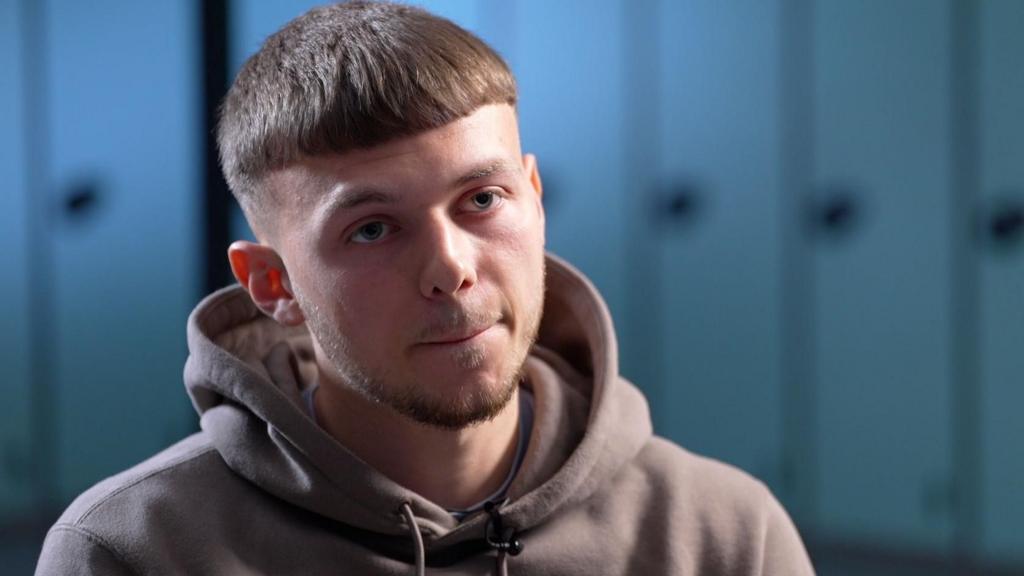
This video can not be played
‘I’m grateful to be alive’ – Gjoshe
“I was on the train, just chilling. Suddenly, someone’s come over my shoulder, and stabbed me.”
Footballer Jonathan Gjoshe reflects on the harrowing events of November 1st of last year.
Just weeks into his first season at Scunthorpe United, the 23-year-old was traveling from Doncaster back to London when the unimaginable occurred.
Gjoshe was among the 11 passengers seriously injured in a knife attack on a train traveling through Cambridgeshire.
Despite widespread reports of Gjoshe’s involvement in an incident that garnered international attention, the defender declined interview requests, choosing to focus on his recovery.
Now, six months later, he is ready to speak publicly about his ordeal for the first time and his search for a new club.
“I got stabbed on the shoulder first,” he told BBC Sport.
“I remember jumping over the table, jumping over the chairs. I was just running down the corridor, telling people, ‘there’s a guy with a knife, run, I’ve been stabbed, run, run, run’. I was screaming. I think I was the first person that got stabbed. I felt the pain. But adrenaline kicked in.”
“That split second, me jumping over the table, saved me. All I thought about was just running for my life, getting off that train. As I got down to the first or second carriage, I pulled the alarm, and was just drenched with blood.”
“I was thinking I wasn’t going to see my family again if I died, and that was the main worry for me,” he says. “Normally I would drive back down to London. That was the first time I got on a train to go back. What’s the chance of that happening? It’s crazy.”
The train made an emergency stop at Huntingdon, where it was met by armed police. After receiving first aid from a fellow passenger, Gjoshe made his way to the station car park, where paramedics transported him to the hospital.
Following surgery, he learned he had sustained seven wounds to his bicep, shoulder, and arm.
Medics informed him that the knife “had gone through my muscles,” narrowly missing a nerve in his arm.
When asked if he feared his footballing career was over, he responded, “I was very worried. Just thinking, ‘what damage has happened to me?’ I didn’t have a clue until I had the surgery. They said, ‘It’s not much from the nerve. You’re very lucky.'”
In the days that followed, Gjoshe recalls, “They had to move me from ward to ward because of the media that were coming there looking for me.”
After being discharged from the hospital, Gjoshe underwent months of rehabilitation, returning to full training in March, which he described as “a big relief. I started to get the movement of my arm, day by day it was getting better. It was an amazing feeling.”
Despite his resilience, Gjoshe has not traveled by train since the mass stabbing.
“I wouldn’t want to now. You just never know. It’s best to be safe. I just can’t trust anything now,” he stated.
Gjoshe joined Scunthorpe last September
After years in lower-league football in London, Gjoshe’s opportunity arrived last September when, after being named Corinthian Casuals’ Young Player of the Year, he joined Scunthorpe on non-contract terms, impressing manager Andy Butler in pre-season.
After ascending four tiers, he debuted against Leeds United’s under-21s in the National League Cup that month, followed by a match against Middlesbrough.
With dual-registration, he was loaned to Bottesford Town for added match experience, playing for them hours before boarding the LNER train to London.
“The Scunthorpe fans started a ‘GoFund Me’, [raising £4,500]. It helped me a lot. The support they showed for me, the club as well, it meant a lot,” he says.
Shortly before this interview, Gjoshe learned he would not be retained by Scunthorpe. On May 8, the club posted an image on Instagram, thanking him and wishing “the best of luck for the future.”
“Obviously [with] everything I’ve been through, I missed half a season… I didn’t get that chance that I wanted,” he says. “I was hoping they’d give me another year to prove that. But unfortunately, I didn’t get that. It’s quite disappointing.”
Describing himself as “fully healed and ready for whatever challenge comes through,” Gjoshe is now focused on “staying fit… hoping a club will come in and give me that chance.”
This video can not be played
Jonathan Gjoshe’s coach Nigel James on the ‘tragic’ incident
Gjoshe spoke to BBC Sport at a five-a-side football center in southwest London, where he honed his skills as a teenager under former coach Nigel James, who runs sessions at the site.
James, the father of England internationals Reece and Lauren, both close friends of Gjoshe, possesses a keen eye for talent. He believes Gjoshe can resume his career, despite the setback of being released.
“Unfortunately, that’s football, and that’s how life is sometimes,” James states.
“He’s like a part of the family. I’m proud of him, how he’s progressed through this. I’m sure there’s going to be a few more opportunities because I believe in him. He’s a very good player and a good person. It all depends on someone giving him an opportunity, and Jonno taking it.”
Last month, Anthony Williams, 32, was charged with 10 counts of attempted murder during the November 1st incident and is scheduled to stand trial in October.
Gjoshe remains determined to stay optimistic, focusing on the future rather than the unfortunate circumstances that disrupted his career.
“Listen, it’s happened, it’s life, thank God I’m alive,” he says, when asked about remaining positive.
“[You] can’t look back at it, just got to move on. That was the only thing on my mind, getting back to football, and hoping I was going to get that chance. You’ve only got one life. Anything can happen… So you’ve got to make the most out of it. And, it’s made me push every day.”
Follow your club with BBC Sport
Listen to the latest Football Daily podcast
Get football news sent straight to your phone