

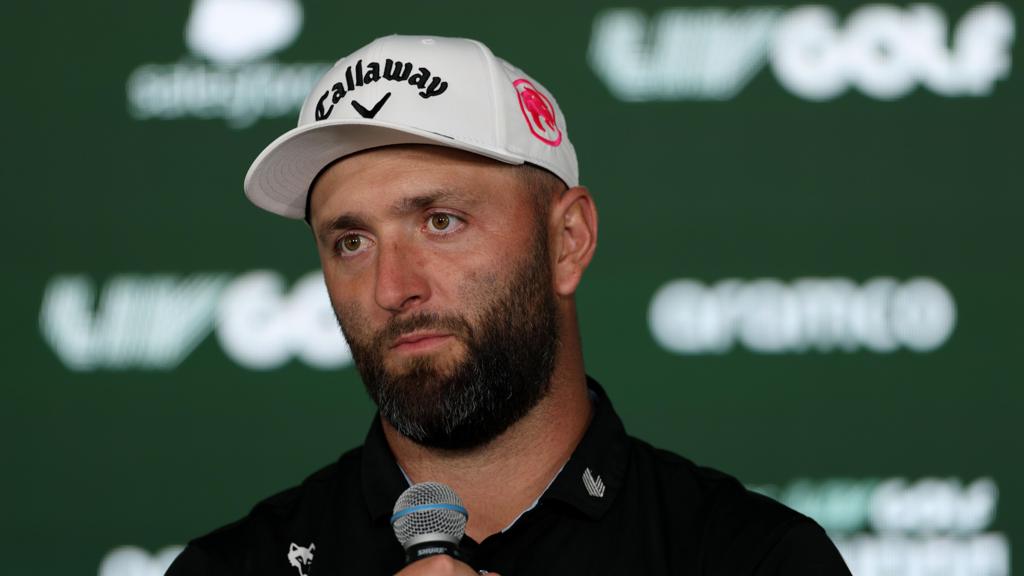
Masters and US Open champion Jon Rahm joined the LIV tour in 2023.
Saudi Arabia is reportedly set to withdraw its multi-billion dollar financial backing from LIV Golf at the end of the current season, casting significant doubt on the league’s future.
On Thursday, the breakaway tour announced a “strategic evolution,” including the formation of an independent board led by Gene Davis and Jon Zinman, individuals the league says possess “proven track records of navigating complex situations,” as it seeks alternative financial investors.
Sources indicate to BBC Sport that Yasir Al-Rumayyan, the governor of the Saudi Public Investment Fund (PIF), has resigned from the board.
Al-Rumayyan was a co-founder of LIV in 2021 and has served as the tour’s most influential figure.
PIF issued a statement on Thursday asserting that the “substantial investment” demanded by the event over the long term “is no longer consistent with the current phase of PIF’s investment strategy.”
“LIV Golf has substantially grown the game globally through its transformational and positive impact. It has forever changed the game of golf for the better,” the statement read.
“PIF remains committed to deploying capital internationally in line with its investment strategy, including its substantial current and future investments in various sports.”
This video can not be played
Funding to be pulled from LIV Golf
Earlier this week, LIV postponed its June event in New Orleans, resulting in a hiatus of US-based tournaments from May 10 until August 6, when the tour visits Trump Bedminster in New Jersey.
However, LIV tournaments are scheduled to proceed in South Korea, Spain, and Britain during this period.
BBC Sport has learned that LIV remains optimistic about maintaining its presence as an international tour with a team-based model and is engaged in “constructive” discussions with potential investors. The series is reportedly “totally up for sale.”
Davis commented, “LIV Golf has built something truly differentiated – a global league with passionate fans, world-class talent, and demonstrated commercial momentum.”
“The executive leadership team, along with Jon and I, see a clear opportunity to help the league formalize its structure, attract and secure long-term capital, and position the business for growth while continuing to promote the game across the world. We look forward to positioning LIV Golf for future success.”
LIV characterized Davis as a “leading corporate governance and strategic advisory professional,” while Zinman is said to possess “expertise in driving financial and operational transformation for companies navigating complex reorganizations.”
The league’s statement omitted any mention of PIF or Al-Rumayyan.
Sources suggest that executives are actively exploring various avenues to “reposition” the business. They stated that LIV Golf is projected to generate $100 million (£86 million) more in revenue in 2026 than in the previous season and are informing potential investors that ten of the LIV teams will achieve profitability this year.
However, officials concede that a significant scaling back of the series is almost inevitable, with a reduction in the current number of 14 events.
Team captains and staff have been informed of LIV’s plan to seek new funding.
Earlier this month, LIV Golf CEO Scott O’Neil assured players that the 2026 season would proceed “as planned and uninterrupted” amid speculation about the tour’s potential collapse, though he did not address future prospects.
This announcement coincided with PIF’s unveiling of a new strategy, emphasizing more sustainable investments.
Major champions Jon Rahm, Bryson DeChambeau, Phil Mickelson, and Cameron Smith are among the prominent players competing on the LIV tour.
The project, which has transitioned to a more conventional 72-hole format this year, has been financially supported by a substantial investment from PIF.
The total investment has exceeded $5 billion (£3.8 billion), including a recent injection of $267 million (£229 million) this year.
The tour’s net losses in markets outside the US increased to $462 million (£340 million) in 2024, resulting in cumulative losses exceeding $1.1 billion (£810 million) since its inception in 2021.
However, with substantial capital infusions into the US division, overall losses are projected to reach several billion dollars.
In February, Rahm, Smith, and DeChambeau declined an opportunity to apply for reinstatement to the PGA Tour under its ‘Returning Member Programme,’ which was extended to players who had won a major championship or The Players Championship since 2022.
Five-time major winner Koepka was the only player to accept the offer, facilitating his return by paying fines reportedly worth approximately £63 million.
Amid reports that some LIV golfers have approached the PGA Tour and DP World Tour to explore potential returns, it remains uncertain whether the potential demise of LIV would lead to a reopening of such avenues and what terms might be imposed.
Speaking after the most recent event in Mexico City, DeChambeau stated, “As of right now, my job is to help make the league work after this year. I just feel like I have a responsibility. I’ve put a lot of effort into it. So that’s what I’m going to do, we’re going to make this work.”
“As long as LIV is here, I would figure out a way for it to make sense.”
LIV Golf Virginia at Trump National Golf Club, situated just outside of Washington DC, is scheduled to commence on May 7.
Saudi Arabia hosts and invests in a range of sports, encompassing football, boxing, Formula 1, and tennis, and is slated to host the 2034 World Cup. Earlier this month, PIF announced the sale of a 70% stake in Saudi Pro League club Al-Hilal.
The Saudi Arabia Snooker Masters, one of the sport’s most lucrative events, was canceled after only two years of a 10-year agreement.
Is this the beginning of the end for LIV Golf?
What does PIF’s change in approach mean for Newcastle?
From real sport to esports – why Saudi Arabia spent $55bn on EA