

“`html
This video can not be played
Why VAR intervention to disallow Eze penalty raises questions
Following a goal-filled Champions League encounter between Paris St-Germain and Bayern Munich, the officiating took center stage in the subsequent semi-final.
Arsenal’s 1-1 draw in the first leg against Atletico Madrid offers a reasonable result to take back to the Emirates Stadium, but the scoreline only hints at the evening’s drama.
The match hinged on three penalty incidents: one converted by Arsenal, one by Atletico Madrid, and a third, controversially overturned after initially being awarded to Arsenal.
Viktor Gyokeres opened the scoring for the Premier League side, converting a penalty after being fouled in the box.
Julian Alvarez then equalized from the spot following a contentious handball decision against Ben White, a point to which we shall return.
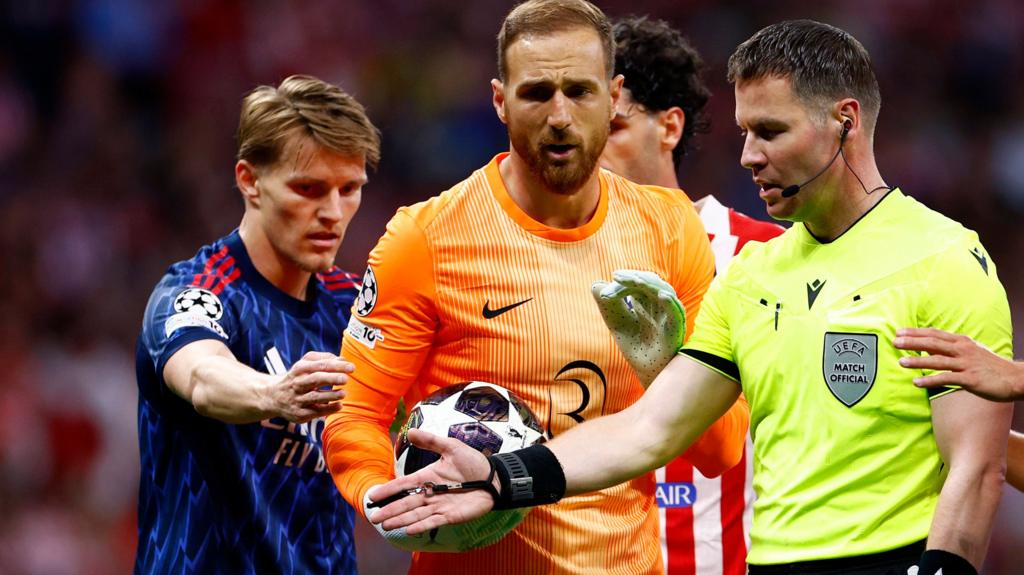
However, the most debated moment came when referee Danny Makkelie initially awarded a penalty for a foul by David Hancko on Eberechi Eze. VAR intervened, prompting Makkelie to review the footage, ultimately leading to the penalty being rescinded. Mikel Arteta expressed his strong displeasure.
“There is no clear and obvious error,” Arteta stated. “This decision alters the course of the match. At this level, this is unacceptable.”
When questioned about the reasoning behind the decision, he replied: “No explanation was provided. A referee reviews the incident 13 times; what could be clearer? This is untenable, and we are all frustrated.”
Arsenal will lament the overturned penalty decision. A similar incident recently resulted in a different outcome.
In the first leg of their last-16 tie against Bayer Leverkusen, Arsenal received a late penalty when Noni Madueke went down in the area following a challenge from Malik Tillman.
The contact on Madueke was minimal, with Tillman’s foot making contact as the forward fell.
BBC Sport consulted a senior figure within Uefa’s refereeing department regarding this specific incident. The explanation provided was that, while a penalty might not have been preferred on the field, the contact left VAR with limited recourse.
Fast forward to Wednesday’s game, and Atletico’s David Hancko clearly made contact with Eberechi Eze’s boot after he had played the ball.
Was it soft? Certainly. A clear and obvious error? Based on Uefa’s precedent with the Madueke incident, the initial on-field decision should have stood.
The Premier League operates under a similar principle. While the decision may appear lenient, there is no justification for overturning the referee’s original call.
If the Madueke decision was upheld as a penalty, the same standard should have been applied to Eze.
In fact, the Eze decision likely would not have been overturned in a Premier League fixture.
The past two nights have been marked by handball controversies, involving both Bayern Munich and Arsenal.
In both instances, the ball deflected off another part of the body before striking the arm, leading to a common perception that a penalty cannot be awarded.
However, referees prioritize identifying a clear change in the ball’s trajectory. This is because such a change suggests the arm’s position altered the ball’s natural path.
If the ball maintains its original course, the contact with the arm takes precedence.
The penalty against Alphonso Davies on Tuesday would not have been given in the Premier League due to the arm’s proximity to the body.
For Uefa, the fact that the arm moved away from the body prior to contact would override the minor deflection.
Ben White’s handball against Atletico was a clear penalty under Uefa’s guidelines. The arm was extended far from the body and made contact with the ball.
While some leniency is granted if the arm is drawn in to minimize body size, White’s arm was initially extended, warranting a penalty.
The Premier League adopts a more lenient approach than European competitions regarding deflections before handballs. That said, Arsenal’s Gabriel should have conceded a penalty at Newcastle earlier this season, as his raised arm during a slide offered negligible deflection.
Would White’s deflection off his shin have prevented VAR intervention in the Premier League? Possibly, but the arm’s movement was unambiguous.
A definite penalty in Europe, borderline in the Premier League.
Regarding the handball decision, former Liverpool captain Steven Gerrard suggested referee Makkelie was “influenced” by the earlier penalty awarded to PSG against Bayern Munich.
Speaking to TNT Sports, he stated, “I believe the referees were influenced by the decision made [in Paris].”
“They saw Alphonso Davies’ handball resulting in a penalty and felt compelled to follow suit with Ben White, even if he attempted to move his arm out of the way.”
Match of the Day pundit and former Liverpool left-back Stephen Warnock believes Atletico’s handball penalty would not have been awarded in English domestic competition.
“I simply don’t see it given in the Premier League,” Warnock commented.
“His arm is already in that position, and while some may argue it’s unnatural, he’s attempting to block a shot, and the ball deflects off his leg and onto his arm.”
“It’s a perplexing decision, but not entirely unexpected in the Champions League.”
Regarding the overturned penalty, Match of the Day pundit Nedum Onuoha stated he “can understand” why VAR prompted the referee to review the decision.
“One could argue that all three penalties, if awarded, were somewhat soft,” he added.
“While some believe the referee was always going to overturn the decision upon viewing the replay, we have seen instances where referees have not. In this case, he deemed it the correct course of action.”
This video can not be played
Arsenal’s penalty overturned, Atletico equalize as first leg ends in stalemate
Follow your club with BBC Sport
Listen to the latest Football Daily podcast
Get football news sent straight to your phone
“`