

This video can not be played
Lifting weights while pregnant – why Ward is ‘changing the narrative’
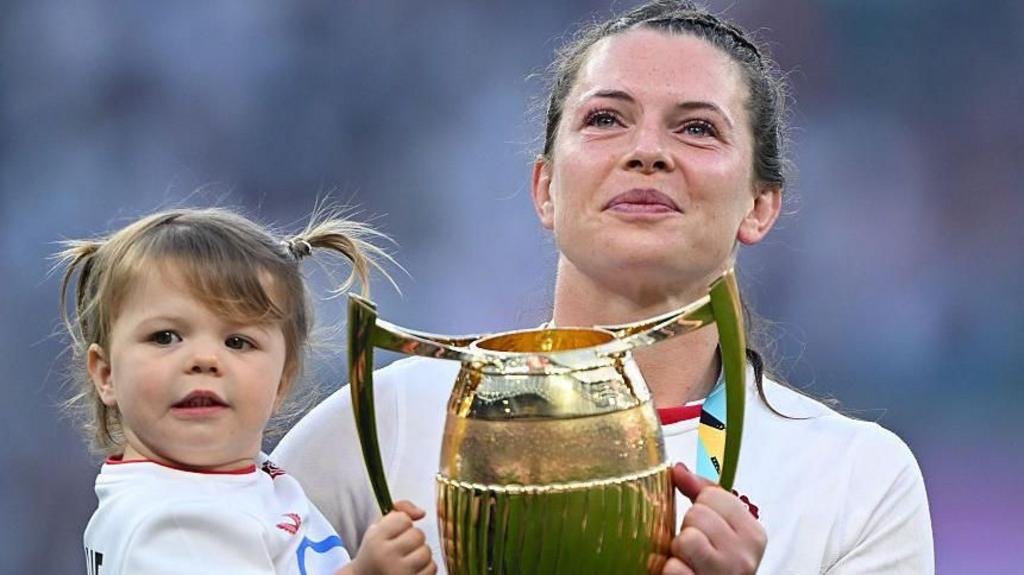
The image of Abbie Ward parading around a sold-out Allianz Stadium, Women’s Rugby World Cup trophy in hand, daughter Hallie in the other, resonated deeply with team-mate Lark Atkin-Davies.
Lock Abbie Ward is currently expecting her second child. Her return to international rugby in 2024 marked her as the first contracted England woman to have a baby since the Red Roses turned professional in 2019.
Motherhood became a reality without having to wait until after her career. The 33-year-old returned just 17 weeks after giving birth and, less than two years later, started and scored in the 2025 World Cup final.
Inspired by Ward’s return to rugby, Hooker Atkin-Davies, who was a replacement in that final, announced her own pregnancy in December 2025 and, like Ward, is due to give birth this summer.
England captain Zoe Stratford and fellow World Cup winner Rosie Galligan also announced pregnancies earlier this year.
“Seeing Abbie go through her pregnancy with Hallie was the turning point,” Atkin-Davies told BBC Sport.
“I always had this desire to be a mum, but I did not know what it would look like. I love playing rugby – it is a huge part of who I am.”
“I thought I would love to have a baby and return, but I didn’t know how that would work. Not many people have done it.”
“One of the key moments was seeing Abbie on the pitch after the World Cup final, with the trophy in her hands. I saw it was possible, and I want to give it a shot.”
The players will receive support from the Rugby Football Union’s maternity policy, updated in February 2023.
The policy provides players with 26 weeks of fully paid leave, as well as coverage for travel and accommodation costs for children of players selected within 12 months of giving birth or adopting a child.
A “support person” is also permitted to join them at games or training camps, with similar provisions in place for players who prefer their infant to remain at home.
Scotland v England
Women’s Six Nations
Saturday, 18 April, kick-off 13:30 BST
Murrayfield Stadium
Watch live on BBC Two, iPlayer and online; updates on BBC Radio 5 Live and BBC Sounds; live text and video highlights on BBC Sport website and app
Atkin-Davies, pictured with her niece and nephew, and Ward both started England’s Grand Slam decider against France in last year’s Six Nations
England players can remain in camp on specialised training programmes throughout their pregnancy, with Ward and Atkin-Davies continuing to train alongside their team-mates in the gym.
After making her return in the 2024 Women’s Six Nations, Ward said she felt “judged” for playing international rugby less than a year after giving birth.
“I experienced so much outside noise about whether you should be training,” Ward told BBC Sport.
“The first thing you are told when you go to the doctors or look online is that you should not lift heavy things. Well, I lift heavy things every day – it is part of my job, and I will continue to do that.”
“Why I want to speak about it and share it is because that narrative is changing in terms of what women can do and are capable of. It is a huge amount.”
The NHS recommends continuing “your normal daily physical activity for as long as you feel comfortable” during pregnancy.
“The guidance is around doing what is normal for you,” Ward continued. “Our normal is very different from the everyday person.”
“That has brought huge positivity on social media and in person, with the number of mums who come up to me and say thank you for changing that narrative. Something they felt they could not go back and do, they have.”
“The guidance is changing from what it has been historically. Women are capable of an awful lot.”
World Cup winner Kildunne reveals body dysmorphia struggle
Women’s Six Nations guide: Fixtures, results and BBC coverage
Previously, the RFU did not have a maternity policy specifically designed for players, with former England prop Vickii Cornborough – the second Red Rose to announce a pregnancy after the update – describing the old policy as “not fit for purpose”.
Cornborough, a Rugby Players’ Association (RPA) representative, helped create the policy through input from the RPA and players themselves.
Following the birth of twins, 74-cap Cornborough announced her retirement from international rugby at the age of 34, citing a lack of mental readiness to return.
With their babies due this summer, Atkin-Davies and Ward are both aiming to be back playing by the start of next season.
Ward, who played in two World Cup finals with Cornborough, cautioned her pregnant team-mates that returning will not be straightforward.
“It is amazing to know women have a choice and an option – great if I have played any part in that,” she added.
“There is also pressure, as I hope I have not catfished them into thinking it is easy. Everyone will find out it is not easy.”
Hooker Atkin-Davies has earned 74 caps and has been a regular since her England debut in 2015.
Having played in the past two World Cup finals, the 31-year-old wants to compete at the next World Cup in Australia and have a similar moment to Ward’s 2025 Allianz Stadium celebrations.
“Becoming a mum and having a baby will make me a better person and player,” Atkin-Davies added.
“I know it is going to be really hard, and I am aware of that. I do not just want to come back – I want to come back and be better.”
“That is what really drives you as well. It might take time, as your body and mind go through so many changes, but the fire and desire are in me to be at that World Cup in 2029 with a three-year-old.”
“Those big moments of running out with my baby at Ashton Gate or Allianz Stadium would be absolutely amazing, but it will be hard.”
This video can not be played
England begin Six Nations title defence with victory over Ireland