

In a post containing strong language on social media, U.S. President Donald Trump threatened to target Iran’s power plants and bridges if it failed to meet his Tuesday deadline to reopen the Strait of Hormuz to all shipping.
He reiterated a prior warning to unleash “hell” but indicated to U.S. media outlets that there was a “good chance” of reaching a deal with Tehran.
Iran dismissed his ultimatum, deriding it as “helpless, nervous and stupid”.
Trump’s renewed threat emerged after he announced the successful rescue of the second crew member of a U.S. fighter jet downed over Iran in an operation conducted deep within hostile territory.
Both the U.S. and Iran had been engaged in efforts to locate the U.S. serviceman in a mountainous region of southwestern Iran. The pilot of the F-15 had been recovered shortly after the aircraft was downed on Friday.
The incident occurred after more than a month of ongoing conflict, with Iran responding to U.S. and Israeli airstrikes with attacks on Gulf nations allied to the two countries.
Iran has also significantly disrupted transit in the Strait of Hormuz, a critical shipping lane responsible for the passage of approximately one-fifth of the world’s oil and gas, leading to skyrocketing global oil prices and concerns about rising inflation worldwide.
This disruption prompted Trump to announce a series of deadlines in March for Iran to reopen the strait. On Sunday, he reaffirmed this demand on his Truth Social platform.
The paragraph below contains very strong language.
He stated: “Tuesday will be Power Plant Day, and Bridge Day, all wrapped up in one, in Iran. There will be nothing like it!!! Open the Fuckin’ Strait, you crazy bastards, or you’ll be living in Hell – JUST WATCH! Praise be to Allah. President DONALD J. TRUMP”
Subsequently, he told Fox News that there was a “good chance” a deal would be reached on Monday, but he was considering “blowing everything up and taking over the oil” if an agreement to end the war was not promptly achieved.
Later, the U.S. president posted again – “Tuesday, 8:00 P.M. Eastern Time!” – seemingly extending the deadline originally set to expire on Monday, April 6.
Trump has previously postponed deadlines for the reopening of the Strait of Hormuz on several occasions.
On March 21, Trump initially threatened to “obliterate” Iran’s power plants if the Strait of Hormuz was not “FULLY OPEN” within 48 hours.
Two days later, he stated that he would not launch strikes for another five days – until March 28 – while “good” and “productive” talks with Iran continued. Iran denied that any contact between its officials and the Trump administration had taken place.
As that date approached, Trump once again delayed the deadline by an additional 10 days, until April 6. This is the date from which the new 48-hour deadline has been extended.
Mahdi Tabatabaei, a spokesman for Iran’s president’s office, stated that the Strait of Hormuz “will be reopened” when “a portion of transit tolls is used to compensate for all the damage caused” by the war. Iran has indicated plans to impose tolls on ships passing through the strait.
Gen Ali Abdollahi Aliabadi of Iran’s central military command characterized Trump’s threat as a “helpless, nervous, unbalanced and stupid action,” adding that “the gates of hell will open” for the U.S. leader.
Meanwhile, Israel has targeted civilian Iranian infrastructure sites – with a petrochemical facility being the latest on Saturday – and is awaiting U.S. approval to strike additional energy facilities next week, according to defense officials.
U.S.-Israeli strikes also impacted the Qasem Soleimani International Airport in southwestern Iran on Sunday.
Iran has continued to launch drones and missiles at Israel and U.S. Gulf allies.
A residential building in the Israeli city of Haifa was directly hit by a ballistic missile on Sunday, resulting in injuries to four people.
Earlier in the day, authorities in Abu Dhabi reported battling fires at a Borouge petrochemical facility caused by falling debris from an Iranian missile.
Kuwait stated that strikes by Iranian drones had severely damaged oil and petrochemical facilities. Industrial and fuel plants were also targeted in Bahrain.
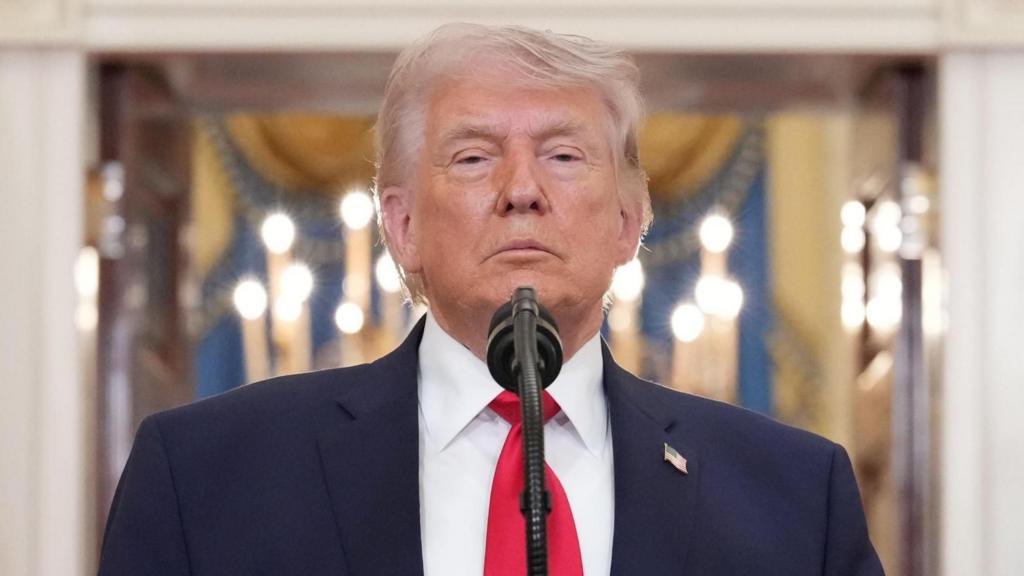
The U.S. president threatened the destruction of Iran’s bridges and power plants unless it opened the Strait of Hormuz.
Officials reported “a heightened security posture is in place,” with no injuries reported and no suspects identified.
The operation to extract him from hostile territory was highly complex and involved multiple U.S. government agencies.
The U.S. has successfully rescued the missing crew member of the U.S. F-15 fighter jet that was shot down over southern Iran.
The recovery of the airman follows separate search efforts by both the U.S. and Iran.