

In a daring operation, the U.S. military has rescued a crew member whose fighter jet was downed in a remote region of Iran.
While the precise details remain unclear, the extraction from hostile territory was an operation of considerable complexity.
U.S. media outlets report that dozens of special forces personnel, alongside U.S. warplanes and helicopters, were involved, with support from the CIA.
President Donald Trump stated on social media Sunday, “We have rescued the seriously wounded, and really brave, F-15 Crew Member/Officer, from deep inside the mountains of Iran.”
The airman’s ordeal began Friday, amidst reports that an F-15 jet, carrying a weapons systems officer and a pilot, was shot down over southern Iran.
This marks the first instance of a U.S. fighter jet being downed by enemy fire in over two decades.
Both U.S. military personnel aboard the F-15E Strike Eagle ejected from the aircraft. The pilot was rescued the same day, but the second crew member remained missing.
The U.S. subsequently initiated a race against time to locate the missing officer.
Iran declared its intention to capture him alive, offering a bounty of £50,000 ($66,100).
Unverified videos circulating on social media appeared to depict armed civilians searching for the airman.
U.S. officials indicated that once on the ground, the officer possessed only a handgun for defense.
The airman would have undergone training for such a scenario, involving activating his beacon signal, seeking higher ground, concealing himself, and establishing communication.
U.S. media reports suggest the airman concealed himself in a mountain crevice and limited the use of his beacon, fearing its signal could be intercepted by Iranian forces.
He then reportedly awaited the arrival of his rescuers.
A senior Trump administration official told U.S. media that the CIA played a critical role in the rescue operation.
The U.S. intelligence agency reportedly pinpointed the airman’s location in the mountain crevice and relayed the information to the Pentagon.
Trump stated that his location was monitored “24 hours a day” by U.S. officials planning the rescue.
The president added that the officer was “being hunted down by our enemies, who were getting closer and closer by the hour.”
Reports also indicate the CIA conducted a deception campaign, disseminating information within Iran suggesting U.S. forces had already located the second airman.
President Trump stated on Truth Social that the U.S. military “sent dozens of aircraft, armed with the most lethal weapons in the World, to retrieve him.”
Reports suggest that as U.S. special forces advanced toward the stranded officer, bombing and weapons fire were employed to deter Iranian troops from approaching his location.
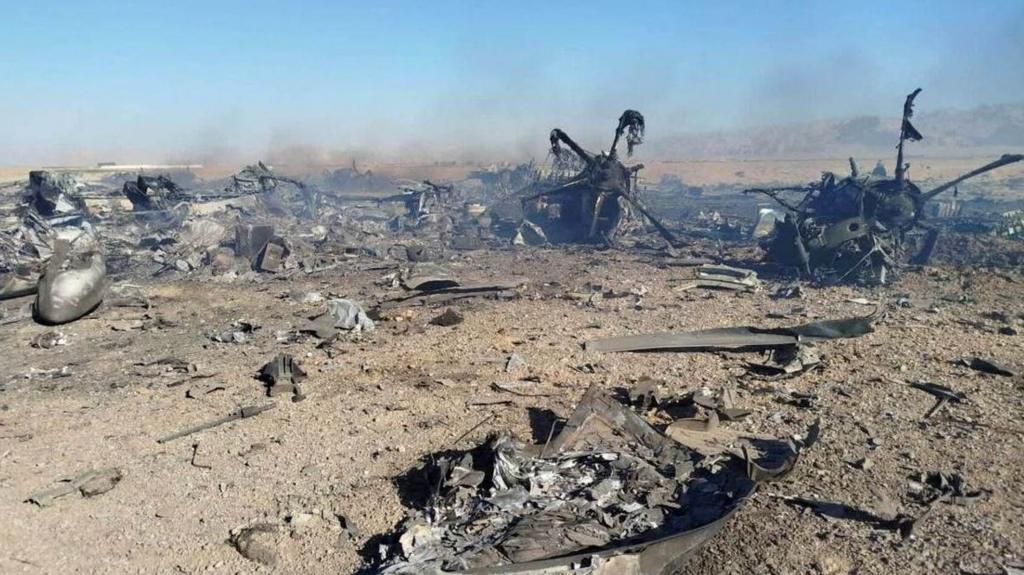
U.S. media also reported that two transport planes intended to fly out rescue crews were unable to take off from a remote base inside Iran and were subsequently destroyed to prevent their capture. Special forces then reportedly flew in on three additional aircraft to retrieve the crews.
Footage and photos verified by BBC Verify appear to show smoldering aircraft wreckage in a mountainous region of central Iran, approximately 50km (30 miles) southeast of Isfahan.
Iran’s military stated that two U.S. C-130 military transport planes and two Black Hawk helicopters were destroyed during the operation and that “a deception and escape mission at an abandoned airport in southern Isfahan…was completely foiled.”
Iranian state media reported Sunday that Islamic Revolutionary Guard Corps (IRGC) troops shot down a U.S. drone over Isfahan while it searched for the missing airman.
The BBC has been unable to independently verify either account of the events near Isfahan.
Officials reported that the rescue was completed before midnight U.S. time, and the airman was flown to Kuwait for medical treatment. Trump described the officer as “seriously wounded” but added, “he will be just fine.”
U.S. authorities have not released information regarding the airman’s exact location at the time of rescue or his identity.
Former U.S. military official William Fallon, a retired U.S. Navy admiral, told the BBC that “time of day” likely benefited the rescue mission, stating, “Darkness is better for our people because they’re used to operating at night.”
Fallon added that when flying over hostile territory, “you have to be prepared to be the person that’s hit.”
U.S. media broke the news that the second pilot had been found just before 00:00 EDT (04:00 GMT) on Sunday.
Trump wrote on social media that the U.S. would “NEVER LEAVE AN AMERICAN WARFIGHTER BEHIND!”
Iran insisted the operation was a failure. Ebrahim Zolfaghari, a spokesman for Iran’s main military command, said in a video address that several U.S. military aircraft had been forced to make emergency landings.
“The ignorant president, trapped in the swamp of the war and aggression that he himself started… fully realised that any aggression, ground operation, or infiltration… would face decisive and disgraceful defeat,” he stated.
This rhetoric of a “failed” mission has been echoed by Iranian officials and state TV, particularly since Donald Trump announced the pilot’s rescue.
Some U.S. analysts have characterized the loss of an F-15E deep within Iranian territory, followed by the destruction of several rescue aircraft, as demonstrating the limitations of U.S. air power.
Gen. Frank McKenzie, a former commander of U.S. Central Command, told the BBC’s U.S. partner CBS that “we did in fact lose a couple of aircraft in that mission,” but he says you accept that loss “any day” in such a situation.
“It takes a year to build an aircraft – it takes 200 years to build a military tradition where you don’t leave anybody behind,” he told CBS’s Face The Nation program.
Additional reporting by Ghoncheh Habibiazad, BBC Persian.
The BBC’s Orla Guerin travels to the edge of the critical waterway that Iran has put a stranglehold on.
The US has rescued the missing crew member of the US F-15 fighter jet which was shot down over southern Iran.
The recovery of the airman follows separate search efforts by both the US and Iran.
One elderly couple had to find £1,000 for an oil delivery and suppliers are not giving quotes, a councillor says.
Iran rejected Donald Trump’s ultimatum for a deal to re-open the Strait of Hormuz whose closure has led to a spike in oil prices.