

Amid escalating tensions, former U.S. President Donald Trump has warned that Iran would face severe consequences if it failed to reach a deal, prompting a reciprocal response from Tehran.
An Iranian military spokesperson cautioned that the entire region could descend into chaos if the U.S. and Israel continued to escalate the conflict.
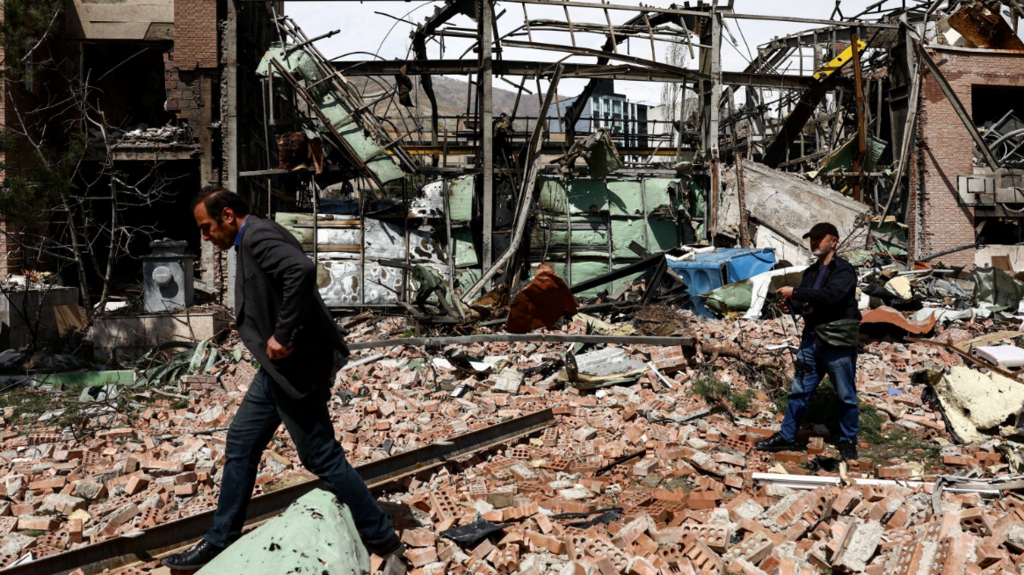
On Saturday, Iran reportedly launched multiple missiles targeting Gulf States, Iraq, and Israel, with debris from intercepted projectiles causing damage.
In a separate development, U.S. and Iranian forces are engaged in a search for a missing American crew member after a U.S. F-15 fighter jet was reportedly downed over southern Iran on Friday. U.S. media outlets have reported the pilot’s rescue.
Iranian officials have urged citizens to locate the missing American “alive” and are offering rewards for his capture.
A U.S. A-10 Warthog aircraft, participating in the search-and-rescue operation for the downed jet, was also reportedly struck and damaged, though its pilot was rescued.
On March 27, Trump announced a 10-day pause in attacks on Iranian energy facilities to allow Tehran time to “make a deal.”
On Saturday, he reiterated his threat on Truth Social, stating that Iran would face dire consequences if it failed to reach an agreement or reopen the Strait of Hormuz within 48 hours.
Ebrahim Zolfaghari, spokesperson for Khatam al-Anbiya Central Headquarters, stated, “If hostility escalates, the entire region will turn into hell for you; the illusion of defeating the Islamic Republic of Iran will become a quagmire into which you will sink.”
The Strait of Hormuz, a crucial waterway for global oil and gas transport, has been effectively closed for over a month due to the ongoing conflict, disrupting approximately one-fifth of the world’s oil and gas supply.
The disruptions to energy exports have led to a surge in global fuel prices.
The price of Brent crude, the global benchmark for oil prices, has increased from $73 (£55) to over $100 in recent weeks.
On Friday, a French-owned carrier became the first vessel owned by a major Western European company to transit the strait since the conflict began.
While Iran has stated that “non-hostile vessels” are permitted to use the waterway, the ongoing conflict, marked by attacks on several ships, has impeded normal transport activity.
On Saturday, the U.S. and Israel continued their bombardment of Iranian military, energy, and industrial sites.
Trump shared a video on his Truth Social platform, claiming it depicted a “massive strike” on the capital, Tehran. However, the video appeared to be from the previous day.
Trump claimed in his post that “many of Iran’s Military Leaders, who have led them poorly and unwisely, are terminated, along with much else” as a result of the strike.
Tehran has not responded to Trump’s claims, and the U.S. has not provided further details regarding the post.
Israel reported hearing explosions over Jerusalem. Meanwhile, Iran has continued to launch missiles at Gulf States and Iraq.
Iran stated that the area surrounding its Bushehr nuclear power plant was attacked for the fourth time during the conflict.
Iran’s Atomic Energy Organisation reported that one of the plant’s employees was killed in the attack. It blamed the U.S. and Israel, but neither country has confirmed involvement.
Bushehr is Iran’s only operational nuclear power plant, completed with assistance from Russia.
The International Atomic Energy Agency (IAEA), the UN’s nuclear watchdog, stated that it had been informed of the strike and expressed “deep concern.”
“No increase in radiation levels was reported,” the IAEA wrote on X.
The IAEA emphasized that nuclear power plant sites and nearby areas “must never be attacked” and called for “maximum military restraint” to prevent a nuclear accident.
The Iranian statement regarding the Bushehr attack indicated that the main components of the plant did not appear to be damaged and that its operation had not been “affected.”
Moscow has evacuated a significant portion of its staff from the plant. Alexei Likhachev, head of Russia’s state nuclear corporation, Rosatom, announced on Saturday that the evacuation of the remaining 198 personnel at the plant had commenced that morning.
Iran’s nuclear program has been a longstanding point of contention, resulting in extensive international sanctions. The U.S.-Israeli conflict with Iran began on February 28, two days after a third round of indirect U.S.-Iran nuclear talks in Geneva.
The niece and grand-niece of Qasem Soleimani are reportedly in the custody of U.S. Immigration and Customs Enforcement, according to officials.
A search and rescue mission also came under fire, allegedly resulting in another jet being downed over the Persian Gulf.
The conflict has spread across the Middle East since the U.S. and Israel launched strikes on Iran on February 28.
The advisory follows recent military developments, including reports of a U.S. jet being shot down and Israeli strikes on parts of Beirut.
Reports from the U.S., citing unnamed officials, indicate a search is underway following the reported downing of a U.S. fighter jet over Iran.