

In a landmark decision, a Los Angeles jury has ruled in favor of a young woman who sued Meta and YouTube, alleging that her childhood social media use led to addiction.
The jury determined that Meta, parent company of Instagram, Facebook, and WhatsApp, and Google, which owns YouTube, intentionally designed their platforms to be addictive, resulting in harm to the 20-year-old plaintiff’s mental health.
Known as Kaley, the plaintiff was awarded $3 million in damages, a verdict that could set a precedent for numerous similar cases currently proceeding through U.S. courts.
Both Meta and Google have stated their disagreement with the verdict and intend to appeal. Meta commented, “Teen mental health is profoundly complex and cannot be linked to a single app.”
“We will continue to defend ourselves vigorously as every case is different, and we remain confident in our record of protecting teens online,” Meta added.
A Google spokesperson stated, “This case misunderstands YouTube, which is a responsibly built streaming platform, not a social media site.”
The jury apportioned responsibility for the plaintiff’s harm, assigning 70% to Meta and 30% to YouTube, meaning Meta will be responsible for the majority of the awarded damages.
The court has yet to determine punitive damages, which, under state law, could reach up to $30 million.
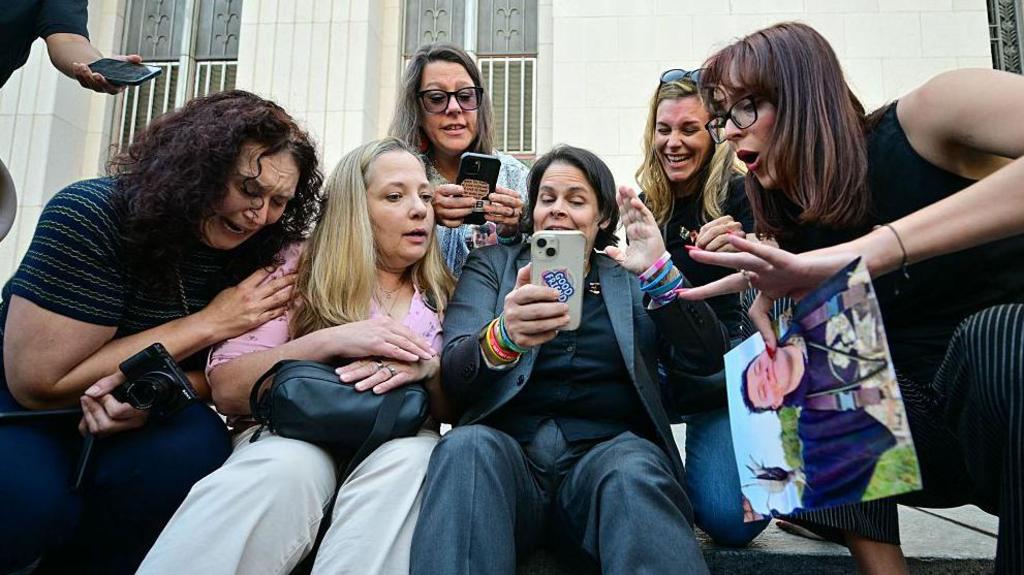
Parents of other children, who are not part of Kaley’s lawsuit but claim to have suffered harm from social media use, gathered outside the courthouse throughout the five-week trial.
Upon hearing the verdict, parents, including Amy Neville, were seen celebrating and embracing fellow parents and supporters.
The LA verdict follows a recent ruling in New Mexico, where a jury found Meta liable for endangering children and exposing them to sexually explicit material and contact with sexual predators.
Mike Proulx, research director for Forrester, characterized the consecutive verdicts as indicative of a “breaking point” between social media companies and the public.
“Negative sentiment toward social media has been building for years, and now it’s finally boiled over,” Proulx stated.
During his testimony before the jury in February, Mark Zuckerberg, Meta’s chairman and CEO, cited the company’s policy of prohibiting users under 13 on its platforms.
When presented with internal research and documents indicating that Meta was aware of young children using its platforms, Zuckerberg stated he “always wished” for quicker progress in identifying users under 13, asserting that the company had reached the “right place over time.”
While Google, as the owner of YouTube, was a defendant in the case, proceedings primarily focused on Instagram and Meta.
Snap and TikTok were also initially defendants, but both companies reached undisclosed settlements with Kaley prior to the trial.
Kaley’s legal team argued that Meta and YouTube had created “addiction machines” and failed to prevent children from accessing their platforms.
Kaley testified that she began using Instagram at age nine and YouTube at age six, encountering no age-related restrictions.
“I stopped engaging with family because I was spending all my time on social media,” Kaley said during her testimony.
Kaley stated that she began experiencing anxiety and depression at age 10, disorders she was later diagnosed with by a therapist.
She also became preoccupied with her physical appearance and began using Instagram filters to alter her appearance almost immediately upon joining the platform as a child.
Kaley has since been diagnosed with body dysmorphia, a condition characterized by excessive worry about one’s physical appearance, preventing individuals from perceiving themselves as others do.
Her legal team argued that features like Instagram’s infinite scroll were intentionally designed to be addictive.
Kaley’s lawyers asserted that Meta’s growth objectives prioritized attracting young users, as they were more likely to remain engaged with the platforms for extended periods.
Referencing testimony from experts and former Meta executives, they contended that the company actively sought young users due to their increased likelihood of long-term platform engagement.
When Kaley’s lawyers informed Adam Mosseri, the head of Instagram, that her longest single day of platform use was 16 hours, he disputed that it constituted evidence of addiction.
Instead, he described a teenager spending the majority of their day on Instagram as “problematic.”
Kaley’s legal representatives stated Wednesday that the jury’s verdict “sends an unmistakable message that no company is above accountability when it comes to our children.”
Another case against Meta and other social media platforms is scheduled to commence in June in California federal court.
Matt Brittin says he’s taking the top job at “a moment of real risk, yet also real opportunity”.
Do the big-name bosses of the six-a-side tournament really get stuck in to helping their teams win?
The owner of Instagram, Facebook and WhatsApp has been found liable by a court in New Mexico.
Natalie McNally was 15 weeks pregnant when she was murdered by McCullagh in her home in December 2022.
Dozens of Instagram and TikTok accounts have used AI avatars to promote explicit content, the BBC finds.