

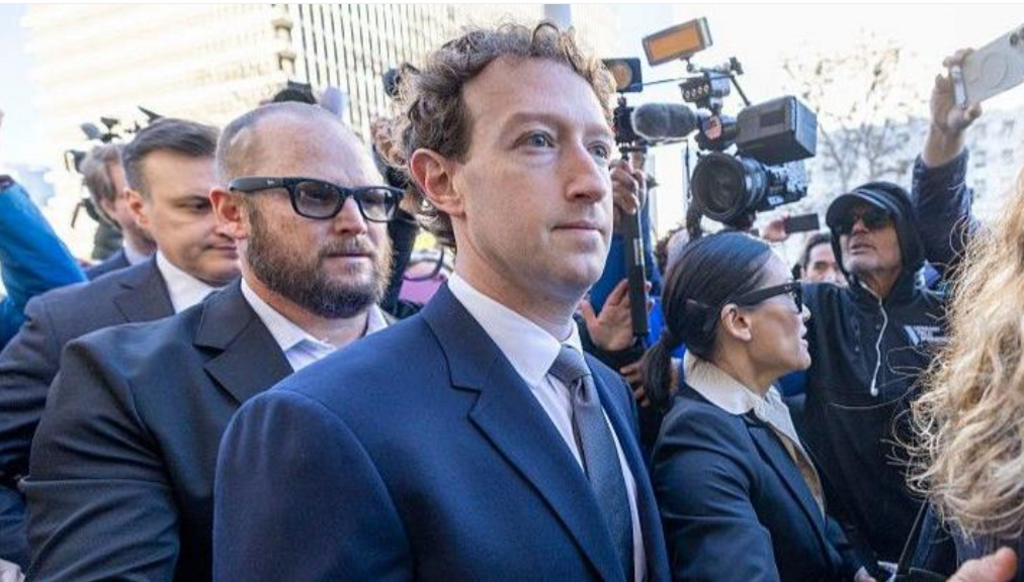
Meta Platforms CEO Mark Zuckerberg faced intense scrutiny in court Wednesday, defending his company against allegations of targeting young users with Instagram. He was confronted with a series of internal documents during the proceedings.
Zuckerberg argued that the lawyers were “mischaracterizing” internal communications presented as part of a landmark trial in Los Angeles examining whether social media platforms are addictive for children.
This marked Zuckerberg’s first appearance before a jury, amid growing criticism of Meta, which also owns WhatsApp and Facebook.
The trial, which also names Google’s YouTube as a defendant, is being closely watched for its potential impact on thousands of similar lawsuits.
TikTok and Snapchat, initially named in the suit, reached settlements shortly before the trial’s commencement. The terms of these settlements remain undisclosed.
Meta has consistently stated its commitment to protecting young users and enforces a ban on individuals under the age of 13.
However, in court, Mark Lanier, the attorney representing the lead plaintiff, identified as K.G.M., presented an internal email raising concerns about the company’s “unenforced” age limits.
The email, from Nick Clegg, Meta’s former head of global affairs and a former UK deputy prime minister, stated that this situation made it “difficult to claim we’re doing all we can.”
Another presentation from 2018 revealed internal discussions about retaining “tweens” on the platform, despite the company’s policy prohibiting users under 13.
Zuckerberg expressed regret for not making faster progress in identifying users under 13, but maintained that the company had ultimately reached the “right place over time.”
He accused Lanier of misrepresenting the “tween” document, explaining that the company had engaged in “various discussions” regarding developing a version of its product for children under 13 “in a regulated way.”
He cited Meta’s Messenger Kids service, which he uses “with my own kids,” as an example. Zuckerberg and his wife, Priscilla Chan, have three children.
“You’re mischaracterizing what I’m saying,” he asserted. “I’m not surprised that people internally were studying this.”
Lanier also questioned Zuckerberg about efforts to encourage teen usage of the platform.
He presented emails from Zuckerberg and other internal communications, in which employees explicitly discussed “teen usage” and strategies for increasing it.
In a 2015 email, Zuckerberg informed a group of executives that his goals for the year included a “12% increase in time spent” and reversing the “teen trend.”
A separate 2017 email from an executive stated that “Mark has decided the top priority for the company is teens.”
Zuckerberg acknowledged that “at an earlier point in the company,” he had set goals for executives to increase time spent, but insisted that this was no longer the company’s operating principle.
K.G.M., also known as Kaley, who began using Instagram and YouTube as a child, was present at the proceedings, seated directly across from Zuckerberg, who arrived with security and associates.
Bereaved parents also attended the proceedings to observe the trial.
The trial is expected to span several weeks and will include testimony from former Meta employees who have publicly criticized the company’s practices.
YouTube CEO Neal Mohan, who was initially expected to testify, will no longer be called, according to the BBC.
During questioning last week, Instagram head Adam Mosseri challenged the concept of social media addiction, arguing that even 16 hours of Instagram use in a single day did not necessarily indicate addiction.
In his testimony, Zuckerberg stated that if something is valuable, “people tend to use it more.”
Lanier pointed out that individuals addicted to something also tend to increase their usage.
“I don’t know what to say to that,” Zuckerberg responded. “I think that may be true, but I don’t know if that applies here.”
This case is among thousands of similar lawsuits filed by families, state prosecutors, and school districts currently progressing through US courts.
The lawsuits accuse Meta and other social media platforms, including TikTok, Snapchat, and YouTube, of operating in an addictive manner that has ultimately harmed numerous children.
In one such case, 29 state attorneys general are urging a California federal court to mandate immediate changes from the platforms, before any trial, including requiring Meta to remove all accounts known to belong to users under 13 years of age.
A growing number of countries are taking steps to restrict social media use by young people. Australia implemented a ban on social media accounts for individuals under 16 late last year.
The UK, Denmark, France, and Spain are considering similar measures.
Promiseworks is looking for more volunteers to support and guide young people.
The project for young people offers weekly outdoor activities like stargazing and campfires.
The leader says more communities should come together to give young people something do.
The centre hosts varied activities including music production and a climbing wall at low cost.
A report finds that many young Londoners “feel they are not believed by the police”.