

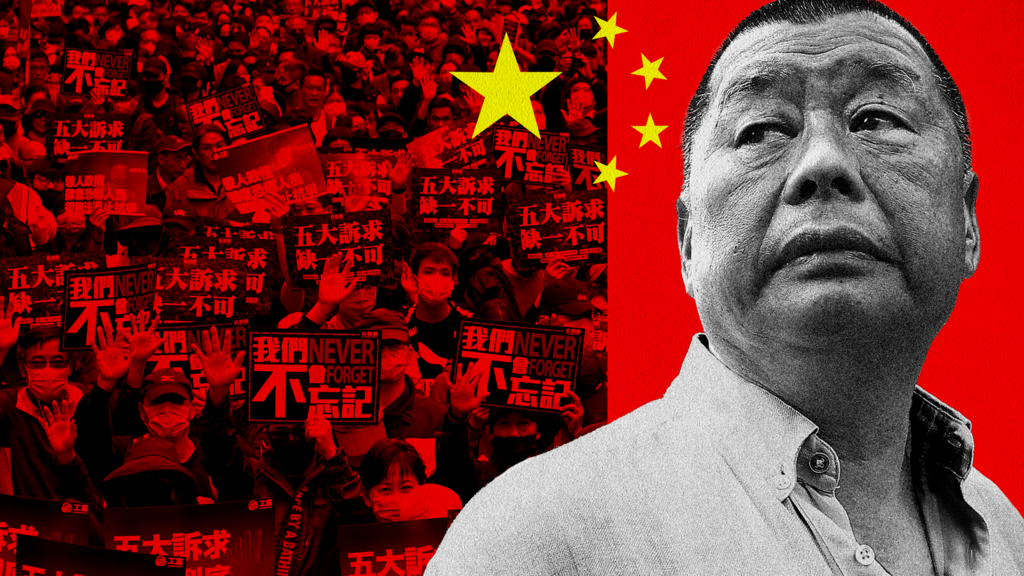
On a winter morning in 2022, Raphael Wong and Figo Chan visited Jimmy Lai at Hong Kong’s Stanley Prison. The media mogul had been incarcerated for two years, awaiting trial on national security charges.
All three had been prominent figures in the 2019 Hong Kong protests, which saw hundreds of thousands take to the streets to demand democracy and greater freedoms in the Chinese territory.
They often met for dinners, sometimes lavish, sharing news and camaraderie over dim sum, pizza, or claypot rice.
In prison, Chan noted, Lai “loved eating rice with pickled ginger.” He added, “No-one could have imagined Jimmy Lai would eat something like that!”
They had never envisioned a reunion in a maximum-security prison, after the protests were quelled, fellow activists were jailed, and Hong Kong, though still vibrant, was irrevocably changed. The once-robust “Fatty Lai” had lost significant weight.
Despite their age difference—Lai in his 70s, Wong and Chan about 40 years younger—they shared a vision for a different Hong Kong. Lai, through his influential newspaper, Apple Daily, aimed to shape Hong Kong into a liberal democracy.
This ambition proved perilous under the national security law imposed in 2020 by China’s Communist Party rulers in Beijing.
Lai consistently maintained his commitment to Hong Kong, even as a UK citizen, refusing to leave.
“I got everything I have because of this place,” he told the BBC shortly before his 2020 arrest. “This is my redemption,” he stated, visibly moved.
He sought to preserve the freedoms the city had afforded him, driving his staunch criticism of the Communist Party and his support for Hong Kong’s pro-democracy movement. This stance ultimately cost him his liberty.
The High Court, in its verdict, stated that Lai harbored “a rabid hatred” of the Chinese Communist Party and “an obsession to change the Party’s values to those of the Western world.”
The court asserted that Lai had hoped for the party’s ouster, or at least the removal of its leader, Xi Jinping.
Lai was convicted on all counts, charges he consistently denied. The most severe charge, collusion with foreign forces, carries a maximum sentence of life imprisonment.
During his testimony, Lai refuted the charges, asserting that he had only advocated for Hong Kong’s core values: “rule of law, freedom, pursuit of democracy, freedom of speech, freedom of religion, freedom of assembly.”
Hong Kong’s chief executive, John Lee, welcomed Monday’s verdict, stating that Lai had used his newspaper to “wantonly create social conflicts” and “glorify violence.” He added that the law never permits anyone to harm the country “under the guise of human rights, democracy and freedom.”
Before Wong and Chan departed the prison in 2022, Lai asked them to join him in prayer, a request that surprised Wong.
Lai’s Catholic faith had deepened during his solitary confinement—an arrangement he had requested, according to authorities. He dedicated six hours daily to prayer and created drawings of Christ, which he sent to friends. “Even though he was suffering,” Wong said, “he didn’t complain nor was he afraid. He was at peace.”
Peace was not a lifelong pursuit for Jimmy Lai, not when he fled China at age 12, not during his ascent through the factory ranks, not even after becoming a prominent Hong Kong tycoon, and certainly not as his media empire challenged Beijing.
For Lai, Hong Kong embodied everything China was not: deeply capitalist, a land of opportunity and immense wealth, and free. He found success and a voice in the city, which remained a British colony when he arrived in 1959.
Apple Daily quickly became a top-selling paper after its 1995 debut. Modeled after USA Today, it revolutionized newspaper aesthetics and layout, and initiated a fierce price competition.
Offering content ranging from guides to hiring prostitutes in its “adult section” to investigative reports and columns by economists and novelists, it was a “buffet” targeting “a full range of readers,” according to Francis Lee, a journalism professor at the Chinese University of Hong Kong.
Former editors and employees spoke of Lai’s encouragement—”If you dared to do it, he would dare to let you do it”—and his temper, with one noting he often swore.
They described him as unconventional, a visionary unafraid to bet on experiments. “Even before the iPhone was launched, he kept saying mobile phones would be the future,” recalled one of the paper’s editors, adding that he was full of ideas. “It was as if he asked us to create a new website every day.”
He displayed the same attitude when he owned a clothing label. “He was not afraid of disrupting the industry, and he was not afraid of making enemies,” said Herbert Chow, a former marketing director at a rival brand.
That was both his making and undoing, Chow said: “Otherwise, there would have been no Apple Daily. Of course, he wouldn’t have ended up like this either.”
An early Apple Daily TV commercial featured the then 48-year-old Lai biting the forbidden fruit as dozens of arrows targeted him.
It became a self-fulfilling prophecy.
Lai’s journey to Hong Kong began with his first taste of chocolate.
After carrying a passenger’s luggage at a railway station in China, Lai received a tip and a bar of chocolate. He tasted it and “asked him where he’s from. He said Hong Kong. I said, ‘Hong Kong must be heaven’ because I had never tasted anything like that,” Lai recounted in a 2007 documentary, The Call of the Entrepreneur.
Life in Mao Zedong’s China was marked by oppressive campaigns aimed at rapid industrialization and the elimination of capitalist “class enemies.” The Lais, once a family of businesspeople, were blacklisted. His father fled to Hong Kong, leaving them behind. His mother was sent to a labor camp.
Years later, Lai wrote about how he and his sisters were dragged from their homes to watch a crowd force their mother to kneel while she was shoved and taunted—cruel public shaming that became commonplace. The first time, Lai wrote, was terrifying: “My tears flowed freely and wet my shirt. I dared not make a move. My body was burning with humiliation.”
Undaunted, his grandmother concluded every story with the same message: “You have to become a businessman even if you only sell seasoned peanuts!”
At the age of 12, he set off for Hong Kong, joining millions who fled the mainland—and Mao’s devastating rule—over the years.
On his arrival day, aboard a fishing boat with about 80 seasick travelers, he was hired by a mitten factory. He described the long working hours as a “very happy time, a time that I knew I had a future.” There, a co-worker helped him learn English, enabling him to later give interviews and testify in court fluently.
By his early 20s, he was managing a textile factory. After gaining from the stock market, he started his own, Comitex Knitters, at age 27.
Business trips often took Lai to New York. On one such trip, he was given a book that shaped his worldview: The Road to Serfdom by Nobel Prize-winning economist Friedrich Hayek, a proponent of free-market capitalism. His takeaway was that “people’s spontaneous reaction” and “the exchange of information” had created the best in the world. To him, that was Hong Kong’s strength.
The book ignited a passion for reading. He would read the same book repeatedly and consume every book by authors he admired. “I want to turn the author’s thoughts into my backyard garden. I want to buy a garden, not cut flowers,” he said in a 2009 interview.
After a decade in manufacturing, he grew “bored” and founded the clothing chain Giordano in 1981, becoming a fast-fashion pioneer. It was so successful that Tadashi Yanai sought Lai’s advice when his Japanese label Uniqlo opened stores.
Lai launched stores in China, which had begun to open up after Mao’s death. He was “excited” as China “was going to be changed, like a Western country,” he said in the 2007 documentary.
However, in 1989, Beijing suppressed pro-democracy protests in Tiananmen Square, a stark awakening for Lai and Hong Kong, which was set to return to Chinese rule in 1997 under a recent agreement between China and the UK.
Giordano sold tees with photos of Tiananmen protest leaders and anti-Beijing slogans, and displayed pro-democracy banners in stores across Hong Kong.
A million people marched in Hong Kong in solidarity with student protesters in Beijing. Until 2020, Hong Kong held the largest vigil commemorating the massacre.
Lai later said he “didn’t feel anything about China” until then. He had always wanted to forget that part of his life but “all of a sudden, it was like my mother was calling in the darkness of the night.”
The following year, Lai launched a magazine called Next. In 1994, he published an open letter to Li Peng, “the Butcher of Beijing,” who played a key role in the Tiananmen massacre, calling him “the son of a turtle egg with zero intelligence.”
Beijing was furious. Between 1994 and 1996, Giordano’s flagship store in Beijing and 11 franchises in Shanghai closed. Lai sold his shares and stepped down as chairman.
“If I just go on making money, it doesn’t mean anything to me. But if I go into the media business, then I deliver information, which is choice, and choice is freedom,” Lai said in the 2007 documentary.
He soon became a “very active participant” in Hong Kong’s pro-democracy movement, meeting leaders to discuss strategy, said Lee Wing Tat, a former lawmaker from the Democratic Party.
He became an outspoken critic of the CCP, writing in 1994: “I entirely oppose the Communist Party because I hate everything that restrains personal liberties.” He also began to voice concerns about the looming handover of Hong Kong from Britain to China in 1997.
“After more than a century of colonial rule, Hong Kongers feel proud to return to the embrace of the motherland,” he wrote. “But should we love the motherland even if it doesn’t have freedom?”
During the handover, China’s then-leader Jiang Zemin promised that Hongkongers would govern Hong Kong and the city would have a high degree of autonomy for the next 50 years.
The 2014 Umbrella Movement, sparked by Beijing’s refusal to allow fully free elections in Hong Kong, marked another turning point for Lai.
Protesters occupied the city’s main commercial districts for 79 days. Lai turned up daily from 9 am to 5 pm, undeterred after a man threw animal entrails at him. “When the police started firing tear gas, I was with Fatty,” the former lawmaker Lee recalled.
The movement ended when the court ordered protest sites to be cleared, but the government remained unmoved. Five years later, in 2019, Hong Kong erupted again due to a controversial plan allowing extradition to mainland China.
What began as peaceful marches escalated into increasing violence, turning the city into a battleground for six months. Black-clad protesters threw bricks and Molotov cocktails, stormed parliament, and started fires; riot police responded with tear gas, rubber bullets, water cannons, and live rounds.
Lai was at the forefront of the protests and served 20 months for participating in four unauthorized assemblies. One protester told the BBC he was surprised to see Lai: “To me, he’s a busy businessman, but he showed up.”
Apple Daily provided extensive coverage, or, as critics argued, a platform for an anti-government movement.
Government advisor Ronny Tong said Lai was “instrumental” in the protests because Apple Daily carried a “totally false” slogan—anti-extradition to China—which “caught the imagination of people who wanted to cause havoc in Hong Kong.”
Whether Apple Daily played a seditious role and the extent of Lai’s control over its stance were central to his 156-day national security trial.
Lai instructed the editorial team to “urge people to take to the streets,” according to Cheung Kim-hung, former chief executive of Apple Daily’s parent company Next Digital, and a defendant-turned-prosecution witness. After the National Security Law took effect, the newspaper was raided twice and eventually shut down in 2021.
During the height of the protests, Lai flew to the US, where he met then Vice-President Mike Pence to discuss the situation in Hong Kong. A month before the National Security Law was imposed, Lai launched a controversial campaign, despite internal resistance, urging Apple Daily readers to send letters to then US President Donald Trump to “save Hong Kong.”
The court ruled that all of this amounted to a public appeal for a foreign government to interfere in Hong Kong’s internal affairs.
“Nobody in their right mind should think that Hong Kong can undergo any kind of political reform without at least tacit acceptance from Beijing,” Tong said. The protests in 2014 and 2019 “are totally against common sense.”
Beijing claims that Hong Kong has moved from “chaos to governance” and onto “greater prosperity” because of the national security law and a “patriot-only” parliament. However, critics, including hundreds of thousands of Hongkongers who have since left, argue that dissent has been stifled and the city’s freedoms severely curtailed.
Lee, the former lawmaker, is among those who have left: “When I first came to the UK, I had nightmares. I felt very guilty. Why could we live in other places freely, while our good friends were jailed?”
Lai’s family has been advocating for his release for years, citing concerns for his health due to his diabetes, but their appeals have been rejected. The government and Lai’s Hong Kong legal team have stated that his medical needs are being met.
Carmen Tsang, Lai’s daughter-in-law, who lives in Hong Kong with her family, says her children miss grandpa and the large family dinners he hosted every two weeks. His loud voice initially scared her daughter, but “they loved going to grandpa’s place… They think he’s a funny guy.”
She is unsure if today’s Hong Kong has a place for Lai.
“If there’s a speck of dust in your eye, you just get rid of it, right?”
The deals would end years of efforts by Washington to force ByteDance to sell its US operations.
The deal, one of the largest ever, includes rocket launchers, self-propelled howitzers and various missiles.
Trump says he has asked China’s Xi to “consider” releasing the Hong Kong pro-democracy tycoon.
The 78-year-old UK citizen was convicted of lobbying foreign governments to impose sanctions on HK and China.
Hong Kong media tycoon Jimmy Lai has been found guilty of foreign collusion following a landmark national security trail. Here’s everything you need to know about the case.