

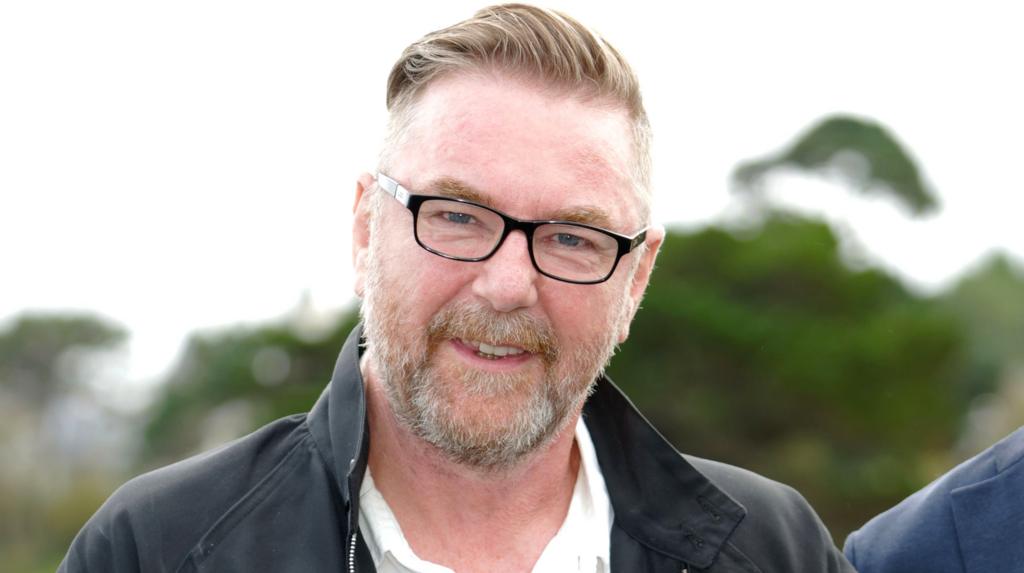
Michael Caton-Jones, a director renowned for helming projects with luminaries such as Leonardo DiCaprio, Robert De Niro, and Jessica Lange, is now the subject of a new documentary.
Filming is underway in his hometown of Broxburn, West Lothian, chronicling his remarkable journey from humble beginnings to Hollywood success.
The 68-year-old director initially hesitated about the offering from Scottish production companies Two Rivers Media and Partickular Films. The project is in collaboration with Matthew Modine’s production house, Cinco Dedos Peliculas.
“My first response was embarrassment because I’m not one for bigging myself up,” he admits.
“But then I thought, it’s not really about you. It’s about where you come from.”
“It’s about showing that this is my job, this is what I do.”
Born in Broxburn in 1957, Caton-Jones’s introduction to cinema came at the local Regal, attending Saturday morning screenings.
“It was as much a social outing as anything else,” he recalls.
“Parents would take their kids down to the cinema and drop them off and that was it – mayhem for an hour or so with five, six, seven-year-olds, just going bananas.
“It was fantastic and something to look forward to every week.”
Developing an entrepreneurial spirit, he delivered posters for the cinema in exchange for tickets, foreshadowing his Hollywood career.
Caton-Jones left school at 15 and soon Scotland, the film explores his early training in London’s theatre scene, culminating in a place at the National Film and Television School.
His debut feature, “Scandal” (1989), marked him as a director to watch, quickly followed by the World War II drama “Memphis Belle,” starring a young Matthew Modine.
“In retrospect, I can see that being Scottish and having the working class upbringing I had was a big bonus for me in many ways,” Caton-Jones reflects.
“In Hollywood, it kept me centred. I had a great time. I enjoyed making films. It got me to travel the world.
“I saw some amazing things, met some incredible people, ate some really good food.
“I would recommend it to anybody.”
In 1993, he directed “This Boy’s Life,” a coming-of-age story that gave Leonardo DiCaprio his first prominent role alongside Robert De Niro.
DiCaprio acknowledged Caton-Jones’s influence upon winning an Oscar for “The Revenant” in 2016.
“I’m very proud of Leonardo. He was a sponge. He wanted to learn,” Caton-Jones notes.
“But he was a bit of an indulged wee kid and essentially I played his big brother while we were making the film.
“Because he was in every single scene in the film the best thing I could do was keep him thinking this was a game and we were playing around.
“But I was aware at the time that he was extraordinarily talented.”
Another casting triumph was Tim Roth in “Rob Roy”.
Fresh from “Reservoir Dogs” and “Pulp Fiction”, Roth was hesitant about a Scottish “western” and playing the villain Archie Cunningham.
Roth’s portrayal earned him a BAFTA and an Oscar nomination, though the film’s commercial success was overshadowed by “Braveheart”.
“I was aware of Braveheart when they were making it,” Caton-Jones states. “I knew what they were going to make because I’d read the script.
“And I knew that they had a bucketload of money, and we didn’t have so much.
“My plan was to use the landscape and figures in the landscape as opposed to an army in the landscape.
“I think Rob Roy is the more Scottish film whereas Braveheart could be anywhere.
“It’s just a wild group of painted faces with good teeth.”
With a budget of $28 million compared to “Braveheart’s” significantly larger one, “Rob Roy” still delivered memorable scenes.
“To this day, Rob Roy remains one of my favourite movies of the 1990s,” shares Adam Rackoff, Matthew Modine’s producing partner at Cinco Dedos Peliculas.
“The end sword fight might be the most realistic ever put to film.”
Caton-Jones drew inspiration from Akira Kurosawa and sword master Bill Hobbs.
Key to the scene was practice, but its effectiveness was boosted by cutting from a crowd scene to focus solely on the two protagonists.
“We’d spent a quarter of a million dollars on wigs and costumes and extras but I went to the producer and said we’ve got to lose it all,” Caton-Jones explains.
“It changed the scene and made it personal. Like a sheriff and a bad cowboy coming in to have a gunfight.”
He also removed the soundtrack, leaving only the sound of the swords.
“And when you took all that out, you could hear people breathe in the audience,” he recalls.
“They were holding their breath as they were watching it. I wasn’t aware that it was going to have this effect. I’m really proud of it.”
Caton-Jones’s recent Scottish film was “Our Ladies”, based on the novel “The Sopranos” following a school choir on a trip from Oban.
Despite having numerous ideas, the film landscape has shifted since his early career.
“At the moment, I’m in what’s called development hell,” he says. “So I have many projects that I’m trying to push forward.
“It’s a period of flux for the film business. I made films in the studio system and that’s kind of gone now.”
He is looking to the autobiographical documentary, targeted for release next year, and an exhibition planned at the Broxburn Strathbrock Partnership community centre.
Caton-Jones concludes, “I am part of the history of this place,”.
“And if I can encourage some kid sitting in a council house who thinks their life is not going to amount to much, I am absolute proof positive that you can.”
Connor Jenkinson and Shane Jenkinson appeared in court charged with murder after the death of Adam Nevin.
Police say three men, aged 18, 25 and 28, were taken to Edinburgh’s Royal Infirmary for treatment.
Veronica Chinyanga begged for her life as her husband turned on her in their back garden in West Lothian.
Police described the attack outside the 37-year-old man’s home in Broxburn as “abhorrent”.
The team defeated Bulgaria to lift the trophy in Belgrade on the motion: “This house regrets the glorification of champions”.