

“`html
The BBC has gained access to detention facilities located on former United Arab Emirates military bases in Yemen, corroborating long-standing allegations of a clandestine prison network operated by the UAE and affiliated forces during the country’s decade-long civil conflict.
A former detainee recounted to the BBC experiences of beatings and sexual abuse within one of these facilities.
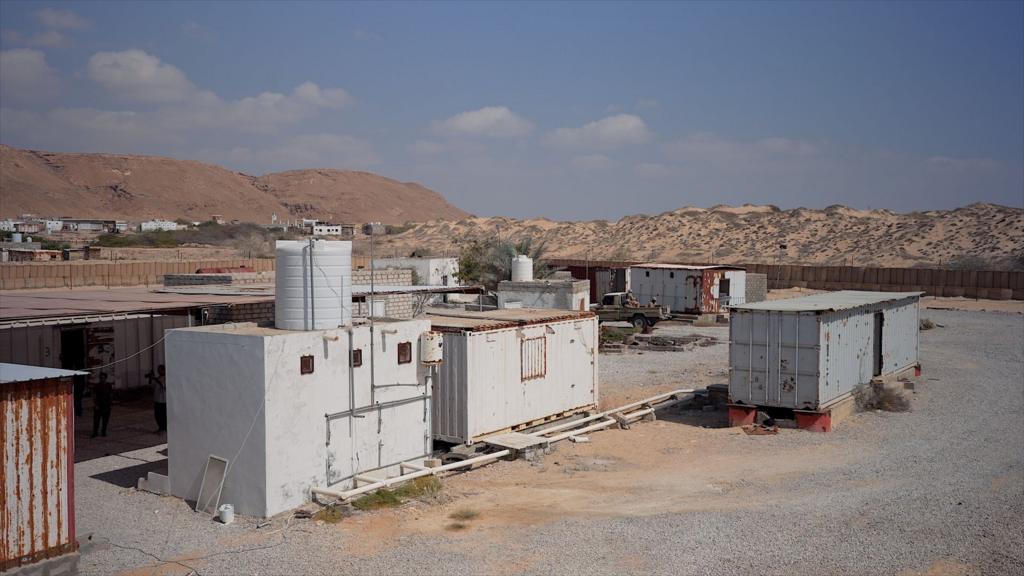
During the visit, cells were observed at two bases in southern Yemen, including shipping containers bearing names—presumed to be those of detainees—and dates etched into their surfaces.
While the UAE has not yet responded to requests for comment, it has previously refuted similar allegations.
Until recently, the Saudi Arabia-backed Yemeni government maintained an alliance with the UAE against the Houthi rebel movement, which controls northwestern Yemen.
However, this alliance between the two Gulf state partners has since fractured. UAE forces withdrew from Yemen in early January, and Yemeni government forces, along with allied groups, have reclaimed significant portions of the south from UAE-backed separatists.
This includes the port city of Mukalla, where the reporting team arrived via a Saudi military aircraft and were subsequently transported to the former UAE military bases in the Al-Dhaba Oil Export Area.
Access for international journalists to report from Yemen has been severely restricted in recent years. However, the government extended an invitation to view the two sites, accompanied by Yemen’s Information Minister, Moammar al-Eryani.
The observations made were consistent with independently gathered accounts, both from prior reporting and interviews conducted in Yemen separate from the government-facilitated site visit.
At one location, approximately ten shipping containers were present, their interiors painted black with limited ventilation.
Markings on the walls appeared to correspond with dates detainees claimed to have been brought in or to track the number of days of their confinement.
Several of these markings were as recent as December 2025.
At another military base, the BBC delegation was shown eight brick and cement cells, including several measuring roughly one meter square by two meters tall, which Eryani indicated were used for solitary confinement.
Human rights organizations have documented testimony describing such facilities for several years.
Yemeni lawyer Huda al-Sarari has been compiling these accounts.
The BBC independently attended a meeting organized by Ms. al-Sarari, attended by approximately 70 individuals who stated they had been held in Mukalla, as well as families of another 30 individuals alleged to still be in detention.
Multiple former detainees reported that each shipping container could hold up to 60 men simultaneously.
They stated that prisoners were blindfolded, their wrists bound, and forced to remain sitting upright continuously.
“There was no space to lie down,” one former prisoner told the BBC. “If someone collapsed, the others had to hold him up.”
The individual also recounted being beaten for three days after his arrest, with interrogators demanding a confession of membership in al-Qaeda—an accusation he denies.
“They told me if I didn’t admit it, I would be sent to ‘Guantanamo’,” he said, referencing the U.S. military detention center at Guantanamo Bay in Cuba.
“I didn’t even know what they meant by Guantanamo until they took me to their prison. Then I understood.”
He reported being held there for a year and a half, subjected to daily beatings and other forms of abuse.
“They didn’t even feed us properly,” he said. “If you wanted the toilet, they took you once. Sometimes you were so desperate you did it on yourself.”
He claimed his captors included Emirati soldiers as well as Yemeni fighters: “All types of torture – when we were interrogated it was the worst. They even sexually abused us and said they would bring in the ‘doctor’.”
“This so-called doctor was Emirati. He beat us and told the Yemeni soldiers to beat us too. I tried to kill myself multiple times to make it end.”
The UAE spearheaded a counter-terror campaign in southern Yemen, but human rights organizations assert that thousands of individuals were detained during crackdowns targeting political activists and critics.
One mother reported that her son was detained as a teenager and has been held for nine years.
“My son was an athlete,” she said. “He had just come back from competing abroad. That day he went to the gym and never came back.”
“I didn’t hear from him for seven months,” she stated.
“Then they let me see him for 10 minutes. I could see all the scars of the torture.”
She alleged that within the Emirati-run prison base, her teenage son was subjected to electrocution, doused with ice-cold water, and sexually abused multiple times.
She claims to have attended a hearing where her son’s accusers played a recording of him purportedly confessing.
“You can hear him being beaten in the background and told what to say,” she said. “My son is not a terrorist. You have robbed him of the best years of his life.”
Over the past decade, human rights groups and media organizations—including the BBC and Associated Press—have documented allegations of arbitrary detention, enforced disappearance, and torture within detention centers operated by the UAE and its allies.
Human Rights Watch reported in 2017 that it had collected testimonies from detainees held without charge or judicial oversight in unofficial facilities, subjected to beatings, electric shocks, and other forms of mistreatment.
The UAE denied these allegations at the time they were made.
The BBC presented detailed allegations to the UAE government regarding the detention sites visited and accounts of abuse, but has received no response.
All parties involved in the civil war have faced accusations of human rights violations, contributing to a devastating humanitarian crisis within the country.
Families of detainees conveyed to the BBC that they had repeatedly raised concerns with Yemeni authorities.
They believe it would have been impossible for the UAE and its allies to operate a detention network without the knowledge of the Yemeni government and its Saudi backers.
Information Minister Eryani stated: “We weren’t able to access locations that were under UAE control until now.”
“When we liberated them we discovered these prisons… we had been told by many victims that they existed but we didn’t believe it was true.”
His government’s decision to grant access to international media comes amid a widening rift between Saudi Arabia and the UAE.
Their long-strained relationship deteriorated in December when UAE-backed southern separatists, the Southern Transition Council (STC), seized territory controlled by government forces in two western provinces.
Subsequently, Saudi Arabia conducted a strike on what it claimed was a shipment of weapons from the UAE to the STC in Mukalla and supported a demand from Yemen’s presidential council for Emirati forces to immediately depart the country.
The UAE withdrew, and within days, government forces and their allies regained control of the western provinces and the entirety of the south.
However, remaining separatists pose a threat to the government’s position in certain areas, including the southern port of Aden.
The UAE refuted claims that the shipment contained weapons and rejected Saudi allegations that it was behind the STC’s recent military campaign.
On January 12, 2026, the president of Yemen’s Presidential Leadership Council, which oversees the government, Rashad al-Alimi, mandated the closure of all “illegal” prisons in southern provinces previously controlled by the STC, demanding the immediate release of those “held outside the framework of the law.”
Eryani stated that some detainees had been discovered inside the facilities but did not provide numbers or further details.
Certain relatives—including the mother of the athlete—reported to the BBC that detainees have since been transferred to prisons now nominally under government control.
Yemeni authorities maintain that transferring prisoners into the formal justice system is complex, while rights groups caution that arbitrary detention may simply continue under a different authority.
“The terrorists are out on the streets,” the mother stated.
“Our sons are not terrorists.”
The government in Mogadishu has accused the UAE of undermining its sovereignty.
Aidarous al-Zubaidi, head of the UAE-backed Southern Transitional Council, fled to Somaliland by boat before flying to Abu Dhabi, according to the coalition.
The presidency also expels Aidarous al-Zubaidi, head of the UAE-backed Southern Transitional Council, after he fails to fly to Riyadh for talks.
It comes after clashes and an independence bid in southern Yemen bring Saudi and UAE-backed forces into confrontation.
The UAE and Saudi have been allies in the war against the Houthis, but infighting between the rival factions they support has caused a rift between them.
“`