

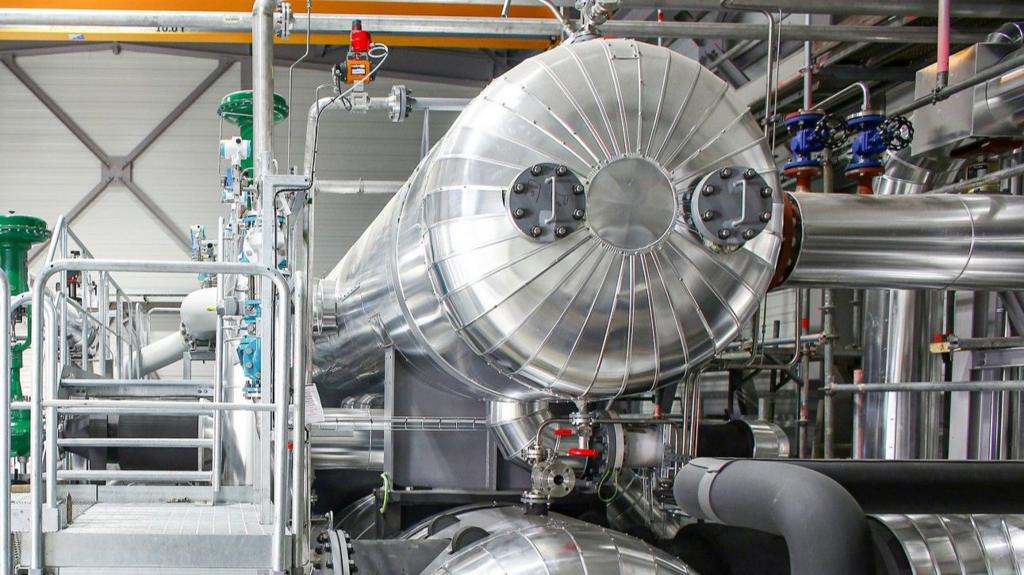
The scale of the piping intended to feed a heat pump system drawing from Germany’s River Rhine is substantial enough to allow a person to walk through it upright, according to reports.
Felix Hack, project manager at energy firm MVV Environment, detailed plans to extract 10,000 liters per second through pipes with a 2-meter diameter in Mannheim, subsequently returning the water after heat extraction.
In October, MVV Energie, the parent company, announced intentions to construct potentially the most powerful heat pump modules to date, consisting of two units each with a capacity of 82.5 megawatts.
This combined output could provide heat to approximately 40,000 homes via a district heating system. MVV Energie plans to integrate this system at the site of a coal power plant undergoing a transition to cleaner technologies.
The size of the heat pumps was determined, in part, by logistical constraints on machinery transport through Mannheim’s streets or via Rhine barges. “That remains to be confirmed,” Hack stated. “River transport remains a possibility.”
Alexandre de Rougemont of Everllence (formerly MAN Energy Solutions), another German firm producing large-scale heat pumps, acknowledged the project. “It’s a competition, certainly,” he said. “We’re transparent about that.”
Heat pumps extract thermal energy from sources like air, ground, or, in this case, water bodies. Refrigerants within the pumps evaporate even with slight warming.
Compressing the refrigerant further amplifies the heat. This process, also found in residential heat pumps, is simply executed on a vastly larger scale to serve entire urban districts.
As cities worldwide pursue decarbonization, many are opting for large heat pumps integrated with district heating networks.
These networks distribute hot water or steam to multiple buildings through extensive piping. Increasingly larger heat pump models are being developed to meet growing demand.
“There was significant pressure to transition heat generation to new, especially renewable, sources,” Hack explained, referencing the decommissioning of coal-fired units at the Mannheim plant. The site’s proximity to the Rhine, substantial grid connection, and existing district heating network make it a logical location for heat pump installation.
He pointed out that the technology is enabled by the availability of large compressors from the oil and gas industry, where they are used for compressing fossil fuels.
Work on the Mannheim project is scheduled to begin next year, with the 162MW heat pumps expected to be fully operational in the winter of 2028-29. Hack also noted that a multi-stage filter system will prevent fish intake, and modeling indicates the system will alter the river’s average temperature by less than 0.1C.
Such installations are capital intensive. The Mannheim setup is projected to cost €200m ($235m; £176m). Everllence’s de Rougemont estimates heat-pump equipment costs at roughly €500,000 per megawatt of installed capacity, excluding additional infrastructure costs.
Everllence is also engaged in a project in Aalborg, Denmark, set to exceed the Mannheim system with a total capacity of 176MW. This system will employ four 44MW units and is slated for operation in 2027, supplying nearly one-third of the town’s heating needs.
The 44MW machines are identical to those in a fully operational project south of Aalborg in Esbjerg, where they operate at 35MW each.
Large hot water storage tanks, each holding 200,000 cubic meters, will add system flexibility. “When electricity prices are high, the heat pump can be paused, and heat supplied from storage,” de Rougemont explained.
Veronika Wilk of the Austrian Institute of Technology stated, “Heat pumps and district heating systems are an excellent match.” Such systems can extract heat from water sources or even wastewater from sewage treatment plants.
Dr. Wilk noted that using multiple large heat pumps on a district heating network increases flexibility and efficiency, for example by running only two of four heat pumps in autumn when heat demand is lower.
While most systems draw energy from water, some very large heat pumps use air as a heat source, even in colder cities like Helsinki.
“The sea in front of Helsinki is too shallow,” explained Timo Aaltonen, senior vice president of heating and cooling at energy firm Helen Oy. “We calculated that we would need to build a tunnel more than 20km long to the ocean, to get enough water [with a] temperature high enough.”
Helsinki is undergoing a significant overhaul of its district heating system, adding heat pumps, biomass burners, and electric boilers to a 1,400km network connecting nearly 90% of buildings in the city, Aaltonen added.
Heat pumps convert single kilowatt hours of electricity into multiple kilowatt hours of heat, while electric boilers do not and are considered less efficient.
When asked about Helen Oy’s decision to install hundreds of megawatts of these boilers, Aaltonen explained that they are cheaper to install than heat pumps and reduce reliance on air, which has limitations in terms of heat provision at scale. Additionally, electric boilers can absorb surplus renewables and provide grid-balancing functions.
The UK currently lacks heat pumps comparable to those being developed in Denmark, Germany, and Finland. However, new district heating networks are emerging, such as the Exeter Energy Network, which will serve the University of Exeter and other customers.
The network’s planned minimum capacity is 12MW, featuring three 4MW air-to-water heat pumps, with the first unit expected to be operational in 2028.
Keith Baker of Glasgow Caledonian University, a researcher of district heating systems, believes the UK can better utilize this technology. Water in disused mines, which maintains stable temperatures, is beginning to supply larger heat pumps here, for example.
Post-industrial and rural areas with sufficient space for heat pumps and storage tanks are “the sweet spots,” he says.
Campaigners fear the site will spoil the local landscape, which includes a listed farmhouse.
The key to the app’s success – its algorithm – is to be retrained on US data. Will that make US TikTok blander?
The deals would end years of efforts by Washington to force ByteDance to sell its US operations.
Andrew Bailey says workers need to be trained to move into jobs that use AI, but adds it might not lead to mass unemployment.
It comes as new PM Sanae Takaichi is keen for inflation to fall but also needs low government borrowing costs.