

“Together we are in a position to… end decades of suffering, stop generations of hatred and bloodshed, and forge a beautiful, everlasting and glorious peace for that region and for the whole region of the world.”
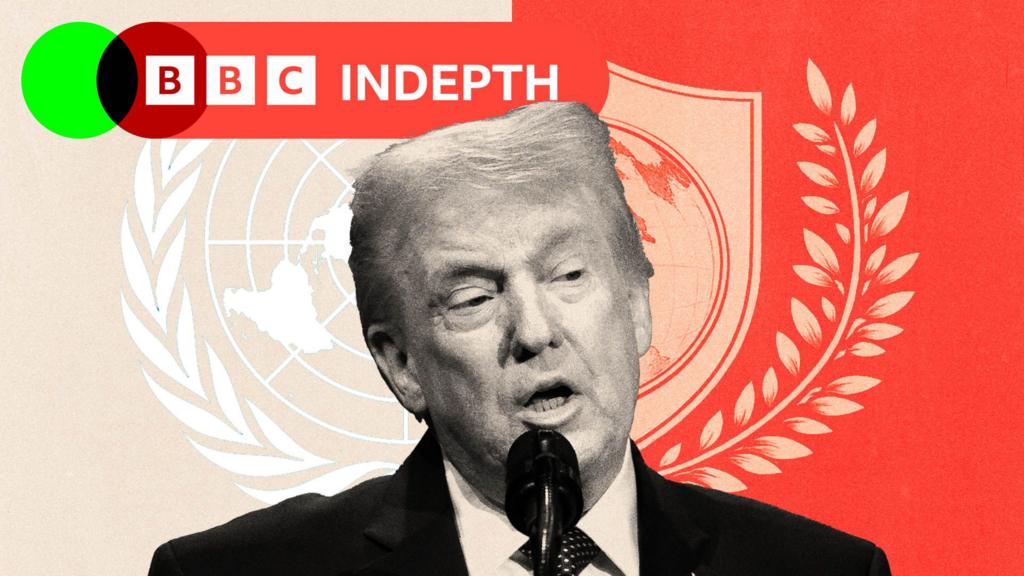
Such was the ambitious pledge of US President Donald Trump as he unveiled his new Board of Peace at the Davos Economic Forum this week.
In a world rife with conflict, there is a palpable desire to believe in such pronouncements.
However, for many observers and government officials globally, this move is viewed as further evidence of President Trump’s commitment to dismantling the established post-war international order, replacing it with institutions under his influence.
“We will not let anyone play us,” cautioned Poland’s Prime Minister Donald Tusk on social media.
Conversely, Viktor Orban, a prominent European supporter of President Trump, offered enthusiastic support, stating, “If Trump, then peace.”
The precise functions of this Board, to be permanently chaired by President Trump, remain a subject of speculation. Could it be an attempt to create a parallel United Nations?
The concept, originating from US-led efforts to resolve the conflict in Gaza last year and subsequently endorsed by a UN Security Council resolution, has now expanded to encompass a broader, more global scope, centered around the President.
According to leaked details of the draft charter, President Trump would serve as chairman for life, even after leaving office. The charter reportedly grants him extensive powers, including the authority to invite or exclude member states, establish or dissolve subsidiary bodies, and appoint his successor.
Permanent membership for other countries would reportedly require a substantial contribution of $1 billion (£740m).
This latest development follows a series of recent events, including the US capture of Venezuela’s leader, threats and preparations for military action against Iran, and the proposal to acquire Greenland, which has reverberated across Europe and beyond.
Nineteen countries from various regions attended the Board’s inauguration in Davos, with many more reportedly “agreed to join”.
“In this group, I like every single one of them,” remarked President Trump, addressing leaders and officials now associated with the Board and its associated bodies.
However, numerous potential members have so far refrained from joining.
“This is about a treaty that raises much broader issues, and we do also have concerns about President Putin being part of something that is talking about peace” explained the UK’s Foreign Secretary Yvette Cooper.
While President Trump asserts that Russia is participating, Moscow has indicated that they are still “consulting partners.”
“As the text stands right now,” we’re not joining, replied Sweden.
“The proposal raises unanswered questions that require further dialogue with Washington” was Norway’s diplomatic response.
Even a coalition of seven predominantly Muslim countries, including six Arab nations, as well as Turkey and Indonesia, emphasized their focus on achieving a “just and lasting peace in Gaza,” including the reconstruction of the area.
However, leaked details of the Board’s charter make no mention of Gaza.
Some critics view the Board as a vanity project for a president known to covet the Nobel Peace Prize, previously awarded to President Obama early in his first term.
World leaders are aware of potential consequences for declining to join the new body.
“I’ll put a 200% tariff on his wines and champagnes, and he’ll join, but he doesn’t have to join.” This was the president’s rebuke to France’s President Emmanuel Macron with a threat to wield his weapon of choice.
Slovenia voiced its concerns explicitly, with Prime Minister Robert Golob stating that the Board “dangerously interferes with the broader international order”.
President Trump directly addressed this concern.
“Once this Board is completely formed, we can do pretty much whatever we want to do and we’ll do it in conjunction with the United Nations,” he explained.
However, he maintains an element of ambiguity.
When asked whether his Board would replace the UN, he replied “Well it might. The UN just hasn’t been very helpful.”
He added “I’m a big fan of the UN potential, but it has never lived up to its potential. The UN should have settled every one of the wars that I settled.”
The UN, with its 193 member states, has indeed seen its role as primary peacemaker diminished.
Secretary General António Guterres promised “a surge in diplomacy for peace” upon assuming office in October 2016.
However, the UN’s efforts have been hampered by gridlock within the Security Council, the growing influence of spoilers and state sponsors of conflict, and the erosion of its standing relative to major global powers, including the United States.
“We must all welcome the activism of Mr Trump on ending wars,” says Martin Griffiths, a UN veteran who believes this new effort is “obviously a reflection of the failure of the UN Security Council and of the UN writ large.”
The former Under-Secretary-General for Humanitarian Affairs and Emergency Relief Coordinator cautioned that “what we’ve learned over these last 80 years, through lots and lots of failures and clunkiness, we learned the value of inclusion, of being representative of the global community, not just the friends of Mr Trump.”
Secretary-General Guterres recently lamented that “there are those that believe the power of law should be replaced by the law of power”.
When questioned about President Trump’s claims of ending eight wars, he responded that “they are ceasefires.”
Some of these agreements have already collapsed.
The temporary peace deal between Rwanda and the Democratic Republic of Congo soon fell apart, Cambodia and Thailand started hurling accusations and more across their border, and India disputed Trump’s central role in ending its conflagration with Pakistan.
But only Trump’s muscular mediation could have ended the 12-day war between Iran and Israel.
His own personal involvement finally secured a ceasefire in Gaza’s destructive confrontation last October which eased both the suffering of Palestinians, and the agony of Israeli hostages. His decision to finally and fully focus on this disaster, partly in response to urging from his closest Arab allies and grieving Israeli families, pushed him to pressure Israel’s Prime Minister Netanyahu and Hamas, to do a deal.
However, even the Board’s initial challenge – transitioning from the first phase of the Gaza deal – is formidable. The Board includes Prime Minister Netanyahu, who has pledged to prevent the establishment of a Palestinian state, and Arab leaders who insist that a sustainable peace requires Palestinian self-governance and an end to the Israeli occupation.
The ongoing conflict in Ukraine also presents a significant challenge, with President Zelensky hesitant to participate in discussions involving Moscow and Minsk.
The structure of the Board includes an Executive Board, a Gaza Executive Board, and the National Committee for the Administration for Gaza.
These bodies comprise senior American officials, billionaires, former politicians, ex-UN envoys, Arab ministers, intelligence chiefs, and Palestinian technocrats.
Some observers acknowledge that the President has raised the issue of reforming the UN’s post-war structure, including a Security Council that no longer reflects the current global distribution of power, to the forefront of international discussion.
“Maybe an unintended good consequence of what Trump has done is those issues will be pushed back towards the top of the international agenda,” reflected Mark Malloch Brown, the former UN deputy secretary-general.
“We’re coming out of a period of extremely weak UN leadership and I think this could be a call to action.”
President Trump’s initiative to lead the world toward peace coincides with growing discussions about replacing Secretary-General Guterres at the end of his second term this year.
The President, who once claimed he could resolve the Ukraine war in a day, has come to recognize that peacemaking is a lengthy and complex process.
Nevertheless, he expressed optimism regarding the Middle East, stating that only “little fires” remain. He also predicted a resolution to the conflict in Ukraine “is coming very soon”.
And he revelled in his new role as would-be peacemaker-in-chief.
“This is for the world” he exclaimed.
Top picture credit: Reuters
BBC InDepth is the home on the website and app for the best analysis, with fresh perspectives that challenge assumptions and deep reporting on the biggest issues of the day. Emma Barnett and John Simpson bring their pick of the most thought-provoking deep reads and analysis, every Saturday. Sign up for the newsletter here
The Conservatives delay the Lord’s debate of the Bill aimed at enshrining the government’s Chagos Islands handover deal in law.
This past week could mark a turning point in the relationship between the UK prime minister and the US president.
The US president’s comments have been condemned by international allies, including UK veterans and politicians.
The meetings between the three countries comes as both Ukraine and Russia say no peace deal can be reached until territorial issues are resolved.
The BBC’s Washington Correspondent Daniel Bush looks at the countries who have joined and how the charter’s funding will be used.