

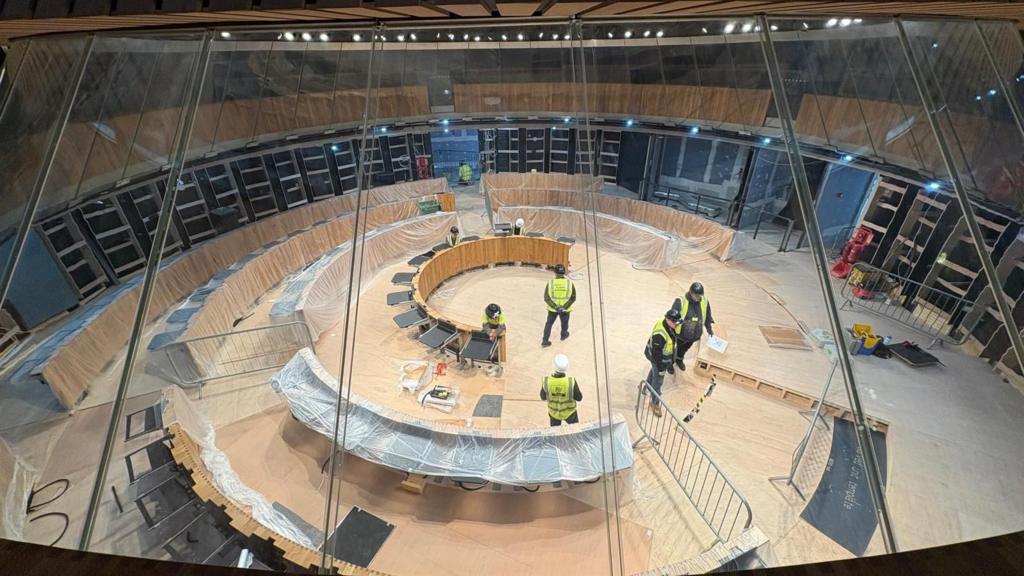
As Wales enters the new year, its parliament is approaching what has been described as a “once in a century change.”
The Senedd election in May will differ significantly from previous contests, with the number of elected Members of the Senedd (MSs) increasing from 60 to 96.
The constituencies and voting system are also undergoing changes.
Furthermore, with polls suggesting a potential political realignment where Labour’s historical dominance could be challenged by Plaid Cymru and Reform, 2026 is poised to be a pivotal year in the Senedd’s history.
While political analysts and media outlets will closely monitor these planned changes, election campaigners emphasize that ensuring voter awareness will be a “significant challenge.”
“There’s a lot of change coming this way,” noted Jess Blair from Electoral Reform Society Cymru.
“It’s hard enough to communicate one change…let alone all these changes. But I think the message to voters is register to vote and turn out on 7 May.”
Historically, effective communication has been a hurdle.
Turnout in previous Assembly or Senedd elections has remained below 50%, potentially due to a lack of clarity and insufficient media coverage.
A spot check on St Mary Street in Cardiff revealed a lack of awareness among many voters regarding these changes.
“I haven’t got a clue about none of it,” confessed one young mother, expressing a desire for more readily available information.
Alice Cockrell acknowledged awareness of constituency changes but was unaware of alterations to the voting system or the number of MSs.
“I read a lot of news on my phone and on TV and stuff and I’ve not heard of these changes,” she said.
“There should be more information for people,” stated Jonathan Harris. “We don’t know nothing about it.”
Yvonne Murphy, founder of The Democracy Box, an educational resource aimed at improving political understanding, stressed the importance of voter education.
“Every time an election comes up we have this frenzy of ‘we must get people to the polls and we must register people to vote’, but why would you want to partake in something that you don’t understand?
“It’s like sitting down at Christmas and asking someone to play a game of Monopoly without explaining the rules.”
Preparations are underway to accommodate the additional Members of the Senedd (MSs) to be elected this year.
The debating chamber is undergoing renovations, including the addition of 36 desks and upgraded technology, at an estimated cost of £4.2 million to taxpayers.
The expansion was a policy supported by Welsh Labour, Plaid Cymru, and the Welsh Liberal Democrats, aimed at better equipping the Senedd to handle its expanded powers.
However, critics, including the Welsh Conservatives, argue that increasing the number of politicians represents a misuse of taxpayer funds.
The election will also witness a reduction in the number of constituencies from 40 to 16, each represented by six MSs elected through a new proportional system.
These reforms represent the most significant changes to the Senedd since devolution began in 1999.
Indeed, according to the Senedd’s Presiding Officer, Elin Jones, the institution “is about to embark on not a once in a generation change but a once in a century change for our Senedd here in Wales.”
“It’s the opportunity to do the work of a Senedd properly and Wales deserves no less than that,” she added, amidst the sound of ongoing construction.
In addition to maintaining order within the Senedd, Jones is primarily responsible for overseeing the implementation of these changes.
While a degree of apprehension might be understandable as the deadline approaches, she insisted on feeling only “excitement at the prospect of Wales finally getting the chance to elect a parliament that is fully, effectively able to fulfil the functions of a parliament.”
Jones acknowledged the significance of these reforms for the public, emphasizing the “responsibility” of politicians and the Senedd itself to explain the changes to voters.
The election’s outcome will determine the future governance of Wales.
Labour’s recent polling struggles introduce “a degree of jeopardy… that we haven’t seen in Wales for a time,” Jones noted.
“That, I hope, will enthuse the people of Wales to engage and to use their vote.”
Labour Senedd member Lee Waters told a podcast Stevens was not “somebody who believes in devolution”.
Next May’s election could be historic – with Labour’s century-long dominance in Wales under threat.
Jo Stevens spoke after a Labour Senedd member said ministers in Cardiff were being “humiliated”.
A Plaid Cymru politician says Jo Stevens showed an “incredible lack of respect” for the Welsh language.
The Welsh government had already warned its plan was unlikely to be ready for next May’s election.