

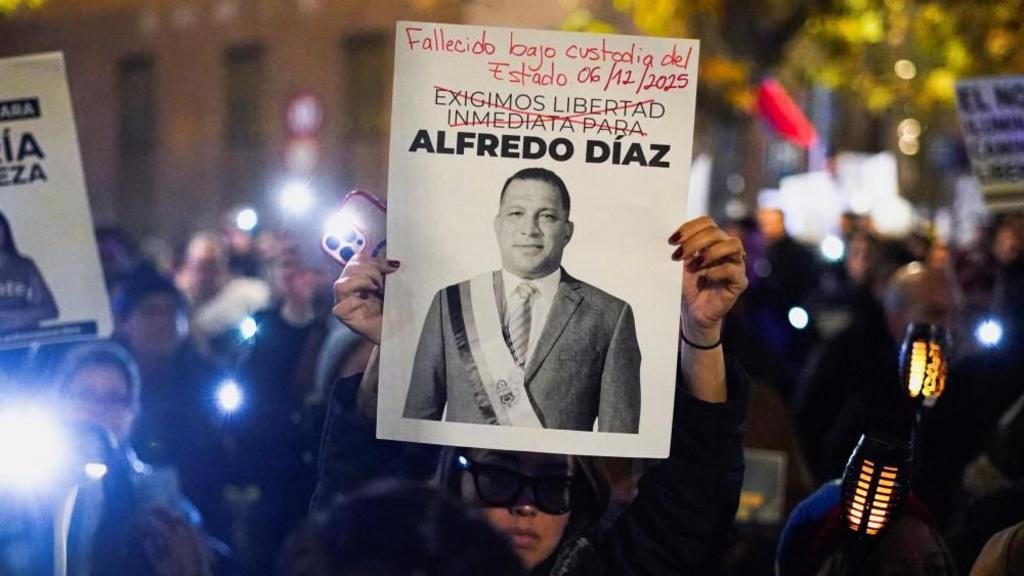
The United States has issued a condemnation of the Venezuelan government following the death of an opposition figure while in custody. The U.S. State Department described the incident as “a reminder of the vile nature” of President Nicolás Maduro’s regime.
Alfredo Díaz, a prominent opposition voice, reportedly died in his cell at the El Helicoide prison in Caracas, where he had been detained for over a year, according to human rights organizations and opposition groups.
The Venezuelan government stated that the 56-year-old exhibited symptoms indicative of a heart attack and was subsequently transported to a hospital, where he died on Saturday.
This U.S. statement marks the latest development in an escalating war of words between the U.S. administration and Maduro, who has repeatedly accused the U.S. of seeking a regime change.
In recent months, the U.S. has augmented its military presence in the region and has conducted a series of strikes against vessels allegedly involved in drug smuggling.
Former U.S. President Donald Trump had previously accused Maduro of leading a drug cartel – an allegation Maduro vehemently denies – and threatened potential military intervention.
The U.S. State Department’s Bureau of Western Hemisphere Affairs asserted that Díaz had been “arbitrarily detained” in a facility it characterized as a “torture center.”
Díaz was arrested in 2024 after joining other opposition figures in challenging the results of the presidential election that year.
Venezuela’s government-controlled election council declared Maduro the victor, despite opposition claims that their candidate won by a significant margin.
The elections were widely condemned internationally as fundamentally flawed, precipitating widespread protests across the country.
Díaz, the former governor of Nueva Esparta, an island state off Venezuela’s Caribbean coast, was accused of “incitement to hatred” and “terrorism” for disputing Maduro’s claim to victory.
The Venezuelan human rights group Foro Penal has voiced concerns over the worsening conditions for political prisoners in the nation.
“Another political prisoner has died in Venezuelan jails. He had been imprisoned for a year, in solitary confinement,” Alfredo Romero, the organization’s president, stated on X.
He added that Díaz was only permitted one visit from his daughter during his entire incarceration, and that 17 political prisoners have died in the country since 2014.
Opposition groups have joined in criticizing the government over Díaz’s death.
María Corina Machado, a leading opposition figure and Nobel Peace Prize laureate who remains in hiding, stated that Díaz’s death was not an isolated case.
“Sadly, it adds to an alarming and painful chain of deaths of political prisoners detained in the context of the post-election repression,” she wrote on X.
Machado, a vocal critic of Maduro’s government and a key figure in mobilizing the opposition, is unlikely to attend the Nobel Prize ceremony in Oslo on Wednesday. Venezuela’s attorney general stated last month that she would be deemed a “fugitive” if she traveled to Norway.
The Democratic Unitary Platform, an opposition alliance, denounced Díaz’s “unjust” death.
Díaz’s party, Democratic Action (AD), also paid tribute to the former governor, stating that he was unjustly detained without due process and held in conditions “that should never have violated his fundamental rights.”
Tensions have escalated between the U.S. and Venezuela amid purported efforts to curb drug and migrant flows into the U.S.
U.S. air strikes on vessels in the Caribbean and Pacific have resulted in the deaths of over 80 individuals.
Trump accused Maduro of releasing prisoners and those from “insane asylums” into the U.S., designating two Venezuelan drug cartels – Tren de Aragua and Cartel de los Soles – as terrorist organizations, with the latter allegedly led by Maduro.
Maduro, in turn, has accused the U.S. of exploiting its war on drugs as a pretext for ousting his government and seizing Venezuela’s extensive oil reserves. Colombia’s President Gustavo Petro has suggested that the U.S. strikes were part of an effort to “dominate” Latin America.
The U.S. has also deployed a substantial naval force – its largest in the region in decades – along with thousands of troops.
The Venezuelan army reportedly swore in over 5,600 soldiers on Saturday in response to perceived U.S. “threats.”
The same day, the Venezuelan government announced that Maduro and Turkish President Recep Tayyip Erdogan had agreed to reinstate Turkish Airlines flights between the two countries.
The carrier was among six major international airlines that had their landing licenses revoked after temporarily suspending flights to Caracas following a U.S. advisory regarding “heightened military activity” in the region.
The admiral who authorized a second strike on a suspected drug boat briefed lawmakers. The military has confirmed another attack.
Republicans and Democrats agreed that he did not order the killing of everyone on board the boat. That’s where the consensus ended.
Legal experts have told BBC Verify that the second strike on a Venezuelan drug boat by the United States military lacked a clear legal basis.
The strike has raised concerns that US forces may have violated conflict laws.
We examine the reasons behind the deployment of a large US military force within striking distance of Venezuela.