

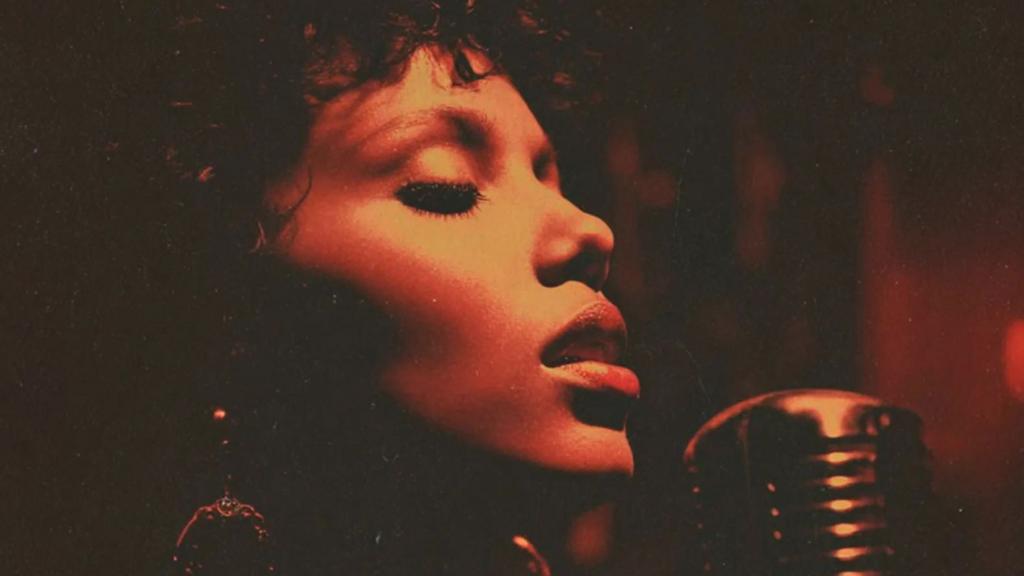
Sienna Rose is experiencing a surge in popularity this month.
Her collection of soulful, jazz-inspired tracks have garnered attention, with three songs currently featured in Spotify’s Viral Top 50. Notably, “Into the Blue,” a captivating ballad, has exceeded five million streams.
Should this momentum persist, Rose stands poised to emerge as a prominent new artist this year.
However, a significant question looms: mounting evidence suggests that Sienna Rose may not be a genuine individual.
Streaming platform Deezer, which employs technologies to identify AI-generated music, has reported to the BBC that “many of her albums and songs on the platform are detected and flagged” as potentially computer-generated.
Closer scrutiny reveals characteristics often associated with AI artists. Rose lacks a social media presence, has never performed live, has no official music videos, and has released a remarkably large volume of songs within a condensed timeframe.
Between September 28th and December 5th, at least 45 tracks were uploaded to streaming services under her name. This output surpasses even that of prolific artists known for their intense creative drive.
Her now-deactivated Instagram account showcased a series of strikingly uniform headshots, exhibiting the soft, artificial lighting characteristic of AI image generators.
Furthermore, the music itself bears scrutiny. Tracks such as “Into the Blue” and “Breathe Again” possess qualities reminiscent of Norah Jones or Alicia Keys, incorporating jazzy guitar arrangements and smooth vocal performances.
However, numerous listeners have identified potential “AI artifacts” within the compositions.
Upon listening to “Under the Rain” or “Breathe Again,” a subtle hiss can be detected throughout the tracks.
This auditory anomaly is commonly found in music generated by applications such as Suno and Udio, stemming from their process of initiating with white noise and gradually refining it into a musical composition.
This particular characteristic allows Deezer to identify potential AI-generated songs.
Gabriel Meseguer-Brocal, a senior research scientist at Deezer, explains that “when the [software] adds all the layers and the instruments, it introduces errors.”
He clarifies that while these errors are not readily perceptible to the human ear, they can be easily identified through mathematical analysis.
Meseguer-Brocal states that these errors function as a “unique signature,” enabling the detection of the specific software used to create a given piece of music.
For the average listener, other indicators include inconsistent drum patterns, uninspired lyrics, and a vocal performance that adheres closely to the melody without deviating or showcasing significant range.
The perceived “generic” quality of the music has been a primary clue for some listeners.
TikTok music critic Elosi57 commented: “I was like, ‘I like this’, but there was something that was very ‘uncanny valley’.” She added, “So I went to look [at her profile] and I was like, ‘This is AI’.”
Another user posted on X: “Started listening to Olivia Dean (fantastic). Within two days Spotify recommended Sienna Rose, who has a similar, but more generic sound. Took me a few songs to realise she’s AI.”
Broadcaster Gemma Cairney told BBC Radio 4: “The photographs of her do look a little bit unreal… And having listened to the music, is there just some of the soul in the soul missing?”
To be fair, many others have enjoyed Rose’s songs.
Notably, pop star Selena Gomez featured Rose’s track “Where Your Warmth Begins” in the background of an Instagram post related to the Golden Globes.
While the song was subsequently removed amid growing questions about Rose’s identity, Gomez’s post significantly amplified interest in Rose and the debate surrounding her true nature.
Many listeners who had been enjoying Rose’s music expressed disappointment upon learning of the possibility that she may not be a real person.
“Please tell me she’s real,” one user lamented on Threads.
Another user concurred on Bluesky: “I’m disappointed cuz a couple of her songs came on and the music isn’t BAD. [But] somebody said once you know then it sounds soulless’ and I agree.”
Of course, the possibility remains that these assumptions are incorrect, and Sienna Rose is a genuine artist who simply prefers to avoid the spotlight. Perhaps she is in a witness protection program, or perhaps she is a real singer, embroiled in a contractual dispute with her record label, and releasing music under a pseudonym.
If that is the case, we offer our apologies. It must be disheartening to have your music dismissed as soulless “slop.” However, this situation underscores a pressing issue confronting the music industry today.
AI software is becoming so advanced that artificially generated artists are increasingly competing with human musicians.
In Sweden, a chart-topping song was recently removed from music charts after journalists discovered that the artist behind it, Jacub, did not exist.
There are many individuals, within both technology companies and the business side of the music industry, who advocate for the advancement and adoption of AI in music creation.
The cost of launching an act like Sienna Rose is virtually zero, yet her music generates an estimated £2,000 in royalties per week.
Compared to the K-Pop industry, where labels invest an average of $1 million (£750,000) per member of a girl or boy group per year, the appeal of AI-generated music becomes clear.
Interestingly, several of Rose’s songs appear to be credited to US indie record label Broke, which has a history of transforming viral artists into chart-topping successes.
While Rose is not listed as one of their current signings on their website, British dance act Haven is.
Haven previously faced controversy for creating a song that used an AI clone of Jorja Smith’s voice.
Their song, “Run,” was removed from streaming services after record industry bodies issued takedown notices, alleging copyright infringement. However, the song was subsequently re-recorded with human vocals and entered the UK Top 10 charts two weeks ago.
The BBC has reached out to Broke for clarification regarding their association with Sienna Rose, but has yet to receive a response.
The BBC has also contacted Nostalgic Records, another label that lists Rose on their website.
Nostalgic Records’ biography describes her as “London-based” and claims that she is “not just a performer, but a storyteller of the heart.”
Deezer reports that 34% of the songs uploaded to its streaming service—approximately 50,000 per day—are AI-generated.
“Eighteen months ago, it was around 5% or 6%,” says Meseguer-Brocal. “It’s kind of shocking how quickly it’s increasing.”
However, Deezer has not yet taken as drastic a step as the online music store Bandcamp, which recently announced a ban on all AI-generated music.
In a statement, Spotify defended the presence of artists like Rose on its platform.
“It’s not always possible to draw a simple line between ‘AI’ and ‘non-AI’ music,” a spokesperson stated. “Spotify does not create or own any music, and does not promote or penalise tracks created using AI tools.”
Meanwhile, a growing backlash against AI-generated music is gaining momentum.
Last year, artists including Paul McCartney, Kate Bush, Damon Albarn, the Pet Shop Boys, and Annie Lennox released a “silent album” in protest against companies that train their AI models using copyrighted material without permission.
Speaking at the Ivor Novello Awards in 2024, pop star Raye expressed her belief that fans will ultimately choose genuine human-created music over algorithmically generated content.
“There’s no reason to feel a threat,” she stated. “I don’t write because I’m trying to be the best writer. I write because I’m trying to tell my story.”
“I’m trying to lift off some weight I’ve been carrying, or I’m trying to express myself and feel better.”
At the same event, Kojey Radical quipped that he was not concerned about AI when he couldn’t even rely on his washing machine to function properly.
“Why is everyone trying to make me scared of the robots?” he laughed.
“I’m not scared of the robots. I will win.”
Avril Davidge gets VIP status at the 125-year-old parade after her family makes her dream come true.
Our pick of the emerging artists in Devon and Cornwall to watch this year.
Ahead of the anniversary tour, Paul Smith says the band still believes in its songs, two decades on.
Alex Warren, Raye and Yungblud are just some of the musicians set to perform in Birmingham.
Meri-Tuuli Auer told her counsellor things about her life she didn’t want her closest family to know.