

“`html
As part of its strategy to reduce energy bills and mitigate climate change, the government’s Warm Homes Plan pledges £15 billion to assist UK households in adopting green technologies, notably heat pumps.
Given that domestic heating accounts for approximately one-fifth of the UK’s carbon emissions, the transition from gas and oil boilers to heat pumps is considered a key priority.
Heat pumps utilize electricity, not gas, to warm buildings by extracting and amplifying heat from the air, ground, or water.
They are widely recognized as a vital tool for diminishing carbon dioxide emissions and facilitating the achievement of net-zero targets.
Heat pumps offer superior efficiency compared to gas boilers, leveraging electricity generated from increasingly sustainable sources as wind and solar power gradually displace fossil fuels.
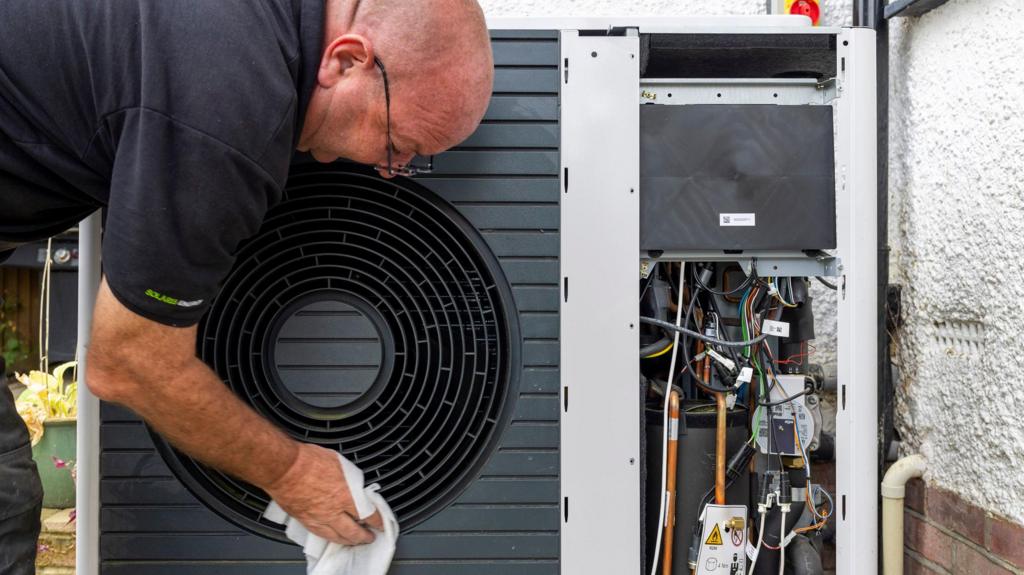
Air source heat pumps, the most prevalent type, draw in external air and circulate it over tubes containing refrigerant fluids. The heat absorbed from the air causes these refrigerants to vaporize, subsequently undergoing compression to elevate their temperature and distribute warmth throughout the home.
The system includes an outdoor unit, measuring approximately 1m x 1m x 0.4m, along with an indoor heat pump unit and a hot water cylinder.
The indoor unit is comparable in size to a conventional gas boiler, while the dimensions of the cylinder are contingent on the size of the property.
Ground source heat pumps offer enhanced efficiency compared to their air-source counterparts.
However, their implementation is typically more expensive and less common, as they necessitate either a deep borehole or a horizontal network buried across a substantial area.
The Boiler Upgrade Scheme provides a grant of £7,500 for homeowners in England and Wales toward the installation of an air source or ground source heat pump.
Even with the grant, households face an average additional expense of £5,000, which the UK’s spending watchdog has cautioned is prohibitively high for many.
The grant is applicable to both existing homes and non-domestic buildings, provided the property has a valid Energy Performance Certificate (EPC) issued within the last decade.
The government’s latest Warm Homes Plan extends this initiative through 2029/30.
Recent revisions to the scheme’s criteria eliminate the requirement for existing loft or cavity wall insulation, potentially saving homeowners approximately £2,500 in initial costs. Adequate insulation enhances the efficiency of heat pump operation.
For low-income households and those residing in social housing, the government is allocating an additional £5 billion in funding for the Social Housing Fund and the Warm Homes Local Grant.
The Warm Homes Local Grant offers funding for insulation, solar panels and air source heat pump via your Local Authority.
Eligibility requires residing in England, owning or renting your property privately, and possessing an Energy Performance Certificate (EPC) with a rating between D and G.
Scotland, and Northern Ireland, have separate programs to enhance home energy efficiency, and the current plan entails increased funding for these devolved administrations.
While upfront costs remain considerable, the Climate Change Committee (CCC), which advises the UK government on emissions reduction, suggests that heat pumps could become more economical to operate than gas boilers.
The overall cost hinges on prevailing energy prices and the efficiency of the heat pump.
Although electric heat pumps consume significantly less energy than gas boilers, electricity rates are generally higher than those for gas.
Energy tariffs specifically designed for heat pump owners can facilitate savings and incentivize the installation of solar panels, enabling households to generate their own electricity and lessen their reliance on the grid.
Nesta, a social charity, estimates that the combination of solar panels and a heat pump could save the average household nearly £1,000 in annual energy expenses.
Previously, homeowners were required to obtain planning permission for heat pump installations within one meter of a neighboring property due to noise concerns.
This regulation has been revoked to expedite the adoption of heat pump technology.
Noise concerns are also mitigated in newer models, although units must still adhere to specified volume limits, set at 42dB, comparable to the noise output of a refrigerator.
Regulations governing the size and quantity of heat pumps that households can install have also been eased.
The rate of heat pump installations in the UK remains substantially lower than that of gas boilers.
Installations are also lower compared to other major European nations such as France, Germany, and Italy.
However, sales are on the rise. Nearly 100,000 heat pumps were sold in 2024, up from approximately 60,000 in 2023, according to the Heat Pump Association.
The CCC projects that this figure must increase to nearly 450,000 annually by 2030 and 1.5 million by 2035 to effectively meet climate objectives.
It suggests that around half of UK homes need to have heat pumps by 2040.
A significant increase in trained heat pump installers is essential to achieve this target.
The plan incorporates the Warm Homes Fund, intended to offer low- and zero-interest loans for solar panels and domestic storage batteries to all households.
The government has yet to determine the precise timing and mechanisms for accessing these funds but has indicated that further details will be announced later in the year.
Low-income individuals will be able to access the aforementioned technologies through the established Social Housing Fund and Local Grant initiatives.
Sign up for our Future Earth newsletter to keep up with the latest climate and environment stories with the BBC’s Justin Rowlatt. Outside the UK? Sign up to our international newsletter here.
The 2015 pact is at the heart of the international commitment to tackle rising global temperatures.
For the first time, the new wind farms will be connected to more than one country through undersea cables.
RHS said it will invest in more water capture and management projects than anything else in 2026.
The island’s Met Office has said weather changes has impacted the island’s farmers and fisheries
Heavy rains have ravaged the country’s North Island, with a minister comparing it to a “war zone”.
“`