

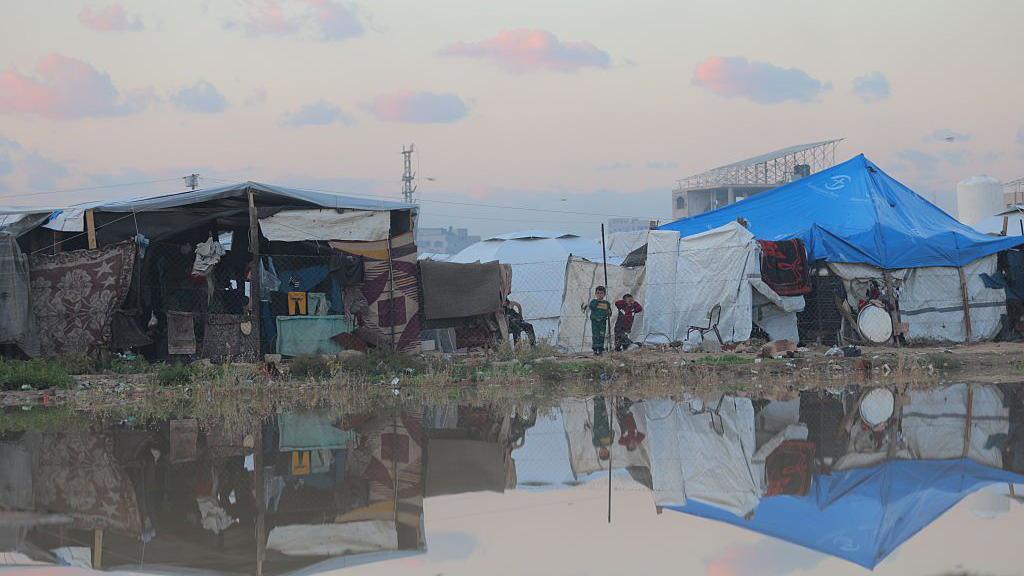
Recent heavy rainfall has intensified the already precarious living conditions for hundreds of thousands of displaced Palestinians in the Gaza Strip, according to reports from UN agencies.
Speaking to the BBC, Unicef spokesman Jonathan Crickx described the overnight weather as “horrendous,” noting floodwaters reaching depths of 15cm (6in) near his office.
Crickx expressed grave concerns that children residing in tents and makeshift shelters, exposed to the elements, are at heightened risk of hypothermia and other severe illnesses.
Gaza’s Hamas-run health ministry reports that one infant has died from hypothermia, with at least 11 additional fatalities attributed to building collapses caused by the severe weather.
Since the commencement of the Gaza ceasefire nine weeks ago, UN agencies have increased the provision of essential supplies, including tents, blankets, and clothing. However, they maintain that current aid levels remain insufficient.
The UN and its partners estimate that approximately 55,000 families have been adversely affected by the recent rainfall, resulting in damage or destruction to their belongings and shelters.
Following intense downpours earlier this week, over 40 designated emergency shelters experienced severe flooding, compelling numerous individuals to relocate once again.
“Last night was really horrendous for the families. The heavy rains were so intense that we could see from our office and guest house 10cm, 15cm (4-6in) of water at some point. And the winds were so strong,” Jonathan Crickx, chief of communications for Unicef State of Palestine, told the BBC’s Today programme on Wednesday.
“When I drove this morning, I could see that many, many people were trying with buckets to remove some of the water.”
He further noted that the majority of the estimated one million individuals residing in tents and makeshift shelters have been displaced multiple times during the two years of conflict between Israel and Hamas, with limited or no access to spare clothing.
“When I was seeing [children] this morning, their clothes were damp. I could see parents trying to dry some of the blankets they had. But it has been raining almost all of the time in the past four or five days, so it is extremely difficult to keep the children dry,” he said.
“With temperatures about 7C, 8C (45-46F) at night, we are extremely concerned about children getting sick or even worse, dying from hypothermia.”
Crickx also highlighted the vulnerability of many tents to strong winds, as they are constructed from rudimentary materials such as tarpaulin or plastic sheeting affixed to fragile wooden frames.
He acknowledged that Unicef has facilitated increased aid deliveries during the ceasefire, including 250,000 winter clothing kits, 600,000 blankets, and 7,000 tents, but emphasized that these provisions remain insufficient to meet the overwhelming need.
“We are working relentlessly to bring in that aid and to distribute it, but the scale of the needs is so immense that we still have thousands of people and children who are really suffering every night,” he warned.
Gaza’s health ministry reported the death of a two-week-old infant, Mohammed Abu al-Khair, due to hypothermia on Monday, following his admission to intensive care. Additionally, 11 individuals have reportedly died as a result of collapses in war-damaged buildings where they sought shelter.
Mahmoud Bassal, a spokesman for the Hamas-run Civil Defence agency, provided a higher death toll, stating that 17 individuals, including four children, have died due to building collapses and exposure to the cold.
He added that 17 residential buildings have been completely destroyed by wind and rain, with an additional 90 buildings suffering partial collapse.
Video footage from Tuesday depicted Civil Defence responders recovering the body of a man from the rubble of a collapsed building in the Shati refugee camp, located northwest of Gaza City. Eyewitnesses reported the sudden collapse of the building’s roof.
“We call on the world to solve our problems and rebuild the territory so that people can have homes instead of being displaced and living in the streets,” said Ahmed al-Hosari, a relative of the deceased, in a statement to AFP news agency.
The International Committee of the Red Cross (ICRC) expressed deep concern regarding the collapse of damaged buildings due to the severe weather conditions.
The ICRC underscored the need for “increased and sustained humanitarian assistance to respond to urgent and long-term needs, including food, shelter and equipment for the repair of critical infrastructure”.
Cogat, the Israeli military body overseeing Gaza’s border crossings, has refuted claims of deliberate aid restrictions, deeming them “inconsistent with facts on the ground, and the ongoing co-ordination taking place daily”.
Cogat reports that between 600 and 800 lorries carrying humanitarian supplies enter Gaza daily, and that nearly 310,000 tents and tarpaulins have been delivered since the start of the ceasefire, along with over 1,800 lorry loads of warm blankets and clothing.
The UN reports that a total of 67,800 tents, 372,500 tarpaulins, and 318,100 bedding items have been collected from crossings during the same period.
The second phase of the ceasefire between Israel and Hamas encompasses plans for the reconstruction of Gaza, post-war governance, the withdrawal of Israeli troops, and the disarmament of Hamas.
Last week, Israel’s prime minister indicated that the second phase was imminent, contingent upon the return by Hamas of the body of one deceased Israeli hostage in Gaza, as stipulated in the first phase.
The conflict was initiated by the Hamas-led attack on southern Israel on 7 October 2023, which resulted in approximately 1,200 fatalities and the abduction of 251 individuals.
According to the territory’s health ministry, over 70,600 individuals have been killed in Israeli attacks in Gaza since then.
The US will restrict entry of people from Burkina Faso, Mali, Niger, South Sudan and Syria as well as holders of Palestinian Authority passports.
Samuel Williams, 20, is due to appear Westminster Magistrates’ Court on 27 January 2026.
The strike killed Raed Saad, a senior commander in Hamas’ Qassam Brigades, the Israeli military said.
The Swiss singer sees a “clear conflict” between Israel’s participation in the event and Eurovision’s values.
Getting both sides to move onto the second stage is a huge challenge for Washington, as Gazans continue to suffer the longer it takes.