

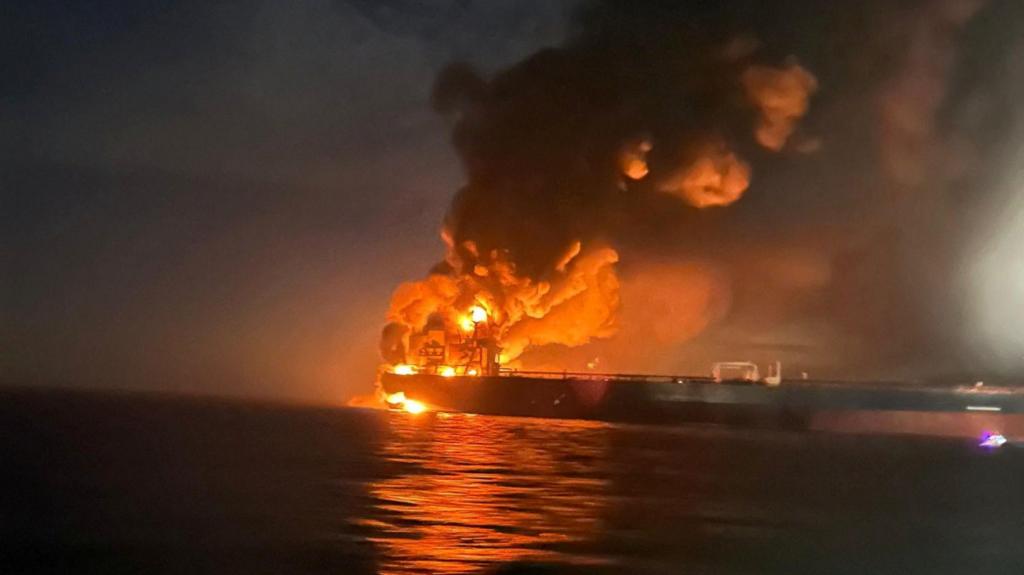
Ukrainian naval drones have reportedly struck two oil tankers belonging to Russia’s so-called “shadow fleet” while they were traversing the Black Sea, according to statements from Ukrainian officials.
Verified footage obtained by the BBC depicts the waterborne drones moving rapidly through the water toward the vessels before detonating, resulting in significant explosions and plumes of black smoke.
Turkish authorities identified the vessels as the Kairos and Virat, both of which are flagged to Gambia. The incidents occurred off the coast of Turkey on Friday, with reports indicating the Virat was struck again on Saturday. No casualties have been reported at this time.
These attacks appear to represent an escalation in Kyiv’s strategy to target Russia’s oil revenues, a crucial source of funding for its ongoing war in Ukraine.
The two tankers are alleged to be part of Russia’s “shadow fleet,” a term used to describe the hundreds of vessels Russia employs to circumvent Western sanctions imposed following its full-scale invasion of Ukraine in 2022.
The “shadow fleet” predominantly consists of older tankers, many with unclear ownership structures or insurance coverage.
The Kairos was struck in the southwestern region of the Black Sea, while the Virat was hit in a more central area further east. According to London Stock Exchange data, both vessels are listed as subject to sanctions.
Sources speaking to BBC Ukrainian indicated that Sea Baby drones, a type of naval drone produced by Ukraine’s security services (SBU), were utilized in the attacks.
Turkish authorities stated that they were providing assistance to the vessels and released footage showing Turkish boats attempting to extinguish the fire on the Kairos.
These attacks are interpreted as a warning from Ukraine, suggesting that vessels transporting Russian oil in the Black Sea face a heightened risk of direct attack, in addition to potential Western sanctions.
In a separate incident, a major consortium responsible for transporting oil from the Caspian region announced a suspension of loading operations at the Russian Black Sea port of Novorossiysk, following an overnight attack by unmanned boats.
The Caspian Pipeline Consortium reported that the attack caused significant damage to a mooring point. Russia and Kazakhstan are major stakeholders in the company, which also includes partial ownership by Western firms such as Exxon Mobil, Chevron, and Shell.
Meanwhile, Ukrainian President Volodymyr Zelensky announced on Saturday that a delegation led by top security official Rustem Umerov was en route to the United States to continue discussions on an agreement to end the war.
Umerov is slated to lead the Ukrainian delegation following the resignation of the previous lead negotiator, Zelensky’s chief of staff Andriy Yermak, after anti-corruption detectives searched his apartment on Friday.
The Ukrainian delegation is expected to meet with American officials in Florida on Sunday. Simultaneously, Steve Witkoff, U.S. President Donald Trump’s overseas envoy, is scheduled to hold talks in Moscow next week.
Andriy Yermak, 54, has served as the Ukrainian president’s chief of staff throughout Russia’s full-scale war.
Andriy Yermak has played a crucial role in Ukraine’s response to Russia’s war and is lead negotiator in peace talks.
The pair need to raise £7,000 to pay for their vehicle, fuel, insurance and passage into Ukraine.
The Russian president accuses Kyiv of wanting to fight “to the last Ukrainian” – which he says Russia is also “in principle” ready to do.
The film Hell Jumper tells the story of Cornwall aid worker Chris Parry who died in 2023.