

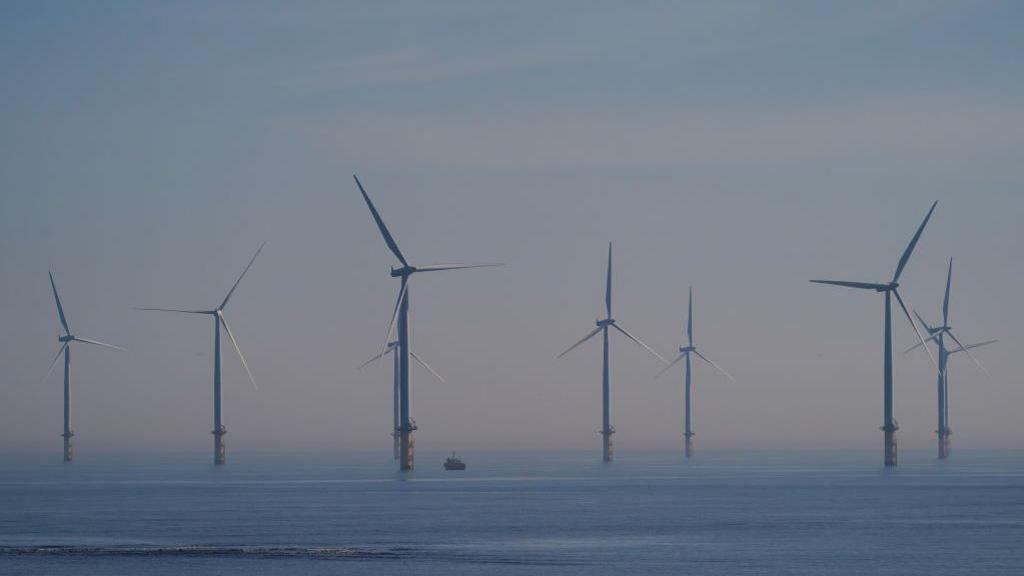
The UK government has awarded contracts for a record-breaking amount of offshore wind capacity, bolstering the nation’s efforts to expand its clean electricity generation.
The projects are distributed across England, Scotland, and Wales, and include a portion of what could become the world’s largest offshore wind farm, situated off the Scottish coast in the North Sea.
However, some analysts caution that despite this unprecedented investment in offshore wind, the government may still face challenges in achieving its 2030 “clean power” target.
While the government asserts that wind projects are more economical than constructing new gas power plants and will ultimately “reduce bills for good,” the Conservative party has criticized the climate targets, arguing that they contribute to rising energy prices.
The offshore wind sector has experienced cost increases in recent years, and the Conservatives contend that the contracts awarded in the latest auction could lock in elevated prices for decades to come.
One of the most significant projects to secure a contract is the initial phase of Berwick Bank in the North Sea, which has the potential to become the largest offshore wind farm globally.
Other projects receiving contracts include the Dogger Bank South wind farm off the Yorkshire coast and the Norfolk Vanguard project off the coast of East Anglia. Awel Y Mor marks the first successful Welsh project in over a decade, according to the government.
Chris Stark, who oversees the government’s clean power initiatives, described the auction results as “a great outcome for the country,” emphasizing that the geographical distribution of projects across England, Scotland, and Wales will facilitate more efficient electricity delivery to homes.
The government aims to generate at least 95% of Great Britain’s electricity from “clean” sources by 2030, partly to combat climate change by reducing carbon emissions from fossil fuel combustion. These clean sources encompass renewables – such as solar and wind – and nuclear energy.
Offshore wind is widely regarded as a critical component of Great Britain’s future clean electricity system, given the abundant wind resources available off the country’s coastlines.
The government is targeting a minimum of 43 gigawatts (GW) of offshore wind capacity by 2030 to help achieve its clean power goals.
This represents a significant increase from the current offshore wind capacity of 16.6GW, with an additional 11.7GW under construction, as reported by the government.
Developing offshore wind farms and connecting them to the grid is a time-intensive process, and many analysts viewed this auction as essential to securing sufficient wind capacity to meet the 2030 target.
The 8.4GW secured in this latest auction roughly maintains the feasibility of achieving the offshore wind target, according to several analysts who spoke with the BBC. However, all these projects will still need to be connected to the grid to generate electricity.
“Getting that amount of capacity online by 2030 [will be] extremely challenging,” stated Nick Civetta, project leader at the Aurora Energy Research think tank.
The increase in offshore wind costs in recent years is attributed to factors such as global supply chain constraints, rising steel prices, and elevated interest rates, partly stemming from the Russia-Ukraine war.
Last year, energy company Orsted decided to “discontinue” one of the country’s biggest wind projects, Hornsea 4, despite having previously been awarded a contract.
In this latest auction, traditional offshore wind projects – those fixed to the seabed – have been awarded an average fixed price of nearly £91 per megawatt-hour of electricity generated, in 2024 prices.
While this is a considerable decrease from the first auction in 2015, it is an increase from the £82/MWh awarded at the last auction for new-build projects in 2024, also in 2024 prices.
The government acknowledges the rising costs associated with offshore wind but argues that these costs should be compared with the cost of constructing new gas power plants.
Government figures suggest that building and fueling new gas plants would cost £147/MWh, including a carbon price – a charge for emissions.
“We’re confident that the renewables auction as a whole will help bring down bills for consumers,” Energy Secretary Ed Miliband told BBC News.
“The truth is, those who say we should stick with fossil fuels are making a massive gamble, and they’re gambling with the British people’s energy bills,” he added, referencing the surge in gas prices at the start of the Russia-Ukraine war.
However, shadow energy secretary Claire Coutinho stated: “They promised the British electorate that they would cut bills by £300. In fact, their bills have gone up by £200 since.”
“This is Ed Miliband’s new grand plan to lower bills, and he signed up to contracts for offshore wind, which are the highest prices we’ve seen in a decade,” she told BBC News.
Coutinho also suggested that offshore wind brings additional costs, such as the need to upgrade the grid.
Reform has also consistently criticized the cost of net zero, but the Lib Dems and Greens both support the expansion of renewables to address climate change and promote green jobs.
SNP and Plaid Cymru also support the growth of offshore wind, but argue that Scotland and Wales should have control over their energy resources.
The auction results have been generally welcomed by the energy industry and climate groups, although RSPB Scotland has expressed concerns about the potential impacts of the Berwick Bank farm on seabird populations.
The prices awarded by the government are fixed – in this auction, for 20 years. This certainty is intended to reassure developers that they will receive a return on their upfront investment.
The projects can ultimately either increase or decrease household bills, depending in part on how they compare to the price of electricity on the wholesale market. Their final impact on bills depends on a range of factors, including future electricity demand – which is expected to rise – and the price of gas.
Previous renewables projects funded by this scheme have often received an effective subsidy. However, analysts suggest they have also generated some savings elsewhere by displacing some of the most expensive gas power stations and lowering prices on the wholesale electricity market.
Currently, wholesale market prices are typically driven by gas, but it is anticipated that growing clean energy sources will more frequently set the wholesale price in the future.
In the Budget, the government announced changes that could reduce energy bills by approximately £150 by shifting some costs for older renewables onto general taxation and eliminating an energy efficiency scheme.
However, at the same time, plans for grid upgrades – announced last year by the energy regulator Ofgem – will also begin to increase bills.
Sign up for our Future Earth newsletter to keep up with the latest climate and environment stories with the BBC’s Justin Rowlatt. Outside the UK? Sign up to our international newsletter here.
Human activities are causing the world to heat up, posing serious threats to people and nature.
The stripes were created in 2018 and show the change in average global temperatures since 1850.
Fosse Green’s plans include putting solar panels on land south of Lincoln that will last 60 years.
The last three years were Earth’s hottest on record, as humanity’s carbon emissions continue to heat the planet.
US emissions of planet-warming gases rise for the first time in three years.