

“`html
Downing Street has stated that the UK remains engaged in “active conversations with US counterparts at all levels of government” regarding a comprehensive technology agreement.
The BBC has learned that discussions surrounding the Technology Prosperity Deal have encountered delays due to concerns from the US side about perceived broader UK trade barriers.
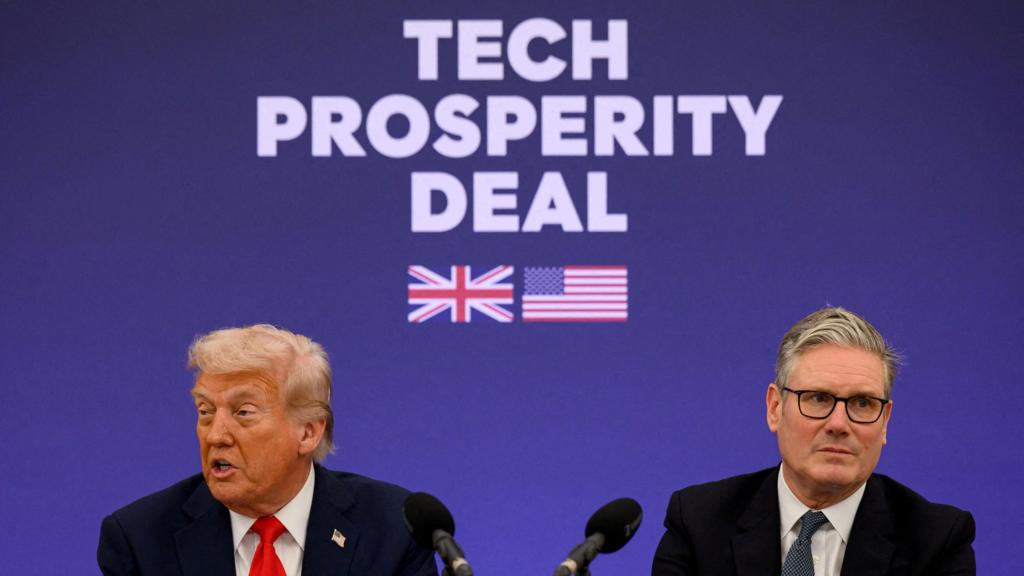
Upon its unveiling during US President Donald Trump’s state visit in September, the partnership was touted as “historic,” with both nations pledging to enhance collaboration in areas such as artificial intelligence and quantum computing.
“We’re confident of securing a deal that will shape the future of millions on both sides of the Atlantic,” the Prime Minister’s official spokesman commented.
While declining to comment directly on the “live” discussions, the spokesman added that “negotiations of this kind are never straightforward.”
The New York Times, which first reported the story, indicated “broader disagreements” between the two countries, encompassing digital regulations and food safety standards.
The UK government refrained from commenting on these specific claims. The White House has not yet responded to the BBC’s request for comment.
However, Trump’s science adviser Michael Kratsios indicated on Tuesday evening that the administration hoped to restart talks over the deal.
“In line with Section III of the US-UK Technology Prosperity Deal, we hope to resume work with the United Kingdom once the UK has made substantial progress in implementing its commitments under the Economic Prosperity Deal,” Kratsios wrote on X.
“We look forward to continuing our productive collaboration across AI, quantum, nuclear, and other critical technology areas under the Deal.”
At the time of the deal’s announcement, the government emphasized the anticipated benefits.
“This Tech Prosperity Deal marks a generational step change in our relationship with the US,” Prime Minister Sir Keir Starmer said in a statement.
Technology secretary Liz Kendall stated that the partnership would “transform lives across Britain” and represented a “vote of confidence in Britain’s booming AI sector.”
Concurrent with the deal’s unveiling, several US tech firms announced significant investments in the UK.
Tech giants including Microsoft, Nvidia, and Google outlined a total of £31bn in planned spending.
These investment plans are reportedly unaffected.
Google, Microsoft, and Nvidia have been contacted for comment, but have not yet responded to the BBC.
Nvidia boss Jensen Huang said in September his company’s UK investment reflected his belief it could become an “AI superpower” – an ambition championed by Sir Keir’s government.
It said investment announced by tech firms alongside the Tech Prosperity Deal would be used to scale-up AI infrastructure such as data centres, across the UK.
The tech pact was formalized in a Memorandum of Understanding (MOU) outlining collaborative efforts in AI, quantum computing, and nuclear power.
The MOU included potential collaborations in building “powerful quantum machines,” supporting AI hardware innovation, and exploring novel applications of advanced nuclear energy.
However, the MOU also stipulates that its proposals are non-binding and “becomes operative alongside substantive progress being made to formalise and implement” the wider US-UK Economic Prosperity Deal, signed in May.
The Trump administration had sought to reshape global trade regulations, imposing tariffs on numerous countries, including allies such as the UK, while pursuing new agreements deemed fairer to the US.
For the UK, this has entailed negotiations across various economic sectors, resulting in agreements on automobiles and, more recently, pharmaceuticals.
Nevertheless, a proposed agreement to eliminate tariffs on UK steel exports to the US has been indefinitely suspended, according to BBC sources.
Allie Renison, director at communications firm SEC Newgate UK and a former government trade advisor, suggested that the current impasse on tech reflected the US and UK’s “slightly piecemeal approach” to securing trade deals.
“Instead of having everything done at once, different areas are being linked to different parts,” she told the BBC – noting how concerns about separate trade areas may now be affecting tech agreements.
While questions lingered regarding the potential implications of the roadblocks for US tech firms’ pledged investments in the UK, Ms. Renison suggested it was likely “a bit of posturing in the wider negotiations”.
Additional reporting by Michael Race and Philippa Wain
Sign up for our Tech Decoded newsletter to follow the world’s top tech stories and trends. Outside the UK? Sign up here.
“`