

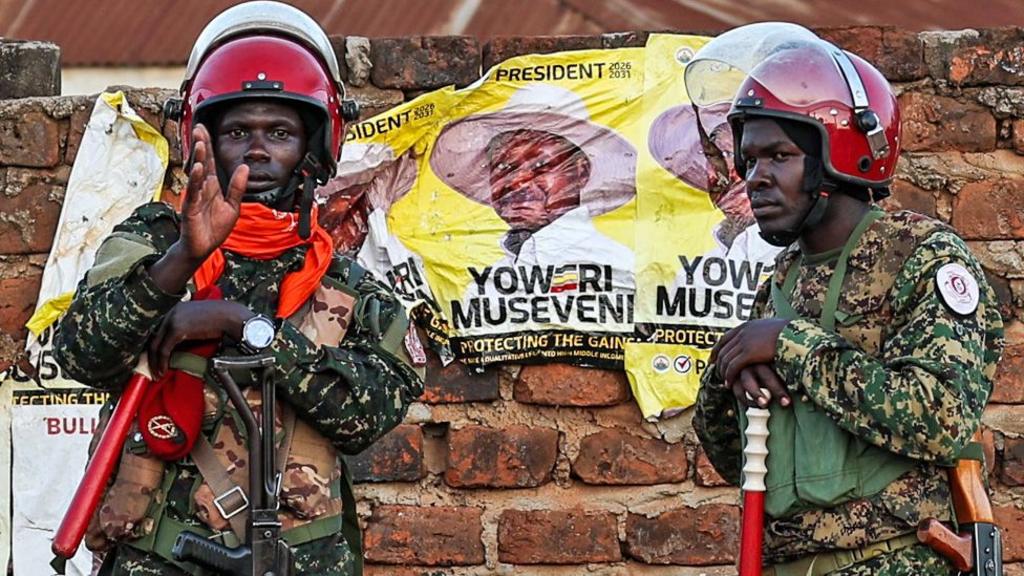
Uganda’s incumbent President Yoweri Museveni has secured a significant lead in Thursday’s presidential election, according to preliminary results. His main rival, Bobi Wine, and his party have already raised concerns regarding the legitimacy of the electoral process.
Current figures indicate Museveni with 75% of the vote, while Wine trails with 21%, based on returns from 70% of polling stations.
Wine’s party alleged via social media that a helicopter landed on his property in Kampala and “forcibly took him away to an unknown destination.”
Due to the ongoing internet shutdown, verification of these claims remains challenging. Local police informed the BBC that they were unaware of the reported incident.
Earlier, Wine stated he was under house arrest, with security forces surrounding his residence.
Police spokesman Kituuma Rusoke told local broadcaster NBS that Wine, as a presidential candidate, was “a person of interest,” adding that the enhanced security presence around his home was for his protection.
Several local journalists reported that security forces prevented them from accessing the opposition leader’s home in Kampala’s Magere area.
Wine has also urged his supporters to disregard the “fake results” being announced, accusing authorities of “stealing the vote.” He has not yet provided evidence to support his allegations, and authorities have not commented on the claims.
Reports emerged late Thursday of at least seven opposition supporters killed in disputed circumstances in Butambala, approximately 55km (35 miles) south-west of the capital.
The internet shutdown imposed earlier in the week delayed the emergence of news regarding the violence until Friday.
MP Muwanga Kivumbi, representing Wine’s National Unity Platform (NUP), told AFP news agency that soldiers and police used tear gas and live ammunition against hundreds of people gathered at his home following early results announcements.
“Ten were killed inside my house,” he stated.
Human rights activist Agather Atuhaire corroborated this account to Reuters news agency.
However, local police spokesperson Lydia Tumushabe offered a conflicting account, asserting that police fired in self-defense after “a group of NUP goons” attacked a police station and planned to overrun a tallying center.
She told Reuters that the group was carrying machetes, axes, and boxes of matches, and confirmed at least seven fatalities.
On Friday, the US embassy issued an alert to its citizens due to reports of security forces “using tear gas and firing into the air to disperse gatherings.”
Following the 2021 election, in which he received 35% of the vote, Wine was confined to his home for several days by security forces.
Electoral chief Simon Byabakama stated Friday that the vote counting process was not affected by the internet blackout, as the commission was utilizing a “private system” to transmit results from districts to the national tally center.
Regarding the timing of the final results announcement, Byabakama said: “We are on course to announce the winner of the presidential election within 48 hours. Before 5 PM [14:00 GMT] tomorrow, we shall have the final results.”
Thursday’s election followed a campaign period often marked by violence. President Museveni, 81, is seeking a seventh term in office, having first assumed power as a rebel leader in 1986.
Wine, a 43-year-old pop star-turned-politician, positions himself as a representative of the youth in a country where the majority of the population is under 30. He has pledged to combat corruption and implement sweeping reforms. Museveni, in contrast, argues that he is the only guarantor of stability and progress in Uganda.
Last week, the United Nation’s Human Rights Office stated that the election would be characterized by “widespread repression and intimidation.”
During Thursday’s vote, many polling stations across the country experienced delays of up to four hours due to the late arrival of ballot boxes and malfunctions with biometric machines used for voter verification.
Some have attributed these issues to the network outage.
While there are six other candidates, the presidential poll is largely seen as a contest between Museveni and Wine.
The campaign period was marred by disruptions to opposition activities, with security forces accused of assaulting and detaining Wine’s supporters.
Rusoke, the police spokesperson, dismissed these complaints, accusing opposition supporters of disruptive behavior.
Internet access was suspended on Tuesday, with Uganda’s Communications Commission stating the blackout was necessary to prevent misinformation, fraud, and the incitement of violence. This action has been condemned by the UN human rights office as “deeply worrying.”
Additional reporting by Sammy Awami in Kampala
Go to BBCAfrica.com for more news from the African continent.
Follow us on Twitter @BBCAfrica, on Facebook at BBC Africa or on Instagram at bbcafrica
Abubakar Abdullahi sheltered 262 people after they came under attack from Fulani herders in 2018.
Severe flooding believed to be worsened by climate change has killed at least 19 people in South Africa in recent weeks.
The defence minister orders an inquiry into reports the military flouted orders to expel Iran from naval drills.
Novelist Chimamanda Ngozi Adichie says her child’s death was caused by medical negligence, which the hospital denies.
Moroccan fans celebrated through the night as their beloved Atlas Lions beat Nigeria to make it to the Afcon final.