

“`html
As President Donald Trump continues to advocate for the United States to possess Greenland, his broader focus on the Arctic region has prompted Washington to commission new icebreakers.
For these specialized vessels, designed to navigate through ice-covered seas, the US has turned to Finland, a recognized global leader in icebreaker technology.
Inside Aker Arctic Technology’s ice laboratory, temperatures remain sub-zero as a scale model of an icebreaker navigates a 70-meter-long simulation tank.
The model efficiently carves a path through the frozen water surface.
This design, undergoing testing at a Helsinki facility, represents the next generation of Finnish icebreakers.
“Sufficient structural strength and engine power are crucial,” notes Riikka Matala, an ice performance engineer.
Mika Hovilainen, the firm’s chief executive, emphasizes the significance of the vessel’s design. “The hull form must break ice by bending it downwards,” he explains. “It’s not about cutting or slicing.”
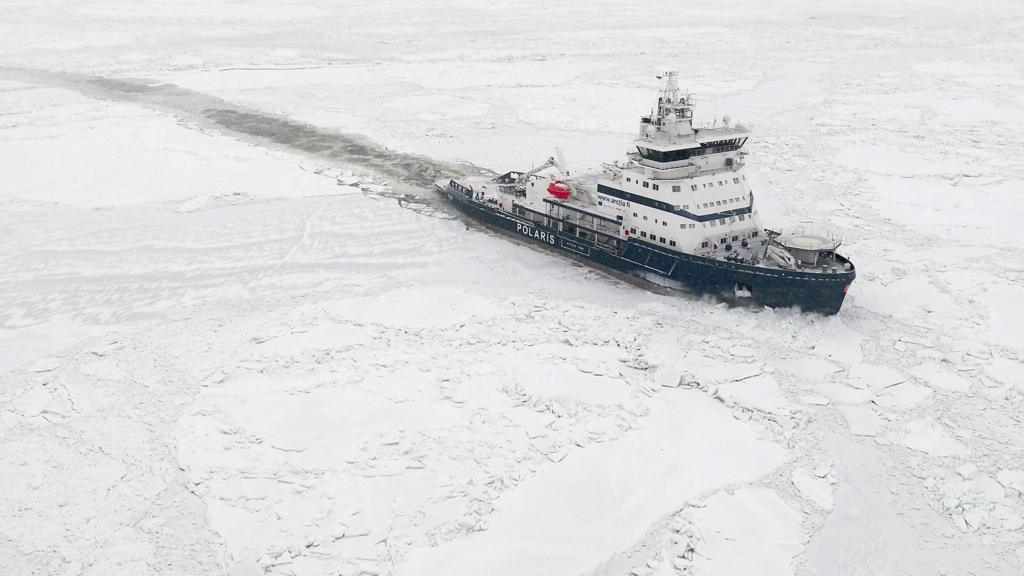
Finland stands as the undisputed world leader in icebreaker technology. Finnish companies have designed 80% of the icebreakers currently in operation, with 60% constructed in Finnish shipyards.
Maunu Visuri, president and chief executive of the Finnish state-owned company Artica, which operates a fleet of eight icebreakers, explains that this leadership is born out of necessity.
“Finland is the only country globally where all harbors may freeze during winter,” he states, adding that 97% of the nation’s goods are imported by sea.
During the coldest months, icebreakers ensure the operability of Finland’s ports, serving as guides for large cargo ships. “It’s a true necessity for Finland; we consider Finland an island.”
This expertise led to Trump’s October announcement that the US planned to order four icebreakers from Finland for the US Coast Guard.
An additional seven vessels, designated “Arctic Security Cutters” by the US, will be built domestically, utilizing Finnish designs and expertise.
“We’re acquiring the finest icebreakers globally, and Finland is renowned for their production,” stated Trump.
While US law typically mandates that naval and coast guard ships be built domestically, the president waived this requirement on national security grounds, citing “aggressive military posturing and economic encroachment by foreign adversaries,” alluding to Russia and China.
This US concern arises as climate change makes the Arctic Ocean increasingly navigable for cargo ships, provided icebreakers can clear the way. This opens commercial trade routes from Asia to Europe, either via Russia or north of Alaska and Canada, then past Greenland.
Furthermore, reduced ice levels enhance accessibility to Arctic oil and gas fields.
“There is simply more activity in that region,” notes Peter Rybski, a retired US Navy officer and Arctic expert based in Helsinki.
“Russia has an active oil and gas exploration and extraction industry, alongside a newly-emerging trans-shipment route from Europe to Asia.”
Following Trump’s initial announcement, the first contracts were awarded on December 29.
Finland’s Rauma Marine Constructions will build two icebreakers for the US Coast Guard at its shipyard in Rauma, with the first ship expected in 2028.
The remaining four will be built in Louisiana, with all six utilizing a diesel-electric powered design from Aker Arctic Technology.
The US orders represent an effort to match Russia’s icebreaker capacity. Russia currently operates approximately 40 icebreakers, including eight nuclear-powered vessels.
In contrast, the US has only three icebreakers in operation.
China operates around five polar-capable vessels. “None are technically icebreakers,” says Rybski, noting that their design does not meet the stringent criteria. “However, they are expanding their fleet.”
He adds that China has been increasingly deploying these “research” ships into Arctic waters between Alaska and the Russian Far East, including areas the US considers its “exclusive economic zone.”
“This presents a problem for the US, given its limited means to respond.”
Lin Mortensgaard, a researcher at the Danish Institute of International Studies, argues that Trump’s ambition to expand the icebreaker fleet extends beyond operational necessities in icy Arctic seas, representing a projection of power.
“Regardless of the number of aircraft carriers or their use in threatening states, they cannot navigate the central Arctic Ocean,” she states.
“Icebreakers are the only naval vessels capable of signaling Arctic state status and capabilities. I believe this is a central theme of the US discourse.”
Back in Finland, Helsinki Shipyard occupies a dock on the capital’s waterfront, where half of the world’s icebreakers have been built. Now owned by Canadian firm Davie, it also seeks new contracts from the US Coast Guard.
“The geopolitical situation has undoubtedly shifted,” says Kim Salmi, the shipyard’s managing director.
“We have our eastern neighbor here [Russia]. They are developing their own [new] fleet. And the Chinese are building theirs.”
He adds: “The US, Canada, and the Western allies, in general, are seeking a balance of power.”
Inside a vast shipbuilding hangar, workers cut and weld steel for the yard’s latest icebreaker, a heavy-duty Arctic vessel named Polarmax destined for the Canadian coast guard.
The Finns can construct these complex vessels with remarkable speed—between two-and-a-half and three years—thanks to a streamlined production method and decades of experience.
“We have practiced this for over 100 years,” says Artica’s Visuri. “There’s a cycle of designers, operators, and builders. This is why Finland is the superpower of icebreakers.”
The conversation follows the US president vowing a 10% levy on the UK and others opposing his annexation of the Danish territory.
Trump’s volatile trade policy has thrown the world economy into chaos, and put some US prices up.
The US president says several European allies opposed to his plans to buy Greenland will face 10% tariffs from February.
The US president’s latest threats will baffle the leaders of allied nations, writes the BBC’s economics editor.
Meri-Tuuli Auer told her counsellor things about her life she didn’t want her closest family to know.
“`