

On Tuesday, the Coalition of the Willing, comprised largely of European leaders, convened in Paris alongside representatives of U.S. President Donald Trump, aiming to foster progress toward a lasting peace agreement for Ukraine.
With Ukrainian President Volodymyr Zelensky asserting that a plan to resolve the conflict with Russia is “90% of the way there,” participants were keen to maintain American involvement.
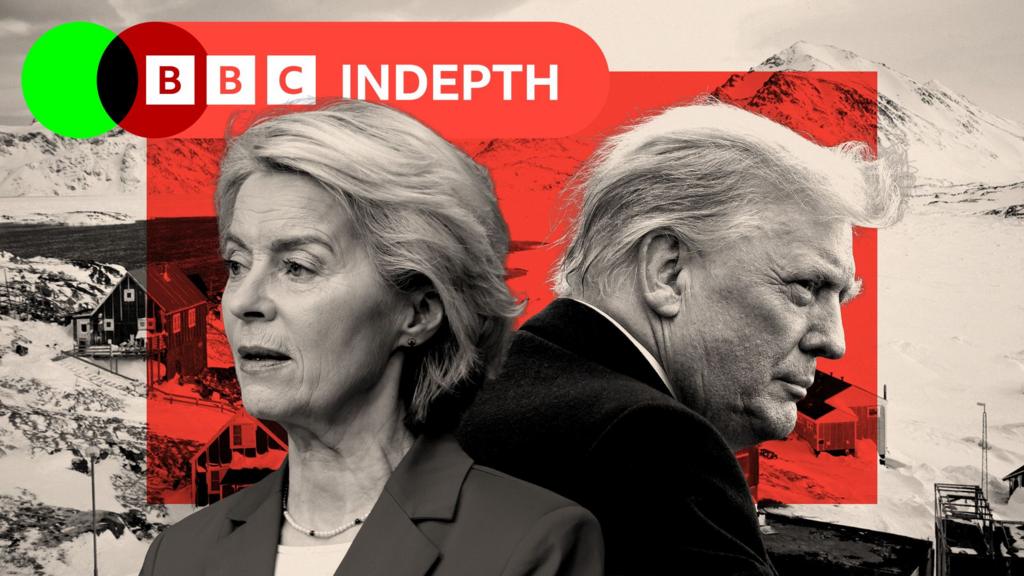
However, the meeting in Paris was overshadowed by a significant concern: Greenland. The issue loomed large over the proceedings.
Greenland, the world’s largest island—six times the size of Germany—is located in the Arctic and constitutes an autonomous territory of Denmark.
President Trump has asserted his desire, citing U.S. national security interests, to acquire the island.
Danish Prime Minister Mette Frederiksen, a crucial EU ally and a key NATO partner of the United Kingdom, attended the Paris gathering.
While these nations are wary of antagonizing President Trump, escalating political tensions in Washington and Copenhagen prompted six major European powers, including the UK, France, and Germany, to issue a joint statement on the sidelines of the Ukraine discussions.
The statement emphasized that Arctic security should be pursued collectively, in conjunction with NATO allies, including the United States, and that matters pertaining to Denmark and Greenland should be decided solely by Denmark and Greenland.
However, the question remained: would this be sufficient to curb President Trump’s ambitions?
The answer, delivered within hours, was negative.
The White House released a statement indicating that it is “discussing a range of options” for acquiring Greenland, including unilateral measures such as purchasing the island.
In a particularly concerning note for European leaders, White House press secretary Karoline Leavitt stated that “utilizing the U.S. military is always an option at the Commander-in-Chief’s disposal.”
While President Trump has previously expressed interest in acquiring Greenland, many in Europe, particularly during his first term, privately dismissed the notion.
However, following the Trump administration’s recent military intervention in Venezuela, the matter is no longer taken lightly.
Denmark’s Prime Minister has asserted that President Trump’s intentions regarding Greenland should be taken seriously, leaving European leaders deeply concerned.
The situation presents a notable irony: European leaders are seeking the Trump administration’s cooperation in safeguarding the sovereignty of Ukraine against Russian territorial ambitions, while the U.S. has militarily intervened in Venezuela and continues to threaten the sovereignty of Denmark.
Adding to the complexity, both Denmark and the U.S. are members of NATO.
Copenhagen considers the U.S. to be a close ally, or rather, did.
Denmark contends that unilateral action by the Trump administration regarding Greenland would jeopardize the transatlantic defense alliance that has underpinned European security since World War II.
President Trump’s skepticism toward NATO is well-documented.
Copenhagen has attempted to engage the Trump administration on the issue of Greenland.
Under a bilateral agreement dating back to the Cold War, the U.S. maintains a military base in Greenland. While the U.S. has reduced its personnel there from approximately 10,000 during the Cold War to around 200, it has faced accusations of neglecting Arctic security until recently.
Denmark recently pledged to invest $4 billion in Greenland’s defense, including boats, drones, and aircraft.
However, the Trump administration has shown no interest in engaging with Danish officials.
On Sunday, President Trump asserted that Greenland is “so strategic right now…covered with Russian and Chinese ships all over the place. We need Greenland from the standpoint of national security, and Denmark is not going to be able to do it.”
Denmark disputes this assertion.
Speaking anonymously, an EU official stated, “This whole situation has just underlined—once again—Europe’s fundamental weakness vis-a-vis Trump.”
While Denmark’s Nordic neighbors swiftly voiced their support after President Trump’s comments on Greenland, there was an initial silence from Europe’s major powers—London, Paris, and Berlin.
Eventually, UK Prime Minister Sir Keir Starmer stated on Monday that Denmark and Greenland alone should decide the island’s future. German Chancellor Friedrich Merz has expressed similar sentiments in the past.
Emmanuel Macron visited Greenland in December as a gesture of solidarity with Copenhagen. And today came the joint statement.
However, the communique notably lacked direct criticism of the U.S.
“Had there been a common statement from all 27 EU partners, plus Nato ally the UK, in support of Danish sovereignty, that would have sent a powerful message to Washington,” Camille Grande of the European Council on Foreign Relations, and former Assistant Secretary General for Defence Investment at Nato from 2016 to 2022, stated.
However, only six of Denmark’s European allies issued that statement together.
This highlights a central issue: President Trump’s assertive approach has made European leaders apprehensive.
They have generally opted to manage the U.S. President, often to safeguard bilateral relations, rather than confront him and risk potential consequences.
In the current landscape of major power politics, dominated by the U.S. and China, along with Russia and India, Europe risks being marginalized.
Despite repeated pledges to play a greater role on the global stage, the EU has appeared weak in the face of President Trump.
At the end of last year, the EU failed to fulfill a pledge to financially support Ukraine using Russian state assets frozen in the EU. They found the money by other means, but critics say the bloc very publicly missed sending a potentially strong message both to Moscow and to the Trump administration, that has repeatedly dismissed the bloc as feeble.
Furthermore, in its role as a major trading power, the EU has deferred to President Trump.
When he imposed 15% tariffs on EU goods last year, the bloc refrained from retaliating, fearing the loss of U.S. support for its security and defense.
Now, the situation with Greenland and Denmark highlights divisions within the EU regarding attitudes toward the Trump administration and the extent to which member states are willing to defend Copenhagen.
Julianne Smith, former U.S. ambassador to NATO, suggests that this situation “risks breaking the EU” and poses an existential dilemma for NATO.
“Europe should take President Trump and his team seriously when they talk about “getting” Greenland,” Julianne Smith stated.
“That means doing more than urging restraint. The leading powers in Europe may want to begin contingency planning; consider how they can make best use [of international meetings, such as] the upcoming Munich Security Conference and Davos where US senior officials will be present; and also consider bold and innovative ideas like new defence pacts.”
NATO treaties do not differentiate between attacks on allies from external countries or from within the alliance, but there is an understanding that Article 5 – its “all for one and one for all” clause – does not apply to conflicts between NATO members.
For example, consider the conflict between Turkey and Greece over Cyprus, with the worst violence occurring in 1974 when Turkey invaded. NATO did not intervene, but the U.S. helped mediate.
Returning to the geography, Denmark is one of NATO’s smaller allies, while the U.S. is its largest and most powerful member.
The prevailing sentiment in Europe is one of deep concern.
While major European powers have issued a joint statement emphasizing NATO as a forum for discussing Arctic security and affirming that only Denmark and Greenland can decide the island’s future, the extent to which the UK, France, Germany, and others would guarantee that sovereignty remains uncertain.
“Nobody’s going to fight the United States militarily over the future of Greenland,” stated White House Deputy Chief of Staff Stephen Miller in an interview with CNN on Monday.
ECFR’s Camille Grande asserts that tensions over Greenland highlight “the need for the Europeans to reduce security dependencies on the US and to speak with one voice.”
Last summer, President Trump secured commitments from all NATO allies, except Spain, to significantly increase their defense spending.
However, Europe remains heavily reliant on the U.S. in areas such as intelligence gathering, command and control, and air capabilities, a fact well-known to Washington.
NATO insiders report that even in private meetings, European member states struggle to contemplate the potential consequences of a U.S. military move on Greenland.
They may soon have to.
Top picture credit: NurPhoto/Getty Images
BBC InDepth is the destination on the website and app for in-depth analysis, featuring fresh perspectives that challenge assumptions and comprehensive reporting on the most critical issues of the day. You can now subscribe to receive notifications whenever an InDepth story is published – click here to find out how.
Wall Street investors have bought thousands of homes to rent out, a practice that has sparked concerns about affordability.
The French film star had wanted her funeral to be without fanfare – but locals wanted to pay her a proper adieu.
The US president’s repeated demands to control Greenland could threaten the Nato military alliance.
The changes receive mixed reviews from experts, in particular over concerns some could lead to people eating more saturated fats.
The White House says it is considering a range of options to acquire the island, including deploying the military.