

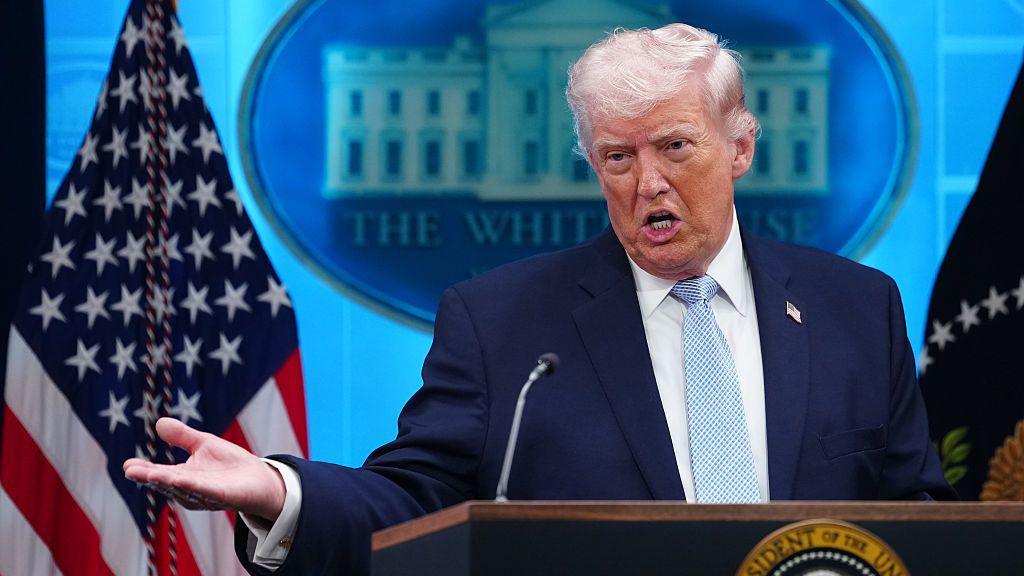
U.S. President Donald Trump has threatened decisive action against Iran, stating the country could be “taken out in one night” if it fails to reach an agreement by his set deadline to reopen the Strait of Hormuz, a crucial artery for global energy supplies.
Trump’s ultimatum demands an “acceptable” deal—ensuring the unimpeded flow of energy through the Gulf—by 8:00 PM Washington D.C. time on Tuesday (00:00 GMT Wednesday).
Speaking at the White House, Trump indicated that he believed “reasonable” leaders in Iran were negotiating in “good faith,” but the ultimate outcome remained uncertain.
Iran has reportedly rejected proposals for a temporary ceasefire, instead advocating for a permanent resolution to the conflict and the lifting of sanctions.
Trump’s news conference, held alongside General Dan Caine, Chairman of the Joint Chiefs of Staff, and Defense Secretary Pete Hegseth, follows the successful recovery of two crew members of a downed U.S. F-15 fighter jet in southern Iran.
While Trump largely focused on what he termed the “heroic” rescue of the aircrew, he reiterated his warning that the U.S. could target Iran’s energy and transportation infrastructure if the Strait of Hormuz remains closed past Tuesday’s deadline.
“The entire country can be taken out in one night – and that night might be tomorrow night,” he stated on Monday.
Trump further asserted that if the deadline passes without an agreement, Iran would be relegated to the “Stone Ages.”
“They’re going to have no bridges,” he said. “They’re going to have no power plants.”
Despite Iran’s previous rejection of U.S. demands, Trump maintained his optimistic view that Iran was negotiating in good faith following recent U.S. and Israeli strikes that resulted in the deaths of several Iranian leaders.
“We’re going to find out,” he said.
According to a regional official with knowledge of the discussions, meaningful progress in negotiations is unlikely without a ceasefire in place.
The official, who requested anonymity due to the sensitive nature of the talks, cited difficulties in communicating with Iranian officials amid an ongoing communications blackout as a complicating factor.
“To convey messages to Iran, getting a response in a reasonable time is not possible,” the official stated. “The average time of response has been a day or so.”
Pakistan, Turkey, and Egypt have reportedly been involved in mediation efforts.
Trump provided limited details regarding the administration’s future plans, stating only that he has “the best plan” but would not disclose it to the media.
Legal experts have cautioned that deliberate and sustained attacks on Iranian infrastructure could constitute a war crime.
“Obliterating all power plants, threatening coercive actions against the civilian population to try to bring a government to the negotiating table, those kinds of things are all flatly illegal,” Tess Bridgeman, former Obama-era National Security Council legal advisor, told CBS, the BBC’s U.S. partner.
Earlier in the day, Trump stated he was not “worried” about that possibility, and in the news conference insisted that Iran’s population would be “willing to suffer to have freedom,” even if toppling Iran’s government was not his intention.
The President also reiterated his criticism of key U.S. allies—including the UK, NATO, and South Korea—claiming they had failed to provide adequate support to the U.S. during the conflict.
“That’s a mark on Nato that will never disappear,” he said, adding that the U.S. does not “need” the UK.
According to an update from the U.S. military’s Central Command on Monday, American forces have conducted over 13,000 strikes across Iran since the commencement of hostilities.
Once contact was regained, astronaut Christina Koch said: “It is so great to hear from Earth again.”
Nations in the region have been keen to reach agreements as their economies are heavily reliant on Middle East energy.
The judge said the musician’s behaviour when he was arrested in LA last year was “aberrant from his normal conduct”.
The crew broke a previous record of 248,655 miles (400,171km) set by the Apollo 13 crew in 1970, and they are still heading further away from Earth.
Artemis II Commander Reid Wiseman’s wife died from cancer in 2020 at age 46.