

“`html
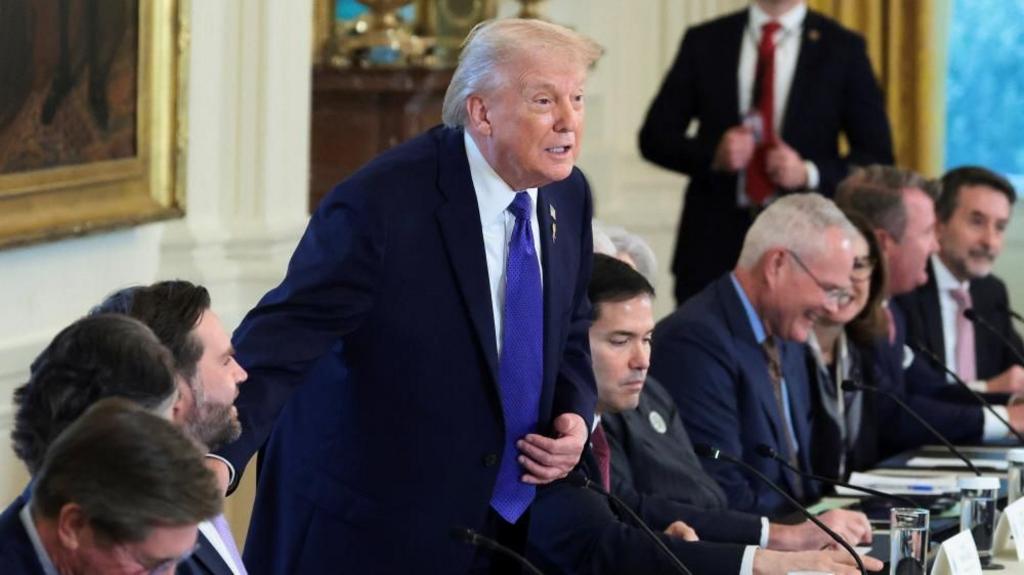
U.S. President Donald Trump convened a meeting with oil industry executives in Washington on Friday, advocating for significant investments in Venezuela’s oil sector.
However, the meeting did not yield immediate major financial pledges. The head of ExxonMobil cautioned that the South American nation is currently “un-investable.”
While Trump expressed his expectation for large oil companies to invest “at least” $100 billion in the country, industry analysts have noted that many companies remain hesitant due to the perceived high-risk environment.
Last week, the U.S. apprehended Venezuelan leader Nicolás Maduro, who is currently detained in New York.
Vice President Delcy Rodríguez, viewed as more pragmatic, has assumed the role of interim president.
Executives from major U.S. oil firms attending the meeting acknowledged Venezuela’s vast proven oil reserves as a significant opportunity.
During a press conference with Trump, they emphasized the need for substantial reforms within Venezuela, along with a welcoming stance from the government and its people, to create an attractive investment climate.
“We have had our assets seized there twice, and re-entering a third time would necessitate considerable changes from historical experiences and the current state,” stated Exxon CEO Darren Woods. “Today, it’s un-investable.”
Venezuela’s relationship with international oil companies has been complex since the discovery of oil on its territory over a century ago.
Chevron remains the last major American oil firm operating in the country, alongside a few companies from other nations, including Spain’s Repsol and Italy’s Eni, both of which were represented at the White House meeting.
Exxon and ConocoPhillips, also in attendance, have been seeking to recover billions of dollars in compensation following the 2007 nationalization of their assets.
Trump has alluded to this issue repeatedly this week as justification for intervention, including on Friday. However, he downplayed the chances of immediate recovery in the meeting, echoing previous comments by administration officials who stated that debt repayment was not a priority.
“We’re not going to go back,” Trump stated, adding that his administration would work to strike a “deal” with companies to realize his vision for revitalizing the industry.
Venezuela possesses some of the world’s largest oil reserves.
However, production has declined sharply in recent decades due to disinvestment, mismanagement, and U.S. sanctions limiting access to the global market.
Currently, the country’s production of approximately 1 million barrels per day accounts for less than 1% of global supply.
The White House has indicated plans to “selectively” roll back these restrictions, while also asserting the intent to control sales of Venezuelan oil as leverage over the Venezuelan government.
The U.S. recently seized several oil tankers carrying sanctioned crude. U.S. officials have stated they are developing a sales process to deposit proceeds into U.S.-controlled accounts.
“We are open for business,” Trump asserted.
Chevron expressed its expectation to increase output based on its current presence, while Exxon announced plans to send a technical team to assess the situation in the coming weeks.
Repsol, with current output of about 45,000 barrels per day, anticipates a potential to triple its production in Venezuela over the next few years under favorable conditions.
Executives at other firms suggested that Trump’s promises of change would stimulate investment, and they expressed a desire to capitalize on the opportunity.
“We are ready to go to Venezuela,” stated Bill Armstrong, head of an independent oil and gas driller. “In real estate terms, it is prime real estate.”
However, analysts caution that significantly increasing production would require substantial effort.
“They are being as polite and supportive as possible, without committing actual dollars,” noted David Goldwyn, president of the energy consultancy Goldwyn Global Strategies and former U.S. State Department special envoy for international energy affairs.
Major oil companies like Exxon and Shell are unlikely to invest “single-digit billions of dollars, much less tens of billions of dollars” without physical security, legal certainty, and a competitive fiscal framework, Goldwyn stated.
“It’s not really welcome from an industry point of view,” he added. “The conditions are just not right.”
Still, smaller companies may be more inclined to invest and help boost Venezuela’s oil production over the next year. However, these investments would likely be in the $50 million range, far from Trump’s “fantastical” $100 billion figure.
Rystad Energy estimates that $8 billion to $9 billion in new investments per year would be necessary to triple production by 2040.
Trump’s proposed $100 billion investment in Venezuela could have a major impact if it were to materialize, according to the firm’s chief economist, Claudio Galimberti.
He suggested that companies would only be likely to invest on that scale with subsidies and political stability.
“It’s going to be difficult to see big commitments before we have a fully stabilized political situation, and that is anybody’s guess when that happens,” he concluded.
Additional reporting by Danielle Kaye
The tanker, the Olina, is on multiple countries’ sanctions list and is “suspected of carrying embargoed oil”, US officials say.
The ships were boarded by US forces in predawn operations in the North Atlantic and the Caribbean Sea.
Officials say sales were expected to start with 30 million to 50 million barrels of oil and the revenue would be controlled by the US government.
US officials say that American forces plan to seize the Russian-flagged ship, which is accused of breaking sanctions.
Malborough is first in line for reconnection, with vulnerable customers taking priority.
“`