

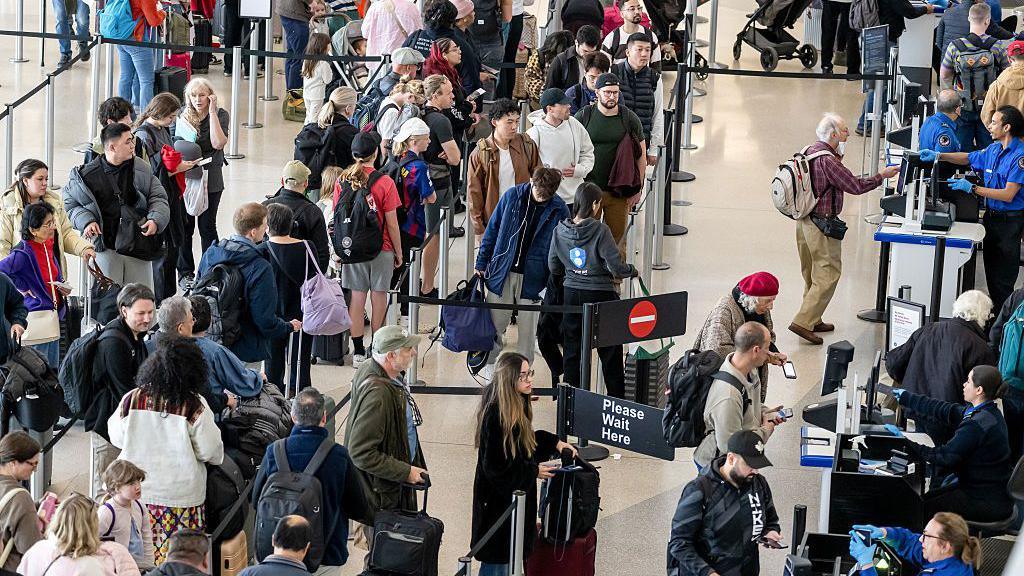
U.S. Transportation Secretary Sean Duffy is advocating for improved attire and behavior among air travelers, a message that has struck a chord amidst widespread frustration with air travel in America, as many Americans consider air travel more frustrating than ever.
In anticipation of what is projected to be the busiest Thanksgiving travel period in 15 years, Secretary Duffy recently launched a campaign entitled “The Golden Age of Travel Starts with You.” The initiative aims to revive the principles of civility and elegance reminiscent of air travel in the 1950s and 60s.
However, with ongoing air traffic controller shortages and frequent flight disruptions, social media users and aviation experts alike suggest that Secretary Duffy’s message overlooks the core issues.
A public service announcement for the Department of Transportation’s campaign contrasts vintage footage of courteous airport staff and well-behaved passengers with contemporary social media clips depicting onboard altercations, passengers placing bare feet on seats, and other instances of disruptive conduct.
“Manners don’t stop at the gate. Things aren’t what they used to be,” Secretary Duffy states. “Let’s bring civility and manners back. Ask yourself, are you helping a pregnant woman put her bag in the overhead bin? Are you dressing with respect?”
The Federal Aviation Administration (FAA) forecasts that this week will witness the highest volume of Thanksgiving air travel in 15 years, with over 52,000 flights scheduled for November 25 alone.
Aviation analysts predict that Duffy’s appeal will have limited impact on the overall atmosphere of air travel.
Scott Keyes, an air travel authority and founder of Going.com, remarked to the BBC that while encouraging mutual respect is commendable, the practicality of such a message is questionable. He stated, “you might as well ask a wall to start printing you money.”
Keyes elaborated that very few passengers board flights with the intention of instigating conflict. He posited that those who reach a level of agitation leading to altercations with flight attendants or fellow passengers are unlikely to be swayed by Secretary Duffy’s words.
He asserts that the fundamental issue lies in individuals succumbing to their tempers, a problem he perceives as intensifying across society, not limited to air travel or the United States.
Since Secretary Duffy began promoting the campaign on X, many of his subsequent posts have been met with a surge of critical responses.
One X user commented, “If you want us to be respectful humans at the airport stop treating us like cattle. Remove the demoralising and humiliating TSA checks (that accomplish nothing) and find a way to get the airlines to give more than 2 inches of space per seat.”
Henry Harteveldt, a travel industry analyst and president of Atmosphere Research Group, conveyed to the BBC that while Secretary Duffy’s emphasis on consideration is valid, his recommendation to dress more formally is unlikely to effect meaningful change.
Harteveldt stated, “You could be dressed in black tie and still be a jerk, and you could be wearing sweatpants and a sweatshirt and be the most considerate person in the world. The clothes, in this case, do not make the person.”
Multiple commenters on Secretary Duffy’s X posts have noted that their casual attire is often a response to the cramped conditions within plane cabins and the expectation of prolonged delays.
“Tell you what,” one X user commented. “You get the planes running on time, and we won’t dress to spend the night in the damn airport.”
Another wrote: “Can I get my legroom back?”
One X user, with nearly 500,000 followers, posted: “Duffy is absolutely right…BUT our declining travel dress is also a reflection of how airlines treat us. Cattle boarding, tiny seats, penny pinching every beverage cost and just generally miserable.”
Echoing the sentiments of numerous social media users, Harteveldt suggested that airlines bear partial responsibility for passengers’ misconduct, citing the unpleasant and physically uncomfortable conditions of economy cabins as a catalyst for negative moods.
He added that limited flight attendant staffing, reduced onboard amenities, and the airlines’ embrace of a pay-for-what-you-want business model contribute to a less pleasant passenger experience.
However, some individuals have lauded Secretary Duffy’s core message of respect and kindness, with one commenter expressing, “I will do my small part to spread civility in my own life.”
The Department of Transportation (DOT) emphasizes that the campaign extends beyond mere politeness, aiming to mitigate the rise in violent and disruptive incidents in airports and on airplanes.
The agency reports a 400% increase in in-flight outbursts since 2019, encompassing both unruly behavior and violent attacks. Since 2021, the department has documented 13,800 incidents involving unruly passengers, with one in five attendants experiencing a physical altercation.
Despite these figures, some experts dispute the notion that air travel has declined in quality.
Dan Bubb, an aviation historian and professor at the University of Nevada Las Vegas, told the BBC that statistically, the increase in incivility cases is not significant.
Professor Bubb noted the considerable increase in the number of flights and passengers, making comparisons between current airline incidents and those of past decades challenging.
Keyes identified another significant issue with Secretary Duffy’s message: air travel previously entailed numerous challenges that are no longer prevalent.
“It’s laughable how much worse air travel was back then,” Keyes stated.
He noted that air travel was significantly less safe, with more frequent plane crashes and hijackings. Flights were also considerably more expensive relative to income. Moreover, cabins were filled with cigarette smoke, and flight attendants faced rampant sexism and stringent physical requirements.
Keyes believes the FAA and DOT could more effectively reduce passenger stress by urging airlines to minimize delays and cancellations.
Professor Bubb suggested, it would also help to “give passengers a little more physical space in terms of seat size and legroom, include meal service in the price of their tickets, reduce alcohol consumption, make going through security at airports less stressful, make parking at airports easier, expand boarding area space at airport gates”.
He added, it remains essential to encourage passengers to treat flight crews and each other with courtesy.
The suspect had been recruited to Unit 03 of the Kandahar Strike Force, a former military commander told the BBC, coming to the US after the withdrawal.
Prestwick Airport has been owned by the Scottish government since 2013.
Trump insists the troops are needed to instill order, but Democratic states say the deployments risk escalating tensions.
The victims, who remain in a critical condition, have been named as Sarah Beckstrom, 20, and Andrew Wolfe, 24.
The alleged gunman in the Washington shooting is an Afghan national who entered the US in September 2021.