

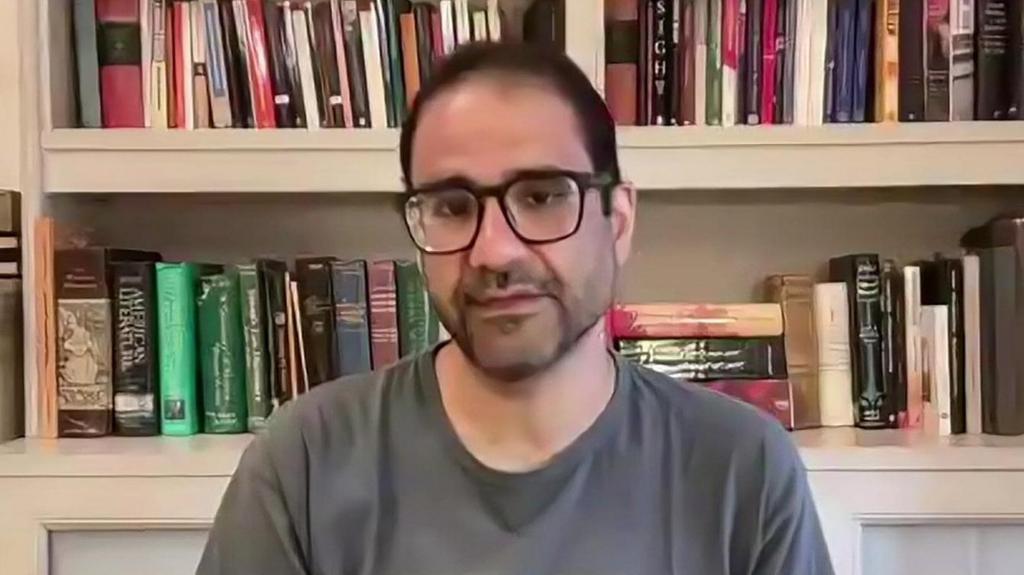
The Conservative Party has called for the deportation of British-Egyptian activist Alaa Abdel Fattah and the revocation of his UK citizenship following the emergence of social media posts in which he allegedly called for the killing of Zionists.
Labour leader Sir Keir Starmer has faced criticism for expressing his “delight” at Abdel Fattah’s arrival in the UK after his release from prison in Egypt, though sources indicate he was unaware of the posts until recently.
Shadow Justice Secretary Robert Jenrick stated that Fattah should “be made to live in Egypt or frankly anywhere else in the world.”
Speaking to the BBC, Jenrick argued that granting Fattah citizenship in the first place was a mistake – a decision made in 2021 while the Conservatives were in power.
The Foreign Office has affirmed that working towards Fattah’s release and reunion with his family in the UK had been a “long-standing priority under successive governments” but condemned his “abhorrent” online statements.
Abdel Fattah arrived in the UK this week after being convicted in 2021 in Egypt for “spreading fake news” related to a Facebook post about torture. His family has been contacted for comment.
He was granted citizenship in December 2021 through his London-born mother.
Jenrick deemed it “indefensible” that Fattah received citizenship given his social media history, which he said demonstrated “extremist views that are completely incompatible with British values.”
Conservative governments, including those in which Jenrick served, had also advocated for Fattah’s release, with the shadow justice secretary calling the situation a “major failure of the British state.”
Jenrick said: “Successive governments and civil servants at the Foreign Office and the Home Office have advised ministers that this is a consular case to be supported, when in fact a cursory examination of… social media shows that he is a man with not just extremist views – but absolutely abhorrent views who hates our country and should not be receiving the support and generosity of people here in the UK.”
He urged the government to “rectify this situation by being clear that they distance themselves and our country wholeheartedly from his views and begin proceedings to revoke his citizenship and have him removed from the UK”.
Speaking earlier on GB News, Jenrick criticized senior ministers for “rejoicing at the fact this man was coming here, bragging that they’d achieved some kind of diplomatic coup”.
The Board of Deputies of British Jews expressed “profound concern” regarding the case.
Adrian Cohen, the board’s senior vice-president, stated: “His previous extremist and violent rhetoric aimed at ‘Zionists’ and white people in general is threatening to British Jews and the wider public.
“The cross-party campaign for such a person, and the warm welcome issued by the government, demonstrate a broken system with an astonishing lack of due diligence by the authorities.”
Fattah is also accused of saying the police do not have rights and “we should kill them all”.
Fattah’s release in September followed a long campaign by his family – backed by celebrities such as actresses Dame Judi Dench and Olivia Colman – and lobbying by the British government.
He had spent more than a decade of his life behind bars, including being handed a five-year sentence in December 2021 following a trial that human rights groups said was grossly unfair.
Former Conservative leader Sir Iain Duncan Smith signed a cross-party letter in December last year urging the government to secure his release in Egypt.
Writing on X on Sunday, Sir Iain said: “I do, however regret signing the letter calling for the release of Alaa Abd el-Fattah, given his views, that have since come to light, are utterly abhorrent.
“Had I known of these I would not have signed the letter. I urge the police to investigate the nature of these extremist comments.”
A Labour source accused Jenrick of trying to rewrite history for his own political advantage.
A writer, intellectual and software developer, Fattah rose to prominence during an uprising in 2011 that forced the former Egyptian president, Hosni Mubarak, to resign.
In 2014, Fattah was nominated for a European human rights award, the Sakharov Prize, but this was withdrawn over tweets about Israel he posted in 2012.
He said his comments had been part of a “private conversation” that took place during an Israeli offensive in Gaza and had been taken out of context.
After being removed from a travel ban list imposed by Egyptian authorities that kept him in the country for three months after his release from jail, Fattah has now reunited with his 14-year-old son, who lives in Brighton.
Speaking to the BBC from Cairo in October after his release, he said: “I’m learning how to get back into life.”
He added: “I’m doing much better than I would have expected. Much better than most people would have expected.”
Trade unionist Paul Nowak says he wants to see the “closest possible” economic relationship with the EU.
For Alaa Abdel Fattah and his family this is a new beginning after years of separation and suffering.
An official involved with the World Cup Pride Match says there has been no contact from Fifa about their plans, despite the Egyptian FA’s complaint.
Find out who has been called up for the 2025 Africa Cup of Nations in Morocco from 21 December to 18 January.
The chair of the Social Mobility Commission has called on the prime minister to set out a clearer strategy.