

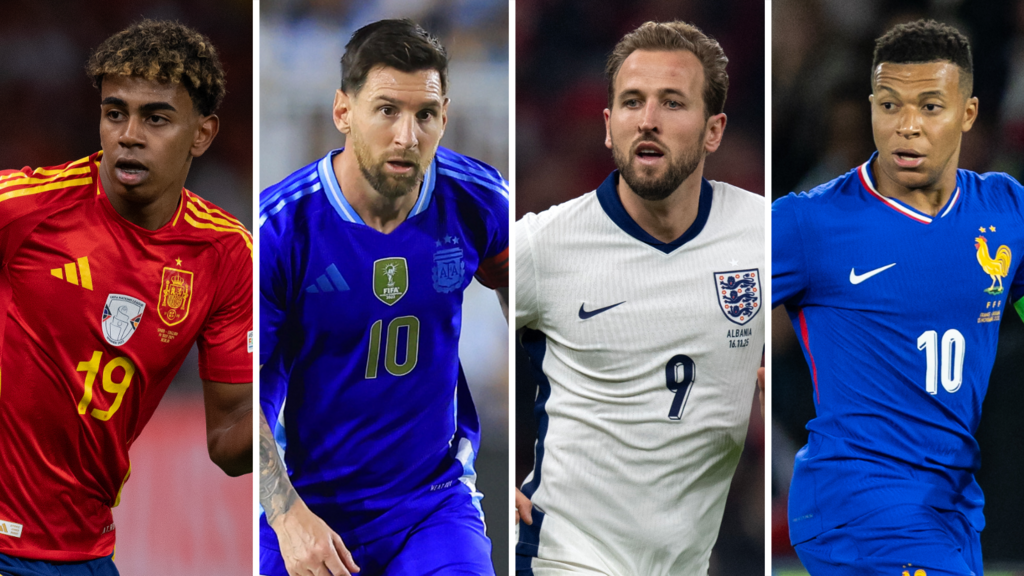
The draw for the 2026 World Cup has been completed, officially beginning the countdown to next year’s tournament across the United States, Canada, and Mexico.
The competition promises to deliver a spectacle of unforgettable moments, featuring potential breakout stars, unexpected upsets, and captivating drama.
As anticipation builds, we examine the leading contenders for the coveted trophy, assessing their prospects based on bookmakers’ odds, recent form, and expert analysis.
While the final tournament lineup remains to be determined, with six spots still up for grabs through play-offs in March, we delve into the teams currently in contention to hoist the trophy in New York next July.
According to FIFA world rankings, Germany, Spain, and Belgium find themselves in the ‘easiest’ groups for the 2026 World Cup, whereas the Netherlands and France face more challenging paths.
England start World Cup against Croatia, Scotland to face Brazil
‘Bring it on’ says Clarke as Scotland face Brazil, Morocco & Haiti in World Cup
Old and new foes – a look at England’s World Cup group
England enters the 2026 World Cup on the heels of a flawless qualifying campaign, securing victory in every match without conceding a single goal.
Following their runner-up finishes at the past two European Championships and a World Cup quarter-final appearance in Qatar three years prior, optimism surrounds the Three Lions’ chances under the guidance of their new head coach, Thomas Tuchel.
Bookmakers are also bullish on England’s prospects, with many placing them as second favorites, narrowly behind Spain.
European champions Spain nearly replicated England’s perfect qualification, marred only by a 2-2 draw against Turkey in their final match.
La Roja’s triumph at Euro 2024, where they defeated England in the final, combined with the emergence of Barcelona’s teenage sensation Lamine Yamal, solidifies their status as a formidable contender.
Excluding a penalty shootout loss to Portugal in June’s Nations League final, Spain has maintained an impressive competitive record since their defeat against Scotland in March 2023.
France, the 2022 World Cup runners-up, also present a strong challenge in what will be their final major tournament under Didier Deschamps, having completed their European qualifying campaign undefeated.
Opta’s supercomputer favors the European contingent, assigning Spain a 17% chance of winning, France 14.1%, and England 11.8%.
Germany, despite an early qualifying setback, rebounded to win their subsequent five matches, securing their place in the tournament and earning favor from bookmakers and data analysts alike. Switzerland, the Netherlands, Belgium, Croatia, and Norway also achieved unbeaten records during European qualifying.
In contrast, Brazil endured a less convincing qualifying campaign, finishing fifth in the CONMEBOL standings with six losses in 18 matches. Despite this, many bookmakers consider them fourth favorites, although Opta ranks them seventh.
Reigning World Cup champions Argentina dominated the South American qualifying group, finishing nine points ahead of second-place Ecuador.
Brazil holds the distinction of being the only team to win consecutive World Cups, achieving the feat in 1958 and 1962. With Lionel Messi expected to participate, Argentina will be among the top contenders for the title.
Japan emerged as the standout team from the Asian qualifying rounds, losing only one match en route to next summer’s tournament.
Morocco, having surprised many with their semi-final finish in Qatar, won all eight of their African qualifying matches and could once again challenge the established powers. Egypt, Senegal, Ivory Coast, and Tunisia also remain unbeaten.
However, with the Africa Cup of Nations (AFCON) commencing later this month, competing in two major tournaments within six months may prove taxing for the African nations.
Cristiano Ronaldo has declared this will be his final World Cup, and his Portugal side should not be underestimated. Euro 2020 champions Italy, while needing to navigate play-offs to qualify, remain a threat on the world stage.
The decision to host the World Cup in the United States, Canada, and Mexico during the peak summer months has raised concerns about the potential effects of extreme heat on the participants.
The recent Club World Cup, held in the US, faced criticism due to the intense conditions, with Chelsea midfielder Enzo Fernandez reporting feeling “dizzy” while playing in “very dangerous” heat.
Research conducted by Queen’s University Belfast indicates that temperatures at 14 of the 16 stadiums slated to host matches during the 2026 World Cup could reach potentially perilous levels during the tournament.
It is reasonable to assume that certain nations will adapt more successfully to the heat. Some European teams may struggle, and England has already expressed a preference for later kick-off times in order to mitigate the impact of peak temperatures.
Conditions are likely to favor South American nations, while African teams may also benefit, despite the fact that no team from the continent has ever won a World Cup.
Playing on home soil could also provide an advantage to the host nations, although the widespread locations and considerable distances between stadiums could hinder any team’s ability to settle into the tournament.
Of the 11 World Cups held in Europe, ten were won by European teams. However, the landscape shifts dramatically when the tournament is held in the Americas.
Prior to Germany’s victory in 2014, each of the seven tournaments hosted in the Americas saw a South American nation emerge victorious. More recently, Argentina claimed the title in the heat of Qatar.
Spain holds the distinction of being the first European team to win the World Cup outside their home continent, securing the trophy in South Africa in 2010.
All eyes will be on Saturday’s announcement of the match schedule for each team, as even the smallest advantages hold significance.
Commenting on England’s group on BBC Radio 5 Live, former striker Dion Dublin stated: “I always worry about Croatia. They have so much experience, and they possess the quality to match. Ghana can deliver some remarkable performances. They’re a strong African nation that will make it incredibly difficult. ‘Concerned’ is the right word.”
European football journalist Julien Laurens noted: “I know Spain lost the Nations League final to Portugal, but they’ve been truly outstanding since Luis de la Fuente took over. The Euros was great, and even though England pushed them hard in the final, I believe they were deserved winners. We [France] are relying on Mbappe, but I don’t see many weaknesses in this team.”
Speaking about Germany, Laurens added: “Right now, it’s difficult to gauge what kind of Germany we’ll see. They still have the potential to be very good, and Jamal Musiala will return in January, allowing us to assess his fitness ahead of the World Cup. With Florian Wirtz in top form, Musiala in top form, and the presence of Nick Woltemade and Kai Havertz, there’s certainly something interesting in attack. Defensively, I’m less confident.”
South American football journalist Tim Vickery remarked: “Brazil is pleased with their draw. They will play in New Jersey, Boston, Philadelphia, Miami, and one game in Atlanta (which has air conditioning). Carlo Ancelotti believes their games are likely to be in the evening, which is why I think they’re very happy. It’s all happening fast, with Ancelotti coming in late. He has significantly improved the side, but he is currently trying to implement a four-man attack. If Ancelotti can unlock that attacking talent, as he has done in some of the friendlies, then nobody will want to face Brazil.”
Regarding Argentina, Vickery stated: “They are attempting to do something unprecedented: no team has ever retained the World Cup outside of their home continent. Things have gone exceptionally well for Argentina since they won the World Cup. They’ve won everything. They comfortably topped the qualification table, and they are not as reliant on Lionel Messi as they once were. And, dare I say it, there have been times when they have been even better without him.”
Group A: Mexico, South Africa, South Korea, Winner of Uefa play-off D*
Group B: Canada, Winner of Uefa play-off A*, Qatar, Switzerland
Group C: Brazil, Morocco, Haiti, Scotland
Group D: USA, Paraguay, Australia, Winner of Uefa play-off C*
Group E: Germany, Curacao, Ivory Coast, Ecuador
Group F: Netherlands, Japan, Winner of Uefa play-off B*, Tunisia
Group G: Belgium, Egypt, Iran, New Zealand
Group H: Spain, Cape Verde, Saudi Arabia, Uruguay
Group I: France, Senegal, Winner of Fifa play-off 2*, Norway
Group J: Argentina, Algeria, Austria, Jordan
Group K: Portugal, Winner of Fifa play-off 1*, Uzbekistan, Colombia
Group L: England, Croatia, Ghana, Panama
*Uefa play-off A: Italy, Wales, Bosnia-Herzegovina or Northern Ireland
*Uefa play-off B: Ukraine, Poland, Albania or Sweden
*Uefa play-off C: Turkey, Slovakia, Kosovo or Romania
*Uefa play-off D: Denmark, Czech Republic, Republic of Ireland or North Macedonia
*Fifa play-off 1: DR Congo, Jamaica or New Caledonia
*Fifa play-off 2: Iraq, Bolivia or Suriname
Follow your club with BBC Sport
Listen to the latest Football Daily podcast
Get football news sent straight to your phone