

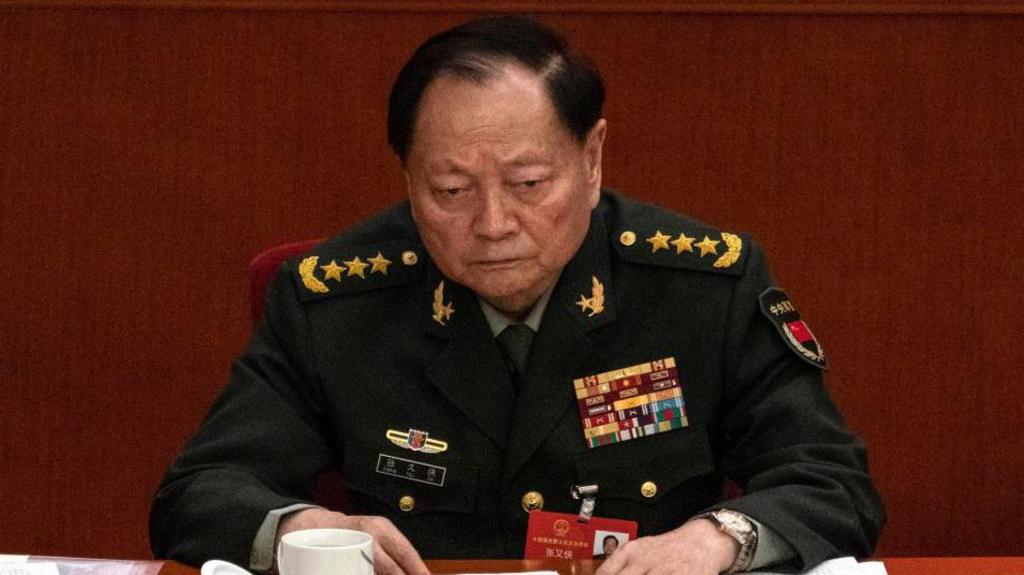
The upper echelons of the People’s Liberation Army (PLA) are reportedly in disarray.
The recent purges of General Zhang Youxia, a prominent figure, and another senior military officer, General Liu Zhenli, have raised significant questions. Observers are now scrutinizing the underlying causes of these power struggles and their potential impact on China’s military capabilities, particularly concerning ambitions related to Taiwan or broader regional conflicts.
Zhang, aged 75, held the position of vice-chairman within the Central Military Commission (CMC), the Communist Party body, led by Xi Jinping, that exercises control over the armed forces.
The CMC, typically composed of approximately seven individuals, has now been reduced to just two members: Xi Jinping and General Zhang Shengmin.
The remaining members have been removed amid an “anti-corruption” campaign following previous waves of detentions.
The CMC holds responsibility for overseeing millions of military personnel. Its influence is such that Deng Xiaoping, during his time as the paramount leader in the 1980s, solely retained this position for a significant portion of his tenure.
Lyle Morris from the Asia Society Policy Institute notes that the current situation, with only Xi and one CMC general remaining, is unprecedented.
Speaking to the BBC, Morris stated that the PLA is in disarray and faces “a major leadership void.”
When questioned about the driving forces behind the removal of numerous top generals, Morris acknowledged the prevalence of rumors. “We don’t know, at this point, what is true and what is false… but it is certainly bad for Xi Jinping, for his leadership and control over the PLA,” he stated.
Associate Professor Chong Ja Ian from the National University of Singapore also expressed uncertainty regarding the true reasons for Zhang’s downfall, noting widespread speculation.
“Everything from leaking nuclear secrets to the United States to plotting a coup and factional infighting. There are even rumours of a gunfight in Beijing,” he said.
“But Zhang and Liu’s downfall along with the wild speculation highlight two things: that Xi remains unassailable and there are significant limits to information in Beijing which fuels uncertainty and feeds this speculation.”
The official announcement of the investigation into Zhang and Liu cited “serious violations of discipline and law,” a common euphemism for corruption.
The PLA Daily reinforced this point in an editorial, emphasizing the Communist Party’s “zero tolerance” stance toward “punishing corruption… no matter who it is or how high their position.”
While the specific allegations against these generals remain undisclosed, the announcement of an investigation typically leads to custodial sentences as a minimum.
The PLA Daily editorial seemingly presumed Zhang and Liu’s guilt, stating they had “seriously betrayed the trust and expectations of the Communist Party’s Central Committee” and had “trampled on and undermining the Central Military Commission”.
The targeting of these generals could be related to corruption, or it may reflect power dynamics, as seen in past purges.
While China faced genuine corruption challenges upon Xi Jinping’s ascent to power, he has also been accused of leveraging his anti-corruption campaign, deploying Party discipline inspection teams, to eliminate political rivals or those perceived as lacking unwavering loyalty.
This has afforded General Secretary Xi a degree of control not seen since Chairman Mao.
However, this leadership style can be counterproductive.
Within the military, a climate of suspicion could foster cautious or even hesitant decision-making.
Zhang’s father had a revolutionary relationship with Xi’s father, and the close ties between Zhang and Xi may exacerbate the situation, leading to a perception that no one is immune.
As one of the few senior PLA officers with combat experience, Zhang’s removal is a significant loss for the military.
Morris suggests that his removal also poses long-term challenges for Xi.
While Xi may have reaffirmed his authority, the upheaval implies ongoing frictions, he stated.
“It’s certainly a bad look for Xi and I think there’s going to be significant turmoil in the PLA, with Xi and his leaders – especially in the PLA – for years to come.”
The purges also place scrutiny on the next tier of officers, who may be wondering who is next?
Given the fate of their superiors, they may not welcome promotion into a position where Xi’s anti-corruption campaign can target them at any time.
This turmoil comes at a time when Beijing is intensifying its pressure on Taiwan, with threats to seize the island through a full-scale attack.
Analysts are assessing the extent to which these removals have impeded such a possibility, although some believe it will have limited impact on curbing Beijing’s ambitions.
“The purge does not affect the PRC’s ambitions to control Taiwan. That comes down to the CCP as a whole and Xi specifically,” said Chong.
“Where the purge may matter are operational decisions. Without top military professionals or military professionals who are cowed, decisions about escalation and aggression toward Taiwan will centre even more on Xi, his preferences, and proclivities.”
Additional reporting by the BBC’s Yvette Tan
Airports in Thailand and Nepal have begun screening passengers from West Bengal.
Despite strong relations between India and EU, trade talks were stuck for two decades. So what changed now?
Firefighters in Victoria are battling at least six major fires amid a record-breaking heatwave.
Shop owners say the frowning toys – originally made in error – are resonating with young workers.
The long-awaited deal comes as both Delhi and Brussels contend with economic and geopolitical pressure from the US.