

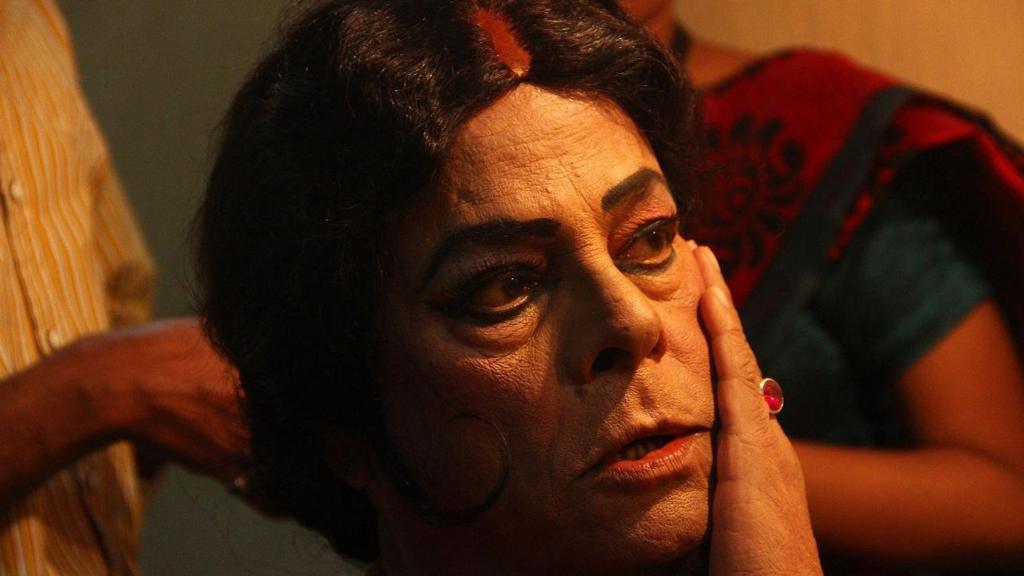
In the mid-20th century, Bengal in eastern India witnessed a fascinating phenomenon: some of its most celebrated female stage stars were, in fact, men.
Leading this cohort was Chapal Bhaduri, better known as Chapal Rani, the reigning “queen” of jatra, a traditional traveling theater that once captivated vast and enthusiastic audiences.
The practice of male actors portraying female characters was a common trope in theaters worldwide, from Europe to Japan and China.
In Bengal, this practice flourished within jatra, a rural, open-air spectacle blending music, myth, and melodrama. Jatra often rivaled cinema in popularity, though not in financial rewards. Rooted in epic and devotional narratives, it unfolded on stages open on all sides, characterized by expressive vocals, gestures, and elaborate costumes.
In his new book, “Chapal Rani: The Last Queen of Bengal,” author Sandip Roy chronicles Bhaduri’s journey from stardom to relative obscurity, capturing a vanishing world where gender itself was a performance.
For decades, female roles in jatra were exclusively played by men known as purush ranis, or male queens.
However, even at its peak, this art form faced a degree of social stigma.
Urban elites in Calcutta during the colonial era, influenced by European tastes, frequently dismissed jatra as unsophisticated. A 19th-century Anglo-Indian journal criticized the voices of boys playing women as “discordant,” unfavorably comparing them to “howling jackals.”
By the time Bhaduri entered the stage in the 1950s, this cultural landscape was already changing. Women were beginning to assume acting roles, and the space for male impersonators was shrinking. Despite this shift, Bhaduri distinguished himself.
Born in 1939 in north Kolkata to stage actress Prabha Devi, Bhaduri was raised among performers. He began acting at the age of 16. “I had girlish manners, a girlish voice,” he would later recall.
On stage, he underwent a transformation, portraying queens, courtesans, goddesses, and brothel madams with refined grace.
His costumes were meticulously assembled, sometimes improvised. Early on, he used rags to create the illusion of a female figure. Later, he used sponge. His beauty routine involved creams and small rituals, all in pursuit of an illusion he took seriously.
“Femininity was always a part of me,” Bhaduri stated.
His performances were not mere comic turns or caricatures. They were immersive and often deeply felt. In a theatrical culture where queer-coded characters were often subjects of ridicule, Bhaduri’s work carried a different significance.
Roy writes, “In Indian performing art where playing gay or queer was in the form of characters who are ridiculed, Chapal morphed into a woman and played his roles with honesty and an act of bravery.”
Off stage, Bhaduri’s life was more complex.
He did not openly identify as gay, given the complexities of social life in middle-class Bengal during his time. However, he was not without admiration, receiving letters of affection and proposals for relationships from fans and admirers.
Bhaduri was selective and proud, emphatically stating, “I refuse to apologize for love.”
His one long-term relationship lasted over three decades, even as his partner married and had children.
Bhaduri remained on the periphery, present but never fully acknowledged, ultimately serving more as a housekeeper.
The decline of his career was not marked by a single event, but by a series of gradual shifts.
As women became more prevalent on stage, audiences began to reject male actors in female roles. The very convention that had sustained jatra began to fall apart.
In the late 1960s and early 1970s, the “moustachioed queens of jatra” were pushed out, Roy writes.
Bhaduri experienced this rejection firsthand. During one performance, while playing an older female character, he was booed off stage and had a clay cup thrown at him. The audience, now accustomed to female performers, found his presence unsettling.
Many of Bhaduri’s contemporaries fell into poverty. One former jatra star became a seamstress. Another ran a tea stall and sold peanuts. Some resorted to manual labor. One died by suicide. Their stories, for the most part, went unrecorded.
Bhaduri survived through odd jobs, such as cleaning and dusting in libraries, and, at one point, performing as Sitala, a Hindu folk goddess worshipped as a protector against infectious diseases, on the streets. This was part of a folk tradition where performers offered blessings in exchange for food or small change.
There were brief returns to visibility in the last decade. Bengali filmmaker Kaushik Ganguly cast Bhaduri in his films.
Earlier, in 1999, Naveen Kishore, a theater impresario and publisher at Kolkata-based Seagull Books, documented Bhaduri’s life in a film and exhibition. A younger generation, encountering him through these works, began to perceive him differently.
For some, he became a queer elder, a figure who had lived a life that defied easy categorization.
As Roy writes, “The LGBTQ+ movement was young in India. Hungry for a queer history, it seemed to have seized on Chapal Bhaduri to be its fairy godmother.”
Yet, Bhaduri himself resisted labels. He did not identify with terms like “third gender.” Off stage, Roy notes, he dressed like any other Bengali man, in kurta and pajamas.
This resistance complicates contemporary interpretations of his life.
“He was a queer survivor,” observes Roy.
Today, as conversations around gender and identity gain prominence worldwide, Bhaduri’s story offers a unique perspective.
It highlights histories of performance where gender was fluid in practice, if not always in name.
Bhaduri, 88, now resides in a retirement facility a few blocks from his maternal home, which is no longer welcoming. He faces nagging geriatric health issues and lives in the company of his memories.
Revisiting Bhaduri’s life for a new generation also raises questions about memory.
Why are some performers remembered, while others are forgotten? Why do certain art forms enter the archive, while others disappear along with the people who sustained them?
By documenting Bhaduri’s life, Roy attempts to answer, or at least confront, these questions.
Bhaduri acted for more than six decades. By any measure, he was a star. And yet, for years, he lived on the margins of the very culture he had helped shape.
A new exhibition charts Bombay’s passage through the centuries via paintings, photographs and prints.
Asia relies heavily on oil and gas from the Gulf, and shortages and higher prices are starting to bite.
Makers of plastic and glass bottles are struggling to access raw materials as the war squeezes supplies.
Yashoda and Krishna, painted by Raja Ravi Varma, beat a record set by an MF Husain work last year.
The organisation has been in a protracted legal battle with its former chief executive.