

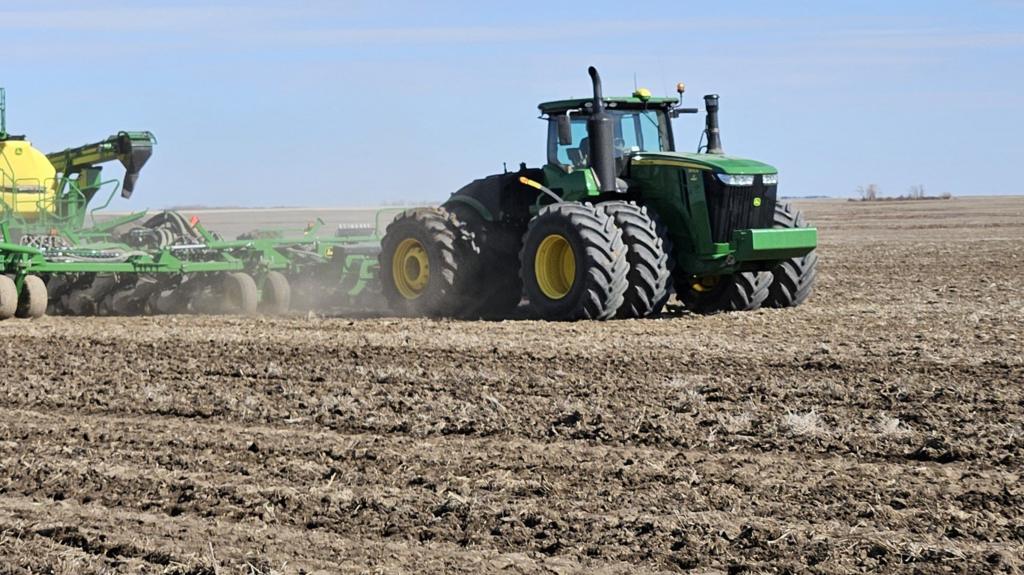
Jake Leguee represents the third generation of his family to farm in Saskatchewan, Canada.
Since 1956, when his grandfather acquired the 17,000-acre property, the Leguee family has cultivated canola, wheat, flax, and green lentils.
Leguee recalls his childhood, observing his father and grandfather dedicating countless hours to sowing seeds and spraying crops from their tractors, often laboring under the intense heat.
“It was significantly less efficient in those days,” Leguee notes. “Today, technological advancements have substantially improved our methods.”
To maintain a competitive edge, Leguee has embraced various innovations, particularly in crop spraying techniques.
By integrating software and remote cameras onto his John Deere tractor, he can now eliminate weeds with greater precision, a crucial step for all farmers before planting.
“The system can identify and target weeds with a specific nozzle while we’re moving at approximately 15 miles per hour,” Leguee explains.
He adds that this targeted approach reduces pesticide usage compared to the blanket spraying methods previously employed.
Leguee emphasizes the significant return on investment realized from these technological upgrades.
“There are cost-effective solutions available, such as apps designed to improve record-keeping, that offer alternatives to more expensive spraying technologies,” he suggests.
This sentiment resonates with farmers across North America.
According to a 2024 McKinsey survey, 57% of North American farmers are likely to explore new yield-enhancing technologies within the next two years.
Furthermore, a 2022 report from the US Department of Agriculture indicates that while the number of farms is decreasing, the remaining farms are becoming increasingly “tech dense.”
Norah Lake, owner and farmer at Sweetland Farms in Vermont, emphasizes the cyclical nature of crop farming, requiring constant assessment and anticipation.
She initially relied on Microsoft Excel to analyze data such as harvest yields, comparing current figures to previous years.
“I needed to know the actual yield from planting, for example, 100 bed feet of broccoli,” she explains.
Lake, who cultivates a variety of vegetables and raises pastured meat, now utilizes software and an app from Tend to digitize and streamline these tasks.
Her goal was to consolidate these labor-intensive processes into a user-friendly platform accessible via her phone or computer.
By inputting harvest data into Tend, the software provides detailed insights and recommendations for optimizing future harvests.
“We can leverage Tend to calculate the precise amount of seed required based on the desired row feet for a specific crop,” she states.
Farmers have a wide array of technological options to choose from.
Syngenta, the Swiss agri-tech giant, offers Cropwise, a software solution employing AI and satellite imagery to guide farmers and alert them to potential issues.
“The system can identify specific areas needing attention, such as a pest outbreak in the southeast corner of a field,” explains Feroz Sheikh, chief information office of Syngenta Group. “Furthermore, it incorporates 20 years of weather data into a machine learning model, enabling accurate predictions based on historical conditions.”
This data empowers farmers to proactively protect their crops from threats like frost, potentially saving significant acreage.
In Germany, Jean-Pascal Lutze founded NoMaze to provide farmers with a deeper understanding of crop performance under varying climate conditions.
Their software, launching this year, utilizes field tests and computer simulations to offer clients insights into optimizing water usage and maximizing yields.
Heather Darby, an agronomist and soil specialist at the University of Vermont, suggests that consumers may also benefit from these technologies.
Increased food production could potentially lead to lower prices at the grocery store, she notes.
“By helping farmers prevent crop failures, technology can contribute to a more stable and reliable food system,” says Darby.
Darby observes that in Saskatchewan, younger farmers are more readily adopting technology, while older generations may be more resistant to change.
Leguee emphasizes the importance of embracing change.
“Many of these farms are multi-million-dollar enterprises supporting multiple families. We need to embrace technologies that enhance our operations.”
He concludes, “I once heard someone say, ‘If you treat farming as a business, it’s a great way of life. But if you treat farming as a way of life, it’s a horrible business.'”
An “unprecedented” oversupply of milk is driving prices down for dairy farmers.
Jonathan Mason says Norfolk has more than 150 years of experience growing and producing mustard.
AI trained to recognise fire is among the latest developments in fire alarm tech.
The Prince of Wales has been highlighting mental health support for the farming community.
More bosses are sharing the top job giving them more time for family and breaks.