

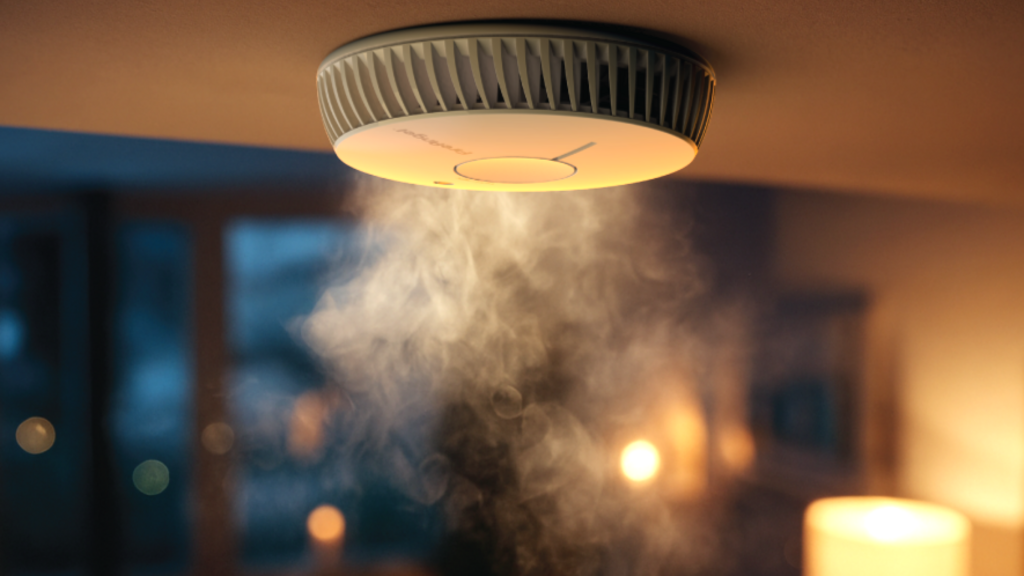
Having just completed the school run and started the laundry, Liz McConnell, a mother and stepmother of four, was preparing to work from her Dover home last September when the piercing sound of a fire alarm shattered the morning calm.
Following the alarm, she discovered smoke emanating from the tumble dryer. Upon inspection, she found the machine was hot and a portion was ablaze.
“At that point I called the fire brigade,” she recalls. They promptly advised her to evacuate the premises. McConnell noted the fire escalated “very, very quickly.” Despite the efforts of the Kent Fire & Rescue Service, who battled the blaze for several hours, the McConnell family home suffered significant damage.
“Had I not have heard [the smoke alarm], I would have just been in there,” says McConnell, emphasizing their critical role. “They are essential, absolutely essential.”
Smoke alarms have been a staple in homes for decades, and while the core technology has remained largely unchanged, questions arise about whether they are keeping pace with the evolving risks of modern life.
Detecting fires involving e-bike batteries, for instance, presents unique challenges due to their rapid and often explosive nature. Researchers are exploring innovative methods for early smoke and fire detection. However, experts stress that a certified, functioning smoke alarm remains a crucial safety measure.
“People are about 10 times more likely to die in a fire if there isn’t a working smoke alarm in the property,” states Suzanna Amberski, head of customer and building safety at Kent Fire & Rescue Service. Her organization discovered approximately 6,500 expired smoke alarms in Kent residences between 2022 and 2024 alone.
Nationally, a survey by insurer Direct Line indicated that nearly four million adults in the UK may be living in homes without any smoke alarm protection. In the United States, an estimated 16% of households lack a working smoke alarm.
According to Raman Chagger, principal consultant at BRE, the Building Research Establishment, there are two primary types of smoke alarm technology. Ionization-based systems utilize a small amount of radioactive material to ionize air particles flowing between two plates. Smoke disrupting this flow triggers the alarm.
Optical-based smoke alarms rely on light. They excel at detecting the larger smoke particles produced by slow, smoldering fires. When these particles enter the device’s chamber, they scatter light from a source, which is detected by a photoelectric sensor.
Heat sensors, typically found in kitchens to prevent false alarms from cooking, activate when temperatures exceed approximately 50°C.
While the standards for evaluating smoke alarms were established in the 1980s, Chagger affirms that smoke alarms remain reliable despite changes in building materials: “They still respond to all the main fires we get today.”
Chagger recounts a personal experience with a tumble dryer fire when his own smoke alarm activated. Upon investigation, he discovered a thin layer of smoke near the ceiling above the appliance. He successfully managed the situation and now recommends installing smoke alarms in laundry rooms.
However, lithium-ion batteries in e-bikes present a new challenge. “When a battery fails, it doesn’t necessarily ignite, it will often produce some off-gases,” explains Stephen Welch, senior lecturer at the University of Edinburgh’s Fire Research Centre. “Those off-gases are toxic and flammable. If they accumulate, you can have an explosion risk.”
Documenting lithium-ion battery fires in experiments, Chagger observed: “It’s just incredible. Nothing’s happening, then: outgassing and boom-boom-boom – all these explosions.”
Some smoke alarms are designed for heightened sensitivity. Aspirating devices continuously draw in air to detect even minute traces of smoke, often employed in commercial settings, such as server rooms.
Niki Johnson, fire systems technical adviser for the UK Fire Association and owner of Derventio Fire and Security, notes that “a lot of stately homes will have that system.” These systems, requiring extensive pipework, can cost “£3-4,000 just to do a corridor.”
One of the most significant recent advancements in fire alarm technology is the development of smart, Wi-Fi-connected alarms that alert users via their phones even when they are away from home.
“Our internet-connected devices use a proprietary radio system, which links the alarms together,” explains Nick Rutter, co-founder and chief executive of FireAngel. These alarms can send push notifications to users’ phones through their home internet router.
He emphasizes the smoke alarm industry’s responsibility to minimize nuisance alarms, which can lead to device deactivation or removal, posing a significant safety hazard.
“If we’re producing technology our customers can’t live with, that’s our failing,” he says, explaining that FireAngel alarms are calibrated to avoid excessive sensitivity and reduce false alarms.
Kidde, another smoke alarm manufacturer, offers a subscription-based service in the US for $5 per month, providing fire monitoring through the Ring doorbell app. According to Kidde’s website, “Trained agents can request emergency help and alert a customer’s emergency contacts in the event of an alarm.”
Isis Wu, its president of global residential fire & safety, adds, “In the case of a fire, it’ll send you an alert and it’ll ask you to confirm before you call out the fire department.”
The company also features a smart alarm that avoids low-battery alerts during nighttime hours, preventing users from disconnecting the alarm and forgetting to reconnect it.
Future smoke alarms may incorporate radically different technologies. Researchers have developed an AI-based system that employs machine learning to detect fire in video feeds. Prabodh Panindre at New York University explains that this tool can identify fire and smoke in footage from “any camera,” including CCTV, doorbell cameras, and phone cameras.
“We monitor the size, shape and growth of the [fire],” he adds, noting that this helps to differentiate real fires from images or videos of fires displayed on screens.
Panindre and his team have also integrated the detection system into drones, which could assist firefighters in locating blazes in high-rise buildings: “These drones can actually go around the building and capture the location of the fire.”
He indicates that the team is actively working to commercialize this technology.
More bosses are sharing the top job giving them more time for family and breaks.
Companies are trying to wean staff off Excel spreadsheets to centralise control of their data.
MSPs have voted in favour of the general principles of a bill that aims to raise money to repair unsafe cladding.
A 17-year-old boy who was left behind in a fire has had his petition debated in Parliament.
The heat alarms sound at least once a week, sometimes three times a day.