

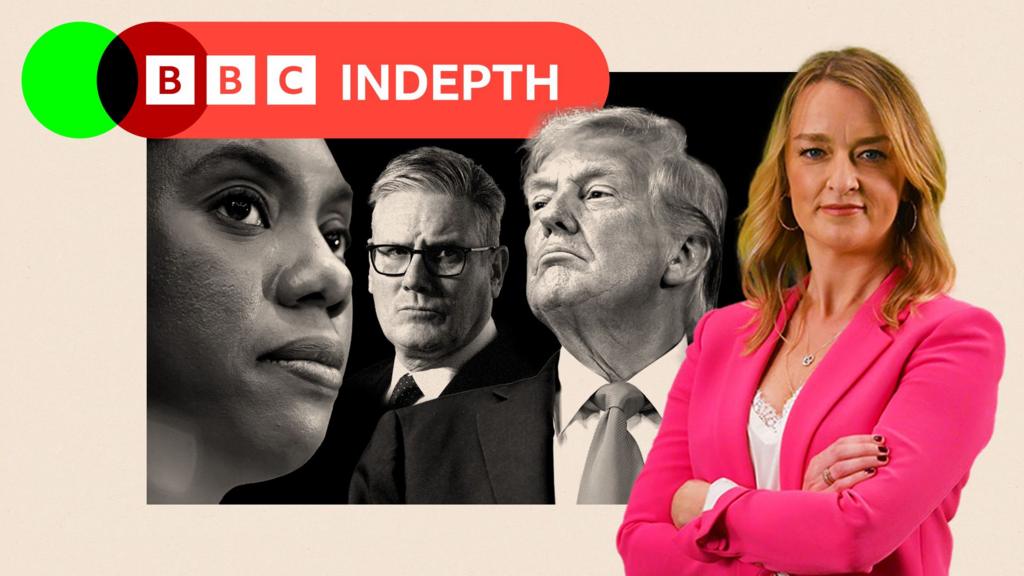
“Keir can’t be the last gasp of the dying world order,” warns a minister.
The Prime Minister navigates a global landscape reshaped by his counterpart in the White House.
Despite domestic challenges, Downing Street’s handling of international affairs has largely been viewed favorably. However, as President Trump’s global activities intensify, particularly concerning Venezuela and Greenland, the Prime Minister’s domestic opposition aims to undermine this perceived strength.
Skepticism, especially within the Labour Party’s left wing, exists regarding Starmer’s alignment with Trump. This reflects a historical unease with the “special relationship,” a sentiment predating and likely to outlast both Starmer and Trump. Instances such as Blair’s association with Bush over Iraq and satirical depictions of Thatcher and Reagan exemplify this trend.
Regardless of personal dynamics, the relationship is inherently transactional. As one Labour MP stated, it’s “the unavoidable cost of doing business.” Demonstrating loyalty to a controversial leader may facilitate securing favorable trade agreements. Offering royal invitations or accommodating US tech firms’ interests could foster a more receptive environment for supporting Ukraine.
Thus far, the approach has been deemed successful, with government insiders praising Blair-era advisor Jonathan Powell’s strategic acumen. However, a senior Labour MP cautioned against the growing risk of “being linked to the madness.” The Prime Minister could face accusations of weakness from across the political spectrum, compounded by the escalating issue of defense spending.
Traditionally, the UK’s opposition has largely aligned with the government on foreign policy, a practice that appears increasingly outdated in the turbulent climate of 2026. Kemi Badenoch, set to appear on the program this Sunday, has notably deviated from this norm.
Badenoch challenged the Prime Minister’s foreign policy in the Commons this week, arguing Starmer’s interactions with Trump’s advisors, rather than the President himself, following the strike on Venezuela, rendered him irrelevant. She also criticized his failure to fully disclose details of the agreement with France and Ukraine regarding UK troop deployment in the event of a peace accord.
Her team believes she successfully weakened his authority on foreign policy, and the Conservatives are expected to continue arguing that the UK isn’t projecting sufficient strength abroad. This raises the question of Badenoch’s alternative approach.
It’s not certain she would have greater access to Trump’s inner circle than Starmer. Would she have facilitated a deal guaranteeing potential peace in Ukraine, or would she have launched more operations against Russia’s shadow fleet, such as the UK-supported seizure of the Marinera tanker in the North Atlantic this week? Ultimately, the opposition’s role is to critique, not to act.
Such critiques are emerging rapidly from both within and outside the Labour Party’s left wing. The Liberal Democrats, closely trailing Labour in polls, also dedicated both their PMQ questions this week to foreign affairs. Leader Ed Davey’s team noted his Venezuela-related comments garnered nearly 10 million views on Instagram, suggesting they resonated with audiences.
Amidst Trump’s accelerating foreign policy initiatives, a senior Lib Dem source remarked: “We see the opportunity – Starmer is so closely hitched to Trump there’s a growing risk it’s damaging – and it works on the doors: lots of Labour voters are anti-Trump but pro-Nato.”
Sources draw parallels to their significant breakthrough opposing Tony Blair over Iraq. While the comparison isn’t exact, Labour’s discomfort is evident, and their rivals are eager to capitalize.
The Green Party is also eager to capitalize on discontent regarding Trump to Starmer’s detriment. A senior party source stated: “It’s hugely problematic for the prime minister. He’s put so many of our eggs in the Donald Trump basket. Lavishing him with a second state visit – to stroke his ego – was always going to end in tears.”
Within Labour, unease exists on the party’s traditional left, with some MPs openly questioning the government’s lack of condemnation of Trump’s actions against Venezuela, and discomfort after the UK backed the seizure of the Marinera.
Even supportive colleagues express concern over the Prime Minister’s domestic perception management. “The responses have been the response of a diplomat’s brain, not a political one,” one remarked, “and if you don’t take a strong political position too, you’ll be attacked by both sides.”
That said, such visible international turmoil may make a leadership challenge to Starmer less likely, as any potential contender could appear self-indulgent amid global instability.
While Trump’s international activities present opportunities for Starmer’s opponents, the severity of the global situation elevates the importance of stability within his own party. Moreover, foreign policy isn’t generally considered a strength of Labour’s primary rival, Reform UK, making it easier to deflect their criticisms in this area compared to issues like immigration.
Beyond partisan politics, the year’s dramatic global events have renewed focus on the question of increased defense spending in an increasingly unstable world, and whether the government has genuinely committed to the necessary decisions. One insider noted: “Defence spending is a proper wound now – it’s not just the chiefs grumbling.”
The allocation of taxpayer funds for national security was already a complex issue. The Prime Minister, as highlighted in last week’s interview, emphasizes the turbulent times and the need for increased European investment in defense.
Responding to reports of budget shortfalls, Defence Secretary John Healey reiterated on Friday that global events demand a new era for defense, promising increased spending at the fastest rate since the Cold War, albeit with caveats.
Prior to 2026, former Chief of the Defence Staff Sir Tony Radakin publicly suggested potential budget cuts. The Defence Secretary refuted this, but the new Chief of the Defence Staff subsequently confirmed that some capabilities had already been reduced, creating an awkward situation.
This dispute, and the government’s defense review, occurred before the United States’ new security strategy and the American strikes on Venezuela. They also preceded the White House’s reiterated ambition this week to possess Greenland, potentially through military force, even targeting a member of the defense alliance the US is bound to defend.
Following Trump’s recent actions, the question of the UK’s willingness to invest in its own protection, and the sacrifices politicians are prepared to make, becomes increasingly urgent.
While some argue that ministers have already committed to increased defense spending, the more critical question is whether they’ve truly acknowledged the scale of the necessary shift and communicated it to the public.
British politics has long held that voters prioritize domestic issues over foreign policy. As one government source stated: “People want to see us handle the foreign stuff competently but it’s not really what people care about – they only vote on foreign affairs grounds in genuinely exceptional circumstances.”
However, opposition parties are eager to exploit this by opening a new avenue to attack the Prime Minister, raising a fundamental question about the government’s priorities in an increasingly dangerous world.
While the saying goes that all politics is local, could 2026 be the exception that proves the rule?
Top image credit: Getty Images
BBC InDepth is the home on the website and app for the best analysis, with fresh perspectives that challenge assumptions and deep reporting on the biggest issues of the day. You can now sign up for notifications that will alert you whenever an InDepth story is published – click here to find out how.
Oil executives expressed caution, with one executive saying Venezuela had seized their assets twice.
Islanders want a bigger say in their ties with Denmark, but also on the world stage too.
Portland’s police chief says the man and woman “do have some involvement” with Tren de Aragua.
The US will do it “the easy way” or “the hard way”, he says, but Denmark stresses the territory is not for sale.
Officials say the East Wing had “chronic water intrusion, accelerated deterioration and mould contamination”.