

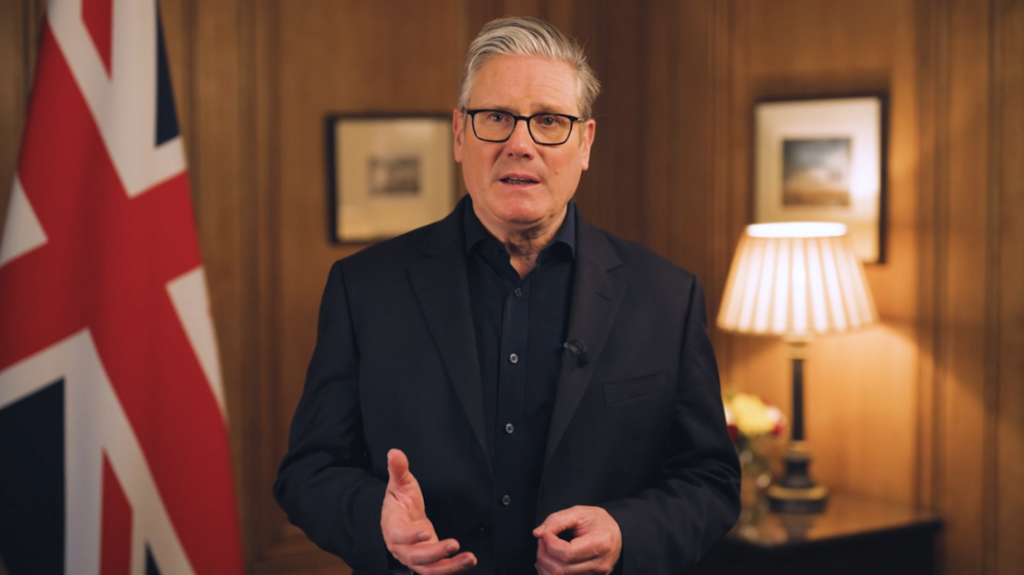
Prime Minister Sir Keir Starmer has pledged to “defeat the decline and division offered by others” in his New Year’s message, asserting that the public will experience “positive change” in their lives by 2026.
Acknowledging the recent hardships faced by Britain, Starmer indicated that citizens should anticipate forthcoming improvements, including reduced utility bills, increased police presence, and the establishment of new health hubs.
The past year has presented challenges for the Prime Minister, who has navigated sluggish economic growth, unfavorable polling numbers, and persistent speculation regarding potential leadership challenges.
In her own New Year’s address, Conservative leader Kemi Badenoch stated that 2025 had been characterized by “no growth, higher taxes, and record unemployment.”
However, she affirmed that Britain is “not destined for decline” and outlined her party’s plan to “back business and fix our economy so we can fund our armed forces, police, schools, NHS and build something that we feel proud of.”
Sir Keir expressed shared “frustration about the pace of change” but cautioned that “the challenges we face were decades in the making, and renewal is not an overnight job.”
He added: “By staying the course, we will defeat the decline and division offered by others.”
The Prime Minister assured that conditions would “start to feel easier” in the coming year, citing frozen rail fares, prescription charges, and fuel duty, alongside increases to the minimum wage.
“In 2026, the choices we’ve made will mean more people will begin to feel positive change in your bills, your communities and your health service,” he said.
“But even more people will feel once again a sense of hope, a belief that things can and will get better, feel that the promise of renewal can become a reality, and my government will make it that reality.”
The Liberal Democrats and Reform UK are focusing on May’s local elections in their respective New Year’s messages.
Both parties aim to improve their standing in the polls, which include the Scottish Parliament and the Welsh Senedd elections, as well as thousands of council seats in England and a limited number of directly elected mayoral positions.
Lib Dem leader Sir Ed Davey expressed confidence that his party could “win again in 2026” following “our record-breaking success” in the recent local elections.
He pledged to “stop Trump’s America becoming Farage’s Britain” and to “change our country for the better.”
Meanwhile, Reform UK leader Nigel Farage, whose party has consistently led in national opinion polls since last spring, emphasized his party’s offer of “hope” and “change,” predicting that May’s elections would be “the single most important set of elections between now and the next general election.”
He argued that the country was becoming “gloomier” and “poorer,” with rising unemployment and debt “running completely out of control.”
Farage criticized both Labour and the Conservatives for their perceived lack of understanding of the “new world” of cryptocurrencies, AI, and digital assets, which he identified as “the technologies of growth.”
In a video message released on New Year’s Day, the Green Party’s co-deputy leader Rachel Millward committed her party to “do everything we can to stop Nigel Farage getting anywhere near Downing Street.”
In the same message, Millward’s counterpart Mothin Ali noted that the party had gained 110,000 new members since the summer, adding: “We’re here to replace Labour.”
In his New Year message, SNP leader John Swinney acknowledged that the past year had been “difficult” for some, marked by “conflict and upheaval” globally.
The First Minister stated he would be “toasting Scotland’s famous win against Denmark” to qualify for the World Cup, while also expressing anticipation for the competition over the summer and the Commonwealth Games in Glasgow.
Sign up for our Politics Essential newsletter to keep up with the inner workings of Westminster and beyond.