

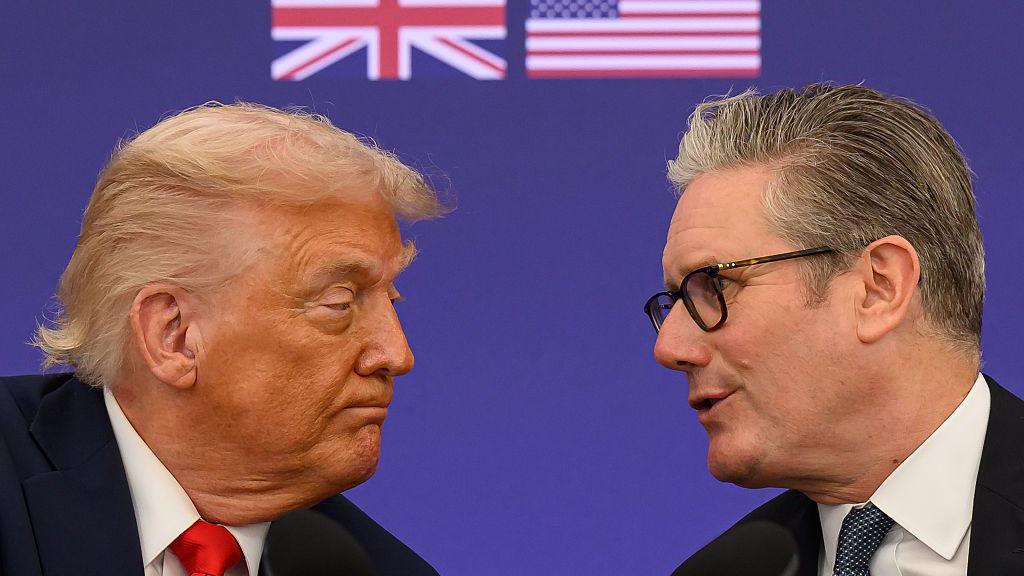
Prime Minister Keir Starmer has publicly criticized Donald Trump’s proposal to impose tariffs on the UK and other European allies, a move reportedly intended to pressure them into accepting a U.S. takeover of Greenland, labeling the plan “completely wrong.”
The former U.S. president announced Saturday his intention to levy a 10% tariff “on any and all goods” exported to the U.S. from these nations, effective February 1, with a potential increase to 25% by June 1.
Starmer, who has previously fostered a constructive relationship with Trump, stated that the UK government would address the matter directly with the White House.
The Trump administration has been increasingly vocal about its desire for the U.S. to acquire control of Greenland, a Danish territory strategically located in the Arctic, citing national security concerns. This pursuit has sparked alarm among European allies and the inhabitants of the island.
In addition to the UK, the proposed tariffs would affect products originating from Denmark, Norway, Sweden, France, Germany, the Netherlands, and Finland.
The UK previously secured an agreement to reverse or reduce some existing U.S. tariffs, and Starmer has played a crucial role as an intermediary between Washington and Europe in efforts to resolve the conflict in Ukraine.
However, the UK recently joined other European nations in reaffirming Denmark’s sovereignty over Greenland amidst escalating rhetoric from the Trump administration. It was also among several countries that deployed troops to Nuuk, Greenland’s capital, earlier this week as part of a reconnaissance mission.
Balancing the delicate relationships between increasingly divided allies, Starmer reiterated the UK’s stance that Greenland is an integral part of Denmark and that its future is a matter for those two nations to decide.
“We have also emphasized that Arctic security is of vital importance to the entire NATO alliance, and that all allies should enhance their collaborative efforts to counter the threat posed by Russia across the Arctic region,” Starmer stated on Saturday.
“Imposing tariffs on allies for their commitment to the collective security of NATO is fundamentally misguided. We will be addressing this issue directly with the U.S. administration.”
By emphasizing the need for enhanced NATO involvement in Arctic security, Starmer signals the UK’s willingness to contribute, mirroring the increased financial commitments made by European nations in support of Ukraine.
However, these remarks represent a rare public divergence from the U.S. president and pose a significant test to the enduring “special relationship” between the two countries.
Trump’s latest tariff threat has also drawn criticism from across the UK’s political spectrum.
Conservative leader Kemi Badenoch described the move as a “terrible idea” that would place “yet another burden on businesses” nationwide.
“The sovereignty of Greenland should be determined solely by the people of Greenland,” she stated, adding, “On this point, I agree with Keir Starmer.”
Meanwhile, Liberal Democrat leader Ed Davey asserted that “Starmer’s U.S. policy lies in tatters” as Trump is “now punishing the UK and NATO allies merely for doing the right thing.”
Reform UK leader Nigel Farage, a historical ally of Trump, stated that “we don’t always agree with the U.S. government, and in this instance, we certainly don’t,” adding that “these tariffs will be detrimental to us.”
The Green Party’s parliamentary leader Ellie Chowns deemed the decision “unhinged,” stating that Trump “treats the international stage like a schoolyard playground, attempting to bully” countries into submission.
Trump has asserted that the U.S. requires Greenland for national security purposes and expressed his interest in acquiring the territory shortly after the commencement of his second term in the White House.
Greenland’s geographical position between North America and the Arctic makes it strategically valuable for early warning systems against missile attacks and for monitoring maritime activity in the region.
The U.S. currently maintains a presence of over 100 military personnel at its missile-monitoring station on Greenland’s northwestern tip and, under existing agreements with Denmark, possesses the authority to deploy an unlimited number of troops to the island.
In recent years, there has been heightened interest in Greenland’s natural resources, including rare earth minerals, uranium, and iron, which are becoming increasingly accessible as climate change accelerates the melting of its ice sheet.
While Trump has not ruled out the potential use of military force, his Truth Social post announcing the tariffs on Saturday focused on reaching a deal for the “complete and total purchase” of the island.
He also reiterated his claim that Russia and China are seeking to gain control of Greenland.
“There is nothing Denmark can do about it,” he wrote. “They currently have two dogsleds as protection, one added recently.”
Trump argued that Denmark’s supporters had created “a level of risk in play that is not tenable or sustainable,” adding: “Therefore, it is imperative that, in order to protect Global Peace and Security, strong measures be taken so that this potentially perilous situation ends quickly.”
Denmark has repeatedly emphasized that Greenland is not for sale and that an attack on its territory would constitute an attack on the NATO alliance. Greenland, which has been moving toward greater independence, has expressed its preference for remaining Danish rather than becoming American.
Tariffs are taxes levied on foreign products, paid to the imposing government by the companies importing those goods, rather than by the exporting countries themselves.
However, these levies can negatively impact the economies of exporting countries, as companies may reduce their imports due to the increased costs. In many instances, these higher costs are ultimately passed on to consumers.
William Bain, head of trade policy at the British Chamber of Commerce, characterized the new U.S. tariffs as “more bad news” for UK exporters already grappling with existing trade barriers.
“We know that trade is a key driver of economic growth, and the success of transatlantic trade depends on reducing, not raising, tariffs,” he added, urging the government to “negotiate calmly” to prevent the new levies from taking effect.
The online safety campaigner says it is better to enforce current laws than use “sledgehammer” techniques.
It comes as fresh details emerged in the death of a Minneapolis woman shot last week by an ICE agent in the city.
President Trump’s proposal to cap credit card interest rates at 10% – an idea with bipartisan support – received swift backlash from bank executives.
The housing proposal will let Americans use their 401(k)s for down payments, a Trump economic adviser said.
The BBC’s Europe Editor Katya Adler has been reporting from Greenland and dissects why the island has so much value in the eyes of President Trump.