

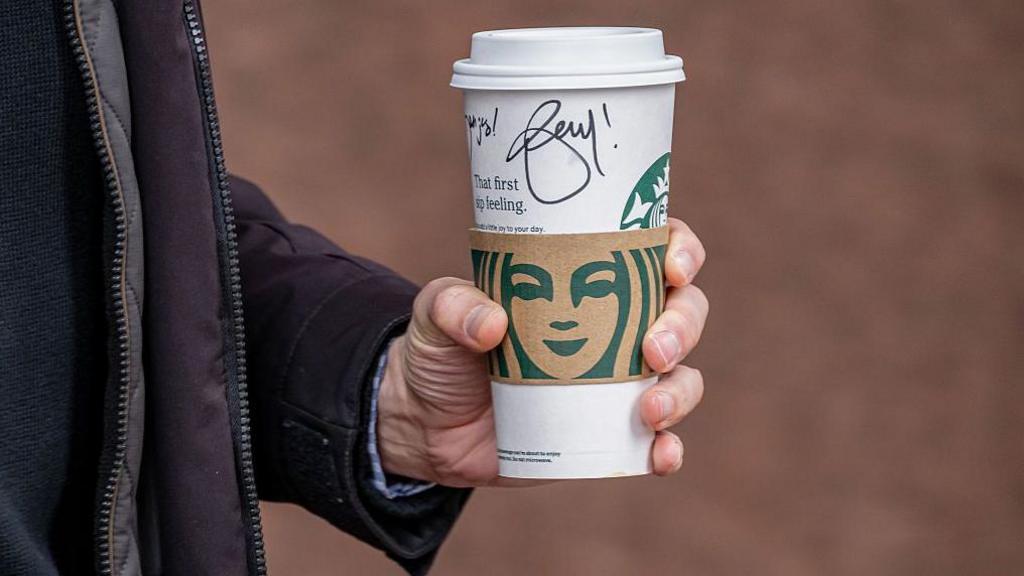
Customers pulling into a Starbucks drive-thru may find themselves interacting with an AI robot, rather than a human employee, at select locations.
Inside the stores, baristas are now leveraging virtual assistants to streamline tasks such as recalling recipes and managing schedules.
In an effort to rectify persistent out-of-stock issues, a scanning tool has been implemented in back-of-house operations, automating the previously labor-intensive inventory counting process.
These technological advancements are part of a multi-million dollar investment by the 55-year-old coffee chain, aimed at revitalizing customer engagement following a period of sluggish sales.
Early indications suggest that these strategic initiatives are beginning to yield positive results.
The company recently announced its first sales increase in two years at established US stores, representing a significant 70% of the company’s revenue.
Despite this progress, the firm’s share price experienced a 5% decline, reflecting investor concerns regarding the impact of extensive spending, including a $500 million investment in staffing, on overall profitability.
Chief executive Brian Niccol remains optimistic, stating that sustained sales growth will ultimately address these financial concerns.
As the company aims to achieve $2 billion in cost savings over the next three years, investments in technology are critical to ensuring that improved sales translate into enhanced profitability.
“I am confident that we have the right plan in place to achieve our goals,” he stated in an interview with the BBC.
Niccol assumed his role in 2024, a period marked by considerable challenges for the company.
Customer dissatisfaction arose following a series of price increases, coupled with heightened competition and boycott calls related to labor disputes and the company’s stance on the Israel-Gaza war.
Niccol, recognized for his successful turnaround of Chipotle Mexican Grill, promptly initiated a series of strategic adjustments.
These included halting price increases, simplifying the menu, and setting a target of completing orders in under four minutes.
Starbucks also reduced its corporate workforce, closed underperforming stores, and divested a significant portion of its business in China.
Niccol has framed the company’s challenges as a deviation from its foundational values, attributing it to an overemphasis on spreadsheets and financial metrics, which overshadowed the core experience of a community coffeehouse.
“We lost our focus due to an excessive focus on efficiency and technology, which detracted from the customer experience and connection,” he explained.
“Our business operates on a store-by-store basis, rather than as an average entity.”
To enhance the atmosphere, staff were encouraged to resume writing customer names on cups by hand.
The company also initiated a $150,000-per-store “uplift” program, involving renovations with comfortable armchairs, fresh paint, and ceramic mugs, slated for completion over four years.
These changes were accompanied by stricter policies, including revised uniform guidelines and restrictions on bathroom access for non-customers.
The firm’s simultaneous push for AI integration and emphasis on personal connection may appear contradictory, but Niccol maintains that these efforts are complementary.
“It’s a means of streamlining the customer experience and reducing friction,” he clarified.
The company is currently testing an AI-powered chatbot designed to match drinks with customer moods and is introducing order scheduling capabilities to minimize wait times.
At drive-through locations, Starbucks is piloting a system to process orders and free up staff to focus on customer service and beverage preparation.
During a recent investor day, Niccol expressed confidence in the company’s momentum, outlining ambitious expansion plans, particularly overseas, where the company aims to nearly double its footprint to almost 40,000 stores in the coming years.
“We are seeing significant progress,” he stated, before addressing analysts’ questions regarding profitability.
Unlike the previous year, the company is not ruling out price increases.
However, Niccol emphasized that “It remains the last resort. Should pricing adjustments become necessary, they will be implemented judiciously.”
He anticipates that the company will benefit from broader economic trends, such as receding inflation and stabilizing coffee prices.
Furthermore, the removal of coffee from the list of items facing US tariffs is expected to alleviate cost pressures.
Social media criticism against the brand has also subsided, although labor disputes with union organizers persist, with accusations of stalled contract negotiations.
The ongoing labor dispute has drawn attention to Niccol’s remote work arrangements, private jet usage, and compensation package, valued at $97 million in 2024 and $30 million in the past year, compared to the average employee’s earnings of approximately $17,300.
Niccol expressed openness to dialogue but declined to provide a timeline for reaching a contract agreement.
“We are committed to reaching a viable and sustainable agreement,” he stated.
Niccol assured analysts that Starbucks remains committed to its labor investments, emphasizing that its distinctiveness lies not only in its coffee but also in its cafes.
“Our cafes provide a vital gathering space for people of all ages,” he stated.
“By creating a third place where everyone feels safe, welcome, and included, the Starbucks brand offers a valuable solution.”
Three million new documents include hundreds of mentions of Trump and emails between Epstein and a person called “The Duke”.
The footage, which is part of millions of files released by the US Department of Justice, shows the late sex offender being questioned by an unnamed interviewer.
The boy was released on the order of a judge who said his detention was “cruel” and “bereft of human decency”.
It is latest in a series of prisoner releases announced by the government amid US pressure for reforms.
The firm’s move comes amid global scrutiny of the methods used by the US immigration enforcement agency.