

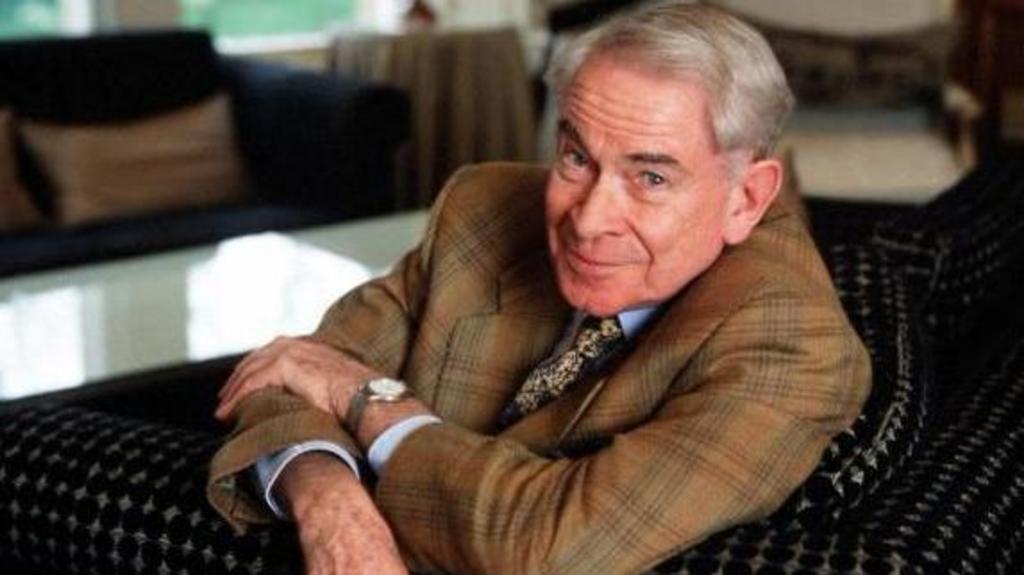
Stanley Baxter, the celebrated Scottish actor and comedian, has passed away at the age of 99.
Born in Glasgow in 1926, Baxter rose to prominence as one of British television’s leading figures for several decades.
From the 1960s through the 1980s, Baxter headlined numerous successful series and was also widely recognized for his dramatic roles and frequent appearances in pantomime.
According to his friend and biographer, Brian Beacom, Baxter died on Thursday at Denville Hall, a care home in north London catering to entertainment professionals, where he had resided since late 2023.
Speaking on BBC Radio Scotland’s Lunchtime Live, actress Elaine C Smith described Baxter as “an inspiration,” adding that his death felt like “the end of something.”
“In one of the early pantos I did, I had one of his costumes,” she recalled.
“I have to say he had a lot longer and better legs than me so it had to be adjusted for my height.
“But his costumes, his standards throughout showbusiness, and in particular in theatre, were legendary because they just were stunning. “
Actor and writer Forbes Masson reflected on Baxter’s influence on his own work with Alan Cumming, including their stage personas Victor and Barry, as well as Steve and Sebastian, the flamboyant cabin crew from the sitcom The High Life.
“You just thought he was going to go on forever and ever and ever. He’s been such a kind of stalwart, certainly of my experiences of comedy when I was a young boy,” he said.
“These things were really formative to what I ended up wanting to do myself. That sort of very Scottish camp, which is quite unique, and I think in a way Alan and I as Victor and Barry were definitely, definitely inspired by Stanley.
“But he was also a really amazing actor as well.”
Impressionist Rory Bremner credited Baxter with inspiring him to “do what I do today.”
Speaking on Radio Scotland’s Drivetime, he remembered seeing him at Edinburgh’s King’s Theatre in the 1970s but was especially fond of the star’s spectacular TV shows.
“He was the king of the variety TV specials,” he said.
“Those huge, extravagant costume numbers, the film parodies, his attention to detail. Ultimately, they became too expensive.
“He was brilliant. He was just a giant. A giant was lost today.”
After beginning his career in Scottish theaters in the 1940s, Baxter achieved widespread recognition in variety theater.
This led to his casting in the comedy sketch show On The Bright Side, where he debuted what would become one of his most beloved sketches – Parliamo Glasgow.
In this spoof of a foreign language program, he delivered phrases in a thick Glasgow accent before “translating” them into the formal pronunciation style prevalent on British television at the time.
The Stanley Baxter Show premiered on the BBC in 1963 and became a significant success, leading to his move to London Weekend Television (LWT) in 1973 with The Stanley Baxter Picture Show.
He played the majority of roles in the show’s film and television parodies, earning several BAFTA awards.
This was followed in 1981 by The Stanley Baxter Series, before he returned to the BBC later in the decade.
He also appeared in the children’s show Mr Majeika before retiring from television in 1990, but continued to perform as a panto dame in Scotland for several more years.
Later, he featured in a series of three half-hour radio sitcoms for BBC Radio 4 and recorded several plays for the station.
Baxter also appeared in a number of films in the 1950s and 60s and received a lifetime achievement award at the British Comedy Awards.
BAFTA Scotland presented Baxter with its Outstanding Contribution to Film and Television Award in December 2020.
Scotland’s First Minister John Swinney was among those who paid tribute.
He described him as “a giant of Scottish entertainment” who had “brought incredible joy to generations.”
BBC Scotland’s Director, Hayley Valentine, said: “We are all very saddened by the passing of Stanley Baxter, who was one of Scotland’s most beloved stars.”
“His talent, wit, and originality set a benchmark for comedy and performance that has spanned decades.”
“His brilliance delighted audiences for generations, and he leaves behind a remarkable legacy, including his legendary BBC TV shows.”
Staff at the King’s Theatre in Glasgow expressed their sadness at the news and announced they would be celebrating Baxter’s life.
“The legendary actor and comedian made a unique and lasting impact in the world of panto with his memorable performances on the King’s stage,” they said.
Baxter always considered himself a character actor rather than a comedian and was a reluctant celebrity, rarely granting interviews and declining invitations to appear on chat shows.
At the age of 94, he confirmed that he had always been gay but had initially concealed the truth to avoid arrest in the years before decriminalization.
He revealed that his wife, Moira, had been fully aware of the situation. The couple, who married in 1951, had lived apart since the 1970s but remained close and never divorced.
Moira passed away in 1997, and Baxter’s long-term partner, Marcus, died in 2016.
At Baxter’s request, his funeral will be a small, private ceremony attended by family and close friends. There will be no memorial service or memorial plaques.
The council introduced the firework control zones for the first time last month across Pollokshields, Govanhill and Broomhouse.
Scotland will face Haiti and Morocco in Boston before taking on Brazil in Miami when they appear in the tournament for the first time in 28 years.
The actor and impressionist, known for comic parodies and his love of dressing up, was one of the biggest stars of the 1970s and 1980s.
A selection of photographs submitted to BBC Scotland News from around the country this week.
A review of the front page stories from the daily newspapers in Scotland.