

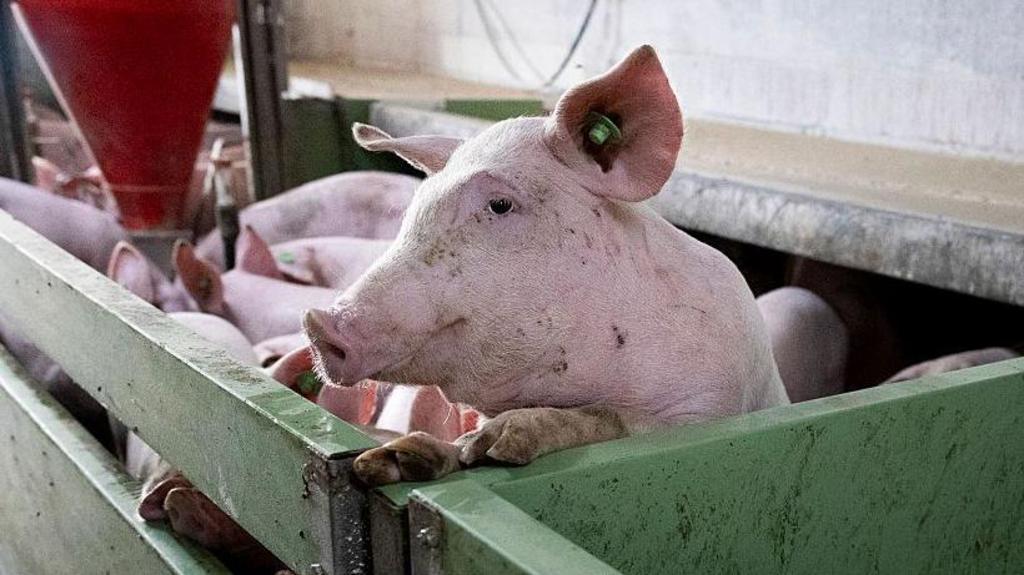
Jordi Saltiveri, a farmer overseeing his 8,000-pig operation, recalls the unsettling day when news broke of African Swine Fever (ASF) detection in Spain late last year.
“I felt sad, angry, impotent,” he recounts. “Once a country is confirmed positive for ASF, other nations halt pork imports.”
Saltiveri’s farm, a legacy passed down from his father and grandfather, is nestled in a remote area of Lleida province, within the northeastern region of Catalonia.
A Catalan independence flag, weathered by the elements, marks the entrance, while the chorus of grunting and squealing pigs echoes from the farm buildings.
Despite the relatively contained nature of the outbreak, which has yet to reach his area, Saltiveri, who also serves as president of the federation of farming cooperatives in Catalonia, and most Spanish pork producers are feeling the economic repercussions.
“Each pig we sell for slaughter has depreciated by approximately €30 to €40 compared to pre-outbreak values,” he explains. “I’m worried because we’re suffering big losses.”
ASF, while harmless to humans, poses a significant threat to pigs and wild boars. The epicenter of the outbreak is Collserola Park, a natural reserve bordering Barcelona, a few hours’ drive from Saltiveri’s farm, where an infected wild boar carcass was discovered in late November.
Authorities responded swiftly, closing the park and restricting access while initiating a search for additional infected carcasses. The precise origin of the outbreak remains under investigation, with preliminary findings ruling out a potential leak from a nearby animal research facility.
However, the park’s large wild boar population, some of which have been known to venture into Barcelona’s outskirts, has been identified as a key factor in the virus’s spread.
“Excessive leniency towards wild animals has led to an overpopulation of rabbits, deer, and wild boar,” states Òscar Ordeig, Catalonia’s minister for agriculture, fisheries, and food.
Ordeig tells the BBC that wild boar have become particularly problematic, contributing to “a substantial increase in traffic accidents and disease transmission.”
He estimates that Catalonia is home to between 120,000 and 180,000 wild boar, with the regional government aiming to reduce that number by half. To date, 24,000 animals have been culled this year.
Rural police officers spearheading the cull are focusing on a 6km radius surrounding the initial cases, designated as a high-risk zone, with a wider 20km radius considered a lower-risk area.
Culling methods include net traps, metal box traps, and silenced firearms. Cameras and drones are deployed to monitor traps and animal movement, with all carcasses tested for ASF. By the end of March, 232 boars had tested positive.
Authorities are also implementing measures to restrict boar movement through fencing. Officers involved in these operations disinfect their vehicles and footwear after patrolling high-risk areas.
Ordeig emphasizes Spain’s “extreme biosecurity” protocols, which have long been in place, as well as ongoing efforts to contain the outbreak.
“We must utilize all available resources to protect our industry, our economy, our farming sector, and our farmers,” he asserts. “The stakes are high.”
Since eradicating its last ASF outbreak three decades ago, Spain’s pork industry has grown to become the largest in Europe, valued at €25 billion. However, ASF detection triggers immediate export market closures.
Brazil, Japan, Mexico, South Africa, and the United States have suspended Spanish pork imports. Other countries, including EU members, China, and the UK, have adopted a more targeted approach, banning pork only from the affected region of northeastern Spain.
The decline in international demand has impacted both the volume and price of Spanish pork exports, directly affecting producers like Saltiveri.
Pork exports from Catalonia dropped by 17% in January compared to the previous year. According to Unión de Uniones, a farmers’ organization, export restrictions and price declines have already cost the Spanish pork industry over €600 million since the crisis began.
Once the disease is fully eradicated, a 12-month waiting period is required before a country can be declared “clean” and have its export status fully restored.
In countries like Germany, which has struggled with ASF in recent years, the disease has severely impacted the pork industry, contributing to a roughly 25% decrease in production and the closure of thousands of farms.
Spanish authorities are looking to Belgium as a model, as the country successfully eradicated ASF 14 months after its initial detection.
Saltiveri, who adheres to strict and longstanding mandatory biosecurity measures, expresses confidence that his farm and others will remain unaffected.
However, some within the pork industry remain critical of Spain’s virus containment efforts.
After wild boar tested positive outside the initial high-risk zone in February, Mercolleida, the Catalan agricultural market that sets food price benchmarks across Spain, criticized the response, warning that boar culling in the Barcelona area was proceeding too slowly.
“Farmers across Spain are now bearing the financial burden of ASF,” its board members said in a statement. “Spain must not be allowed to become another Germany.”
Despite these concerns, domestic consumption remains stable. At Sants market in central Barcelona, located just kilometers from the ASF outbreak’s ground zero, shoppers appear reassured by the authorities’ actions.
“I have complete faith in the safety measures implemented; they have controlled it very well,” says Lupe López, a pork purchaser. “I feel quite calm about it.”
“Right now, I feel calmer than before because pork is subject to increased scrutiny, which reassures me when I buy it,” says Nati Martínez, another shopper. She noted that the BSE, or mad cow disease, outbreak in the 1990s, which affected beef, was more concerning because it posed a risk to humans.
José Rodríguez, a pork butcher with a market stall, reports that retail prices have remained consistent since the crisis began. “Currently, sales aren’t exceptional, but that’s unrelated to swine fever; it’s due to other factors,” he states, citing the high cost of living.
However, he emphasizes that Spaniards’ fondness for pork remains strong. “We consume the entire pig, from head to tail.”
The US president said Iran’s bridges and power plants would be destroyed unless it opened the Strait of Hormuz.
Reading fair to embrace English leg’s official start point on the famous Camino de Santiago route.
The US president said he’ll bring Iran “back to the Stone Age” but gave no detail on ending the war.
The order does not affect generic medicines, the most commonly used in the US.
The US-Israel war with Iran has had a devastating impact on visitor numbers to Dubai, and local businesses are suffering.